
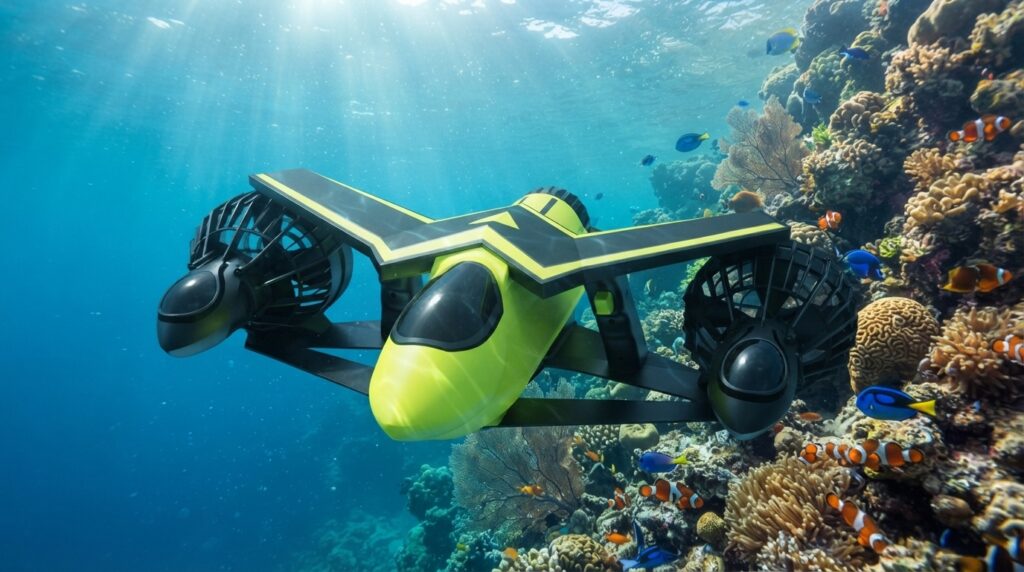
Battery life is one of the most important specifications to understand before buying an underwater scooter.
After all, an underwater scooter is only useful while sufficient battery power remains available to drive its electric motor.
For recreational users, battery life determines how long you can spend exploring a reef, snorkelling around a sheltered bay or enjoying the scooter from a boat. For divers and more experienced users, runtime can become an important part of planning an underwater journey.
Modern underwater scooters vary considerably.
Within Vector Water Craft's current Australian range, published maximum operating times extend from approximately 56 minutes for the lightweight HS-S2 through to 100 minutes for the professional H9 Sub Jet Pro. Other models, including the HS-S3, HS-S4 Bat and H9-1 Sub Runner, are published at around 60 minutes.
However, there is an important distinction every buyer needs to understand:
Published maximum battery runtime is not necessarily the same as the operating time you will experience every time you use the scooter.
Speed, rider drag, conditions, battery condition and how the scooter is operated can all influence practical use.
There is also a second meaning of “How long does the battery last?” Buyers may be asking not only how many minutes they can ride on one charge, but also how long the battery itself can remain useful over its ownership life.
Both questions matter.
This guide explains underwater scooter battery runtime, charging, battery capacity, factors affecting real-world performance and how Australian owners can look after their battery systems properly.
A useful general answer for the current Vector range is:
Around one hour for many compact recreational underwater scooters, with up to approximately 100 minutes available from the larger professional H9 platform.
That is already a substantial amount of powered underwater activity.
Most recreational users will not necessarily run an underwater scooter continuously for an hour.
A typical outing may involve:
Therefore, a scooter with an advertised runtime of around an hour may provide more practical recreational use than the headline figure initially suggests.
For serious diving applications, however, battery duration requires much more conservative planning.
The lightweight Vector HS-S2 has a published maximum battery life of 56 minutes.
It also has a charging time of approximately 1.2 hours and supports USB-C charging at up to 100 watts. The scooter itself weighs approximately 1.4 kg.
This combination illustrates how far compact underwater propulsion has developed.
A relatively small scooter can potentially provide close to an hour of underwater propulsion without the large battery system associated with professional equipment.
For buyers whose priorities include:
a runtime close to an hour may be more than adequate.
The question should not simply be whether another scooter lasts longer.
It should be whether the available runtime is enough for the way you intend to use it.
The Vector HS-S3 has a published maximum running time of 60 minutes.
Its battery is rated at 99.36 Wh, and Vector currently publishes a charging time of approximately 1.5 hours.
That gives buyers a useful reference point.
For a general recreational underwater scooter, around an hour of published operation combined with relatively quick recharging can work well for:
The HS-S3 also offers multiple speed settings, which means the rider is not restricted to one fixed level of propulsion.
This matters because how aggressively the motor is used can affect how quickly available battery energy is consumed.
The dual-motor HS-S4 Bat is also published with approximately 60 minutes of battery life.
Its battery capacity is listed at 95.04 Wh, and charging time is published at up to approximately 2.5 hours.
The HS-S4 provides a useful example of why battery capacity, runtime and propulsion performance should be considered together rather than separately.
It uses twin motors and is designed to deliver stronger recreational propulsion.
A buyer should therefore look at:
A slightly larger battery figure does not automatically mean a better scooter.
What matters is how effectively the complete system uses the stored energy.
Vector currently publishes a 60-minute runtime for the H9-1 Sub Runner.
The H9-1 sits at a significantly higher performance level than the smallest recreational scooters.
That highlights another important battery principle:
A larger or more expensive underwater scooter does not automatically have twice the runtime.
Additional battery capacity may instead be supporting:
Battery specifications must therefore always be viewed alongside motor performance.
At the upper end of the current Vector range, the H9 Sub Jet Pro has a published runtime of 100 minutes.
It carries a substantial 923.52 Wh battery, uses a 3.3 kW motor, reaches a published maximum speed of 13 km/h and is rated to depths of up to 40 metres.
This is a very different battery system from those found in compact recreational scooters.
The H9 demonstrates what becomes possible when greater physical size and battery capacity are accepted in exchange for higher performance and endurance.
For a serious diver or professional user, this may be worthwhile.
For someone who simply wants 30 or 40 minutes of recreational snorkelling, such a large system may be unnecessary.
When a manufacturer states “up to 60 minutes”, the words up to matter.
The figure provides an important comparison between models, but it should not be interpreted as a guarantee that every user will receive exactly 60 minutes every time.
Several factors influence energy consumption.
Higher propulsion settings generally require more electrical power.
If you operate an underwater scooter continuously at maximum output, the battery may be depleted faster than when cruising conservatively.
This is one reason variable-speed scooters can be useful.
You can select lower power when maximum performance is unnecessary.
The motor must move both the scooter and the person using it.
A larger rider can create more resistance through the water.
This can increase the work required from the propulsion system.
A snorkeller and a scuba diver create dramatically different amounts of drag.
A diver may carry:
All of this must be moved through the water.
Greater resistance places additional demands on the propulsion system.
Current and water movement can influence how much work the scooter must perform.
Travelling against moving water may require significantly more propulsion than travelling in calm conditions.
This is also why an underwater scooter's battery should never be relied upon as the only means of returning from a journey.
Some riders use the scooter continuously.
Others alternate between propulsion and normal swimming.
These different patterns naturally produce different practical operating times during an outing.
A new, healthy battery and an older battery may not provide identical performance.
Rechargeable batteries are consumable components.
Their condition changes over time according to use, age, storage and charging history.
Underwater scooter specifications often state battery capacity in watt-hours, abbreviated as Wh.
Watt-hours describe the amount of electrical energy stored in the battery.
For example, Vector currently publishes:
The H9 battery therefore stores vastly more nominal energy than those in the compact recreational scooters.
But again, you cannot compare battery capacity without considering motor power.
The H9 is also driving a 3.3 kW propulsion system.
A large battery is necessary because the equipment itself is substantially more powerful.
It may seem logical to assume that a battery twice as large should provide twice the operating time.
That is only true if all other energy demands remain the same.
If the larger battery is powering a much larger motor, runtime may not increase proportionally.
This explains why serious underwater propulsion equipment can carry dramatically larger batteries while still offering operating times measured in hours rather than an entire day.
For buyers, the correct approach is to compare:
battery capacity + motor output + runtime + weight + performance.
Do not isolate one number.
For many recreational snorkellers, around an hour of maximum published operating time can be quite substantial.
Think about a normal session.
You may spend ten minutes moving along a reef, stop to examine something interesting, swim normally for a while, use the scooter again and eventually return.
The motor may therefore not be operating continuously.
For recreational use, ask:
For many people, these questions are more useful than simply looking for the biggest possible battery.
Shared use can materially change battery requirements.
Imagine four family members each wanting 15 minutes of powered operation.
That represents an hour of motor use.
In this situation, a scooter advertised with approximately 60 minutes maximum runtime may be used quite differently from one operated by a single person for a 20-minute snorkelling session.
Families should therefore think about total daily use, not just the length of one person's session.
Boat owners can also have distinctive requirements.
An underwater scooter might be used several times during a day's boating.
You could use it:
If recharging is not available onboard, total daily battery capacity becomes increasingly important.
On the other hand, if the scooter is only used occasionally for short swims, a compact system may be entirely adequate.
Divers need to think more conservatively.
A scooter can allow a diver to cover much greater distances than ordinary finning.
That means runtime is not simply about convenience.
It can affect planning.
A diver should not assume that a scooter advertised for 60 or 100 minutes can safely be used for half that period travelling away from an entry point and the other half returning.
Safe planning should consider:
Maximum technical runtime and safe operating range are not the same thing.
Charging times vary substantially by model.
Current Vector specifications provide several useful examples.
The HS-S2 is published with a charging time of approximately 1.2 hours.
The HS-S3 is listed at approximately 1.5 hours.
The HS-S4 Bat is listed at up to approximately 2.5 hours.
The H9 Sub Jet Pro offers fast-charging capability alongside its 100-minute published runtime.
Charging time becomes particularly important for people who want several sessions in one day.
A product that can recharge relatively quickly may provide greater practical usefulness than a modestly longer-running product that takes dramatically longer to restore.
Follow the instructions supplied for the particular battery and charger.
There is no need to invent your own charging routine.
Modern battery systems and charging electronics are designed around specific electrical characteristics.
Use:
Do not substitute chargers merely because the plug physically fits.
Australian Product Safety guidance specifically advises consumers to use suitable chargers and cables and not to use damaged charging equipment.
Battery safety deserves particular attention because underwater scooters combine water-based recreational use with rechargeable electrical equipment.
Lithium-ion batteries are widely used because they can store considerable energy in relatively compact packages.
But that stored energy needs to be managed correctly.
The ACCC's Product Safety guidance warns that lithium-ion battery incidents, although uncommon relative to the enormous number of batteries in use, can result in serious fires when batteries are damaged, defective, incorrectly used or incorrectly charged.
Owners should therefore treat battery care as an essential part of underwater scooter ownership.
Before charging or using the scooter, pay attention to unusual battery behaviour.
Australian Product Safety guidance says consumers should stop using lithium-ion batteries showing signs such as:
Do not assume that a battery is safe simply because it still holds a charge.
If something appears abnormal, stop using the equipment and obtain appropriate advice.
A battery, charger and battery-management system are designed to work together.
Using an unsuitable charging system can create unnecessary risk.
Australian safety guidance specifically warns consumers not to use damaged chargers or charging cables.
The practical rule for an underwater scooter owner is simple:
Use the charger and charging procedure specified for your scooter.
Do not improvise to save a few minutes.
There is an important practical point for Australian owners.
After returning from the beach, the scooter may be:
Do not simply connect charging equipment immediately without following the manufacturer's preparation instructions.
Complete the correct post-use cleaning and drying procedures first.
Electrical charging connections need to be treated correctly.
Battery-powered watersports equipment often spends time in cars.
That deserves attention.
Australian Product Safety guidance warns consumers against leaving lithium-ion products exposed to excessive heat, including in hot vehicles.
Anyone who has opened a parked vehicle during an Australian summer knows how extreme cabin temperatures can become.
An underwater scooter should therefore not be regarded as something that can simply remain permanently in the boot between weekends.
Appropriate storage protects both safety and long-term equipment condition.
This question is much harder to answer with one number.
Rechargeable battery longevity depends upon:
Because these variables differ enormously between owners, buyers should be cautious about claims that a particular battery will definitely last a precise number of years.
A better approach is to focus on maintaining battery health correctly from the beginning.
Rechargeable batteries age with time as well as use.
Therefore, buying an underwater scooter and leaving it unused for long periods does not necessarily preserve the battery indefinitely.
Follow the manufacturer's storage instructions, particularly where the product will not be used for an extended period.
This is particularly relevant in southern Australian areas where a scooter may be used heavily during summer and then stored for several months.
Good ownership habits include:
The aim is not to develop complicated home battery-maintenance procedures.
It is simply to treat a sophisticated rechargeable system properly.
The internal battery system is protected within the scooter's design, but saltwater remains extremely demanding on marine equipment.
The concern is not that normal saltwater use automatically damages the battery.
The concern is that poor maintenance can eventually affect housings, seals, connectors and other equipment surrounding the electrical system.
After saltwater use, follow the prescribed freshwater rinsing and maintenance procedures for your particular scooter.
Vector's underwater category emphasises battery reliability, waterproof durability and appropriate maintenance as important considerations in underwater scooter ownership.
An underwater scooter is specifically designed to operate in water.
That does not mean it can be neglected.
Waterproof engineering relies on:
Inspect equipment regularly and follow the manufacturer's instructions.
Never casually dismantle waterproof components without knowing the correct procedure.
Not automatically.
A bigger battery can mean:
If you only require 30 minutes of recreational snorkelling, carrying a very large professional battery system may provide little benefit.
The best battery is not necessarily the biggest one.
It is the battery that provides an appropriate combination of:
runtime, performance, weight, charging and portability.
The contrast between the HS-S3 and H9 is particularly useful.
The HS-S3:
The H9:
The H9 battery stores more than nine times the nominal energy of the HS-S3 battery, yet the published runtime is not nine times longer.
Why?
Because the H9 is supporting vastly greater propulsion capability.
This is perhaps the clearest demonstration of why battery size alone cannot be used to compare underwater scooters.
Electric propulsion always involves balancing several competing objectives.
Manufacturers may optimise for:
It is difficult to maximise all five simultaneously.
More battery can increase weight.
More motor power can increase energy consumption.
Reducing size can limit battery capacity.
Therefore, each underwater scooter represents a particular engineering compromise.
The correct one depends upon what matters most to you.
For a first-time recreational buyer, concentrate on practical questions rather than technical numbers.
Ask:
For many recreational buyers, a published runtime of approximately an hour may answer the first question comfortably.
A more demanding user should investigate:
These questions become particularly important as battery size increases.
Battery-powered marine equipment is very different from ordinary recreational equipment.
An underwater scooter combines:
Having an Australian supplier who understands the complete system can therefore be valuable.
Vector Water Craft specialises in electric watercraft and currently offers underwater scooters ranging from compact recreational models through to the high-performance H9 Sub Jet Pro.
The buyer can therefore compare different battery and performance levels according to actual usage rather than simply selecting the largest battery.
Treat it as a maximum product specification.
Higher propulsion demand can affect practical battery duration.
Always maintain an appropriate reserve and ability to return safely.
A large battery may be powering a much larger motor.
Fast turnaround can matter if you want multiple sessions.
Use the manufacturer-specified equipment.
Stop using a battery that shows abnormal physical or thermal behaviour.
Australian Product Safety guidance specifically cautions against excessive heat exposure for lithium-ion battery products.
Protect the complete electrical and mechanical system with correct post-use care.
For many recreational Australian users:
Around 50–60 minutes of published maximum runtime can provide substantial use.
For people sharing the scooter, taking multiple sessions or operating for longer periods, additional capacity may be worthwhile.
For serious underwater propulsion, Vector's H9 provides up to 100 minutes of published runtime supported by a substantially larger battery system.
There is no universal ideal figure.
The correct battery duration depends upon how you actually use the water.
Modern underwater scooter batteries can provide impressive operating times.
Within Vector Water Craft's present range:
These figures demonstrate that close to an hour has become a practical benchmark across much of the recreational range, while professional equipment can extend operation considerably further.
However, do not choose an underwater scooter by runtime alone.
Consider:
Most importantly, remember that battery-powered propulsion should increase your enjoyment and capability without becoming something upon which your safe return depends.
A well-selected underwater scooter should provide enough battery capacity for your intended session with an appropriate reserve remaining.
If you are unsure whether approximately an hour of underwater propulsion is enough for you, speak with Vector Water Craft before choosing a model.
Tell us:
We can then help you compare the available Vector models according to both their battery systems and their complete performance package.
The objective is not simply to give you the largest battery available.
It is to identify the underwater scooter with the right battery capacity, runtime, charging time, weight and performance for the way you intend to use it.
Many current Vector recreational underwater scooters provide published maximum runtimes of approximately 56–60 minutes, while the professional H9 Sub Jet Pro provides up to 100 minutes.
Vector publishes a maximum battery life of 56 minutes for the HS-S2.
The HS-S3 has a published maximum running time of 60 minutes and a 99.36 Wh battery.
The HS-S4 Bat is published with approximately 60 minutes battery life and a 95.04 Wh battery capacity.
Among the models discussed here, the H9 Sub Jet Pro has the longest published runtime at up to 100 minutes.
Vector publishes the H9 battery capacity at 923.52 Wh. It supports a 3.3 kW propulsion system and up to 100 minutes of runtime.
It varies. The HS-S2 is published at approximately 1.2 hours, the HS-S3 at approximately 1.5 hours, and the HS-S4 at up to approximately 2.5 hours.
Higher propulsion output requires more electrical energy, so how aggressively a scooter is operated can affect practical battery duration. Manufacturer maximum runtime figures should not automatically be interpreted as continuous maximum-speed runtime.
There is no reliable single figure that applies to every scooter and owner. Battery longevity depends on design, age, charging, storage, temperature, use and battery condition. Follow the manufacturer's maintenance and storage instructions rather than relying on a generic lifespan claim.
It should not be routinely stored in a very hot vehicle. Australian Product Safety guidance advises protecting lithium-ion battery products from excessive heat.
Stop using it. Australian Product Safety guidance warns against using lithium-ion batteries showing swelling, bulging, overheating, leaking or other signs of damage.
Not necessarily. Battery size should be balanced against motor power, runtime, weight, speed, portability and your intended use.
For many recreational snorkellers it can be substantial, particularly when propulsion is not used continuously. Buyers expecting multiple users or several sessions during the same outing should consider total expected usage.
No. A scooter's technical runtime does not determine how far a diver or snorkeller should travel. Safe operation requires conservative planning, battery reserve and the ability to manage a loss of propulsion.