
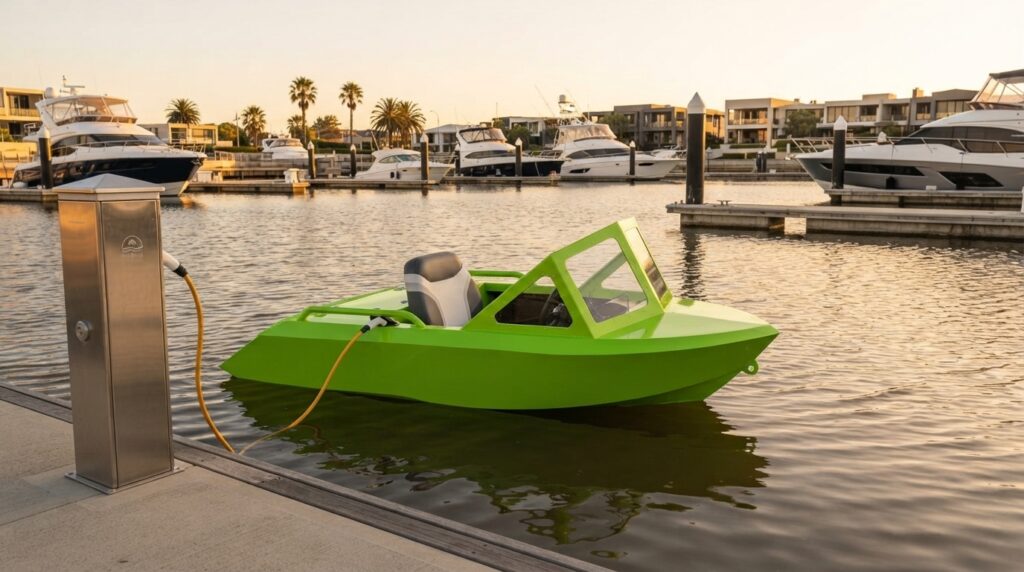
Charging time is one of the most practical, day-to-day considerations of owning an electric mini jet boat, yet it's also one of the most inconsistently reported specifications in the category. Manufacturer figures are often accurate under specific test conditions, but real Australian conditions — hot summer days, standard household power circuits, older or shared power infrastructure at some properties — can meaningfully change how long a genuine full charge actually takes. This article works through what actually determines charging time, what to realistically expect in typical Australian conditions, and how to plan your riding and charging routine around it.
Charging time is fundamentally a function of two things: how much energy the battery needs to take on, and how quickly that energy can be delivered. A larger battery takes longer to charge than a smaller one for a given charger, and a higher-power charger fills a given battery faster than a lower-power one, assuming the household circuit can actually deliver that power safely and consistently.
This sounds straightforward, but the practical reality in Australian homes introduces several layers of nuance that headline charging time figures don't always capture.
Most Australian homes are wired with a standard single-phase power supply, typically providing around 10 amps continuously from a general power outlet, or up to around 15 amps from a dedicated circuit, at 230-240 volts — a maximum continuous charging power in the rough range of 2.3 to 3.6 kilowatts, without any specialised electrical work.
Many mini jet boat chargers are designed to work within these limits, drawing a modest, safe amount of power over an extended period rather than requiring specialised high-power infrastructure — a sensible choice for accessibility, since it means no expensive electrical upgrades simply to charge at home. But it does mean charging times from a standard outlet are considerably longer than a dedicated high-power setup could achieve.
A smaller battery (roughly 3-5kWh), typical of an entry-level 15kW model, charging from a fairly depleted state on ~2.3kW household power, generally takes 2 to 4 hours for a genuinely full charge.
A mid-sized battery (roughly 6-10kWh), typical of a 25kW model, generally takes 4 to 8 hours — meaning overnight charging is often the most practical approach.
A larger battery (12kWh or more), typical of a 70kW performance model, could take 8 to 12 hours or more from a significantly depleted state, which is why many owners of higher-powered boats specifically arrange a higher-capacity charging setup.
These figures are illustrative estimates, not universal guarantees — the actual figure depends on exact battery capacity, the specific charger provided, and the condition of the household circuit being used.
Manufacturer-quoted charging times sometimes reflect charging to 80% rather than a genuinely full 100%, since lithium batteries typically taper their charge rate as they approach full capacity — meaning the final portion, roughly 80% to 100%, often takes proportionally longer than the initial 80% did. A headline "charges in X hours" figure based on an 80% threshold can meaningfully understate the time needed for a genuinely complete charge.
It's also worth checking whether a quoted time assumes a higher-power charger accessory sold separately, or reflects charging from a partially depleted starting point rather than genuinely empty.
Australia's climate introduces a genuinely relevant consideration: ambient and battery temperature affect charging speed and safety. Lithium batteries generally charge most efficiently within a moderate temperature range, and many battery management systems will deliberately reduce charging speed — or in extreme cases pause altogether — if the battery is significantly above its optimal range, a genuine possibility after a boat has been ridden hard on a hot summer day and plugged in immediately while still warm.
This is a sensible safety and longevity feature rather than a fault, but it means charging on hot days, particularly right after a warm-weather outing, can genuinely take longer than on a cooler day or after the battery has had time to cool down.
Conversely, very cold conditions — less commonly a major factor across most of Australia, but relevant in cooler regions during winter — can also slow charging, since lithium batteries generally charge less efficiently at low temperatures.
For owners who find standard charging times genuinely limiting, some manufacturers offer higher-power charger accessories or recommend a licensed electrician install a dedicated higher-capacity circuit, sometimes drawing on three-phase power where available.
This comes with genuine trade-offs: greater cost, both for the charger and any required electrical work, and in some cases a modest trade-off in long-term battery health, since consistently fast charging generates more heat and stress on cells than slower, gentler charging.
Most owners find an overnight charging routine works well — plugging in after an evening outing and having a full charge by morning. This suits the majority of typical riding patterns, where a boat is used once per day at most.
For owners planning multiple outings in a single day, realistic charging time becomes a much more important consideration, and it's worth genuinely testing how quickly your specific setup can deliver a meaningful partial charge during the gap, rather than assuming a quick top-up will be enough without verifying it.
Standard household-style outlets are commonly, though not universally, available at caravan parks, some boat ramps and other locations. It's worth checking in advance rather than assuming availability, and confirming the outlet is genuinely suitable — correct voltage, adequate circuit capacity, and ideally not already carrying other significant loads.
Some properties — newer homes, rural properties, or those with existing higher-demand appliances — have three-phase power available or straightforward to install, supporting meaningfully higher continuous charging rates. Installing it specifically for boat charging represents a genuine additional cost that needs weighing against your actual usage pattern: minimal benefit for an owner who rides occasionally with ample overnight time, genuinely worthwhile for one who rides frequently with limited gaps between outings.
Most modern boats offer some way to monitor charging — an onboard display, companion app, or indicator lights. A charge progressing unusually slowly, stalling partway, or a charger that feels unusually warm to the touch are all worth treating as signals to stop and investigate rather than dismiss.
Owners who plug in immediately after every outing tend to have a consistently ready boat with minimal planning required. Owners who charge more sporadically sometimes need to plan charging time more deliberately, particularly for larger batteries. Neither approach is wrong, but a routine matching your actual usage pattern reduces the chance of an unwelcome surprise at the water.
Charging speed isn't constant throughout the process. Lithium batteries typically charge fastest in the low-to-middle range, then taper progressively as they approach full capacity to protect long-term battery health. This means the last 20% of a charge can take proportionally longer than the first 20%. If you're on a tighter timeframe and don't need a full 100% for your next outing, charging to 80-90% is often meaningfully faster — and often better for long-term battery health in any case.
Given how many variables affect real-world charging time, comparing quoted figures directly across manufacturers can be misleading unless the comparison is genuinely like-for-like. The most reliable approach is asking each manufacturer the same specific questions — actual included charger output, the charge percentage the quoted time reflects, and ideally a real-world example from an existing owner using standard household power.
Owners in the tropical north face consistently high temperatures for much of the year, making heat-related charging considerations a near-constant factor rather than an occasional summer concern. Owners in cooler southern states may see winter charging speeds occasionally reduced during cold spells, though this is generally less pronounced. Owners in remote or regional areas should also consider the reliability of local electrical infrastructure, since older rural properties sometimes have less robust power delivery than metropolitan areas.
Charging time depends on a genuine combination of battery capacity, charger power output, household electrical supply, and — particularly relevant in Australian conditions — ambient and battery temperature. Standard household power generally supports a comfortable overnight routine for most models and most typical riding patterns, but it's worth understanding the specific figures for your chosen model, asking directly about the assumptions behind any quoted time, and planning realistically for how heat, charger power and battery capacity interact in your own circumstances.