
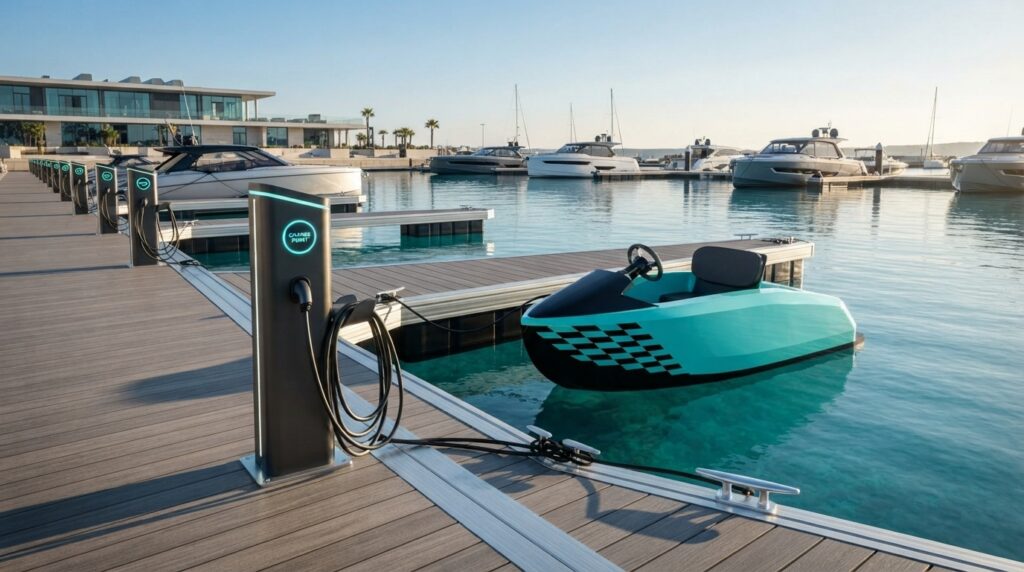
As electric mini jet boats become a more common sight on Australian waterways, marinas and boat clubs are increasingly facing a genuine question worth getting ahead of: how to support members and berth-holders who own electric watercraft, rather than treating charging access as an afterthought. Properties that plan for this proactively stand to offer a genuine point of differentiation, while those that don't risk becoming a less attractive option as electric watercraft ownership continues to grow.
As discussed throughout this series, home charging is one of the more significant practical advantages for owners with private waterfront access. Marina and boat club members, by definition, typically don't have this same direct-from-home charging convenience — their boat is stored at a shared facility, meaning charging access at that facility becomes a meaningful factor in whether an electric mini jet boat is a genuinely practical ownership proposition for members without private waterfront access of their own.
A marina or club that offers convenient, reliable charging access removes a genuine barrier to electric boat ownership for its members, while one that doesn't may find members with electric boats experiencing real friction that a small amount of infrastructure investment could resolve.
Before committing to charging infrastructure, marinas and clubs benefit from an honest assessment of realistic current and near-term demand:
This assessment helps calibrate an appropriately scaled initial investment, rather than either overbuilding capacity well ahead of genuine need, or underinvesting in a way that fails to genuinely serve members who do have electric boats.
Unlike a single home charging point, a marina or club facility serving multiple potential electric boat owners needs to think through infrastructure at a genuinely different scale:
Marinas and clubs have a few genuine options for how to structure charging access, each with different implications:
Beyond the physical infrastructure itself, marinas and clubs can support electric mini jet boat owners in additional practical ways:
Marinas and boat clubs that proactively develop genuine charging capability, rather than waiting until demand becomes impossible to ignore, position themselves as forward-looking, member-focused facilities — a positioning that can support member retention and attract new members specifically drawn to a club or marina that has clearly thought through the practicalities of supporting this growing category of watercraft ownership.
For most marinas and clubs, the most sensible path forward involves a staged approach: starting with an honest demand assessment, developing a modest, appropriately scaled initial charging capability, and expanding based on genuine observed member uptake rather than either ignoring the trend entirely or over-committing to infrastructure well ahead of proven demand. This mirrors the broader theme of realistic, deliberate planning that runs throughout this series — matching investment and infrastructure decisions to genuine, assessed need rather than either extreme.
As electric mini jet boat ownership continues to grow across Australia, marinas and boat clubs have a genuine opportunity to support this trend proactively through thoughtfully planned charging infrastructure, rather than treating it as an afterthought once member demand becomes difficult to ignore. A realistic assessment of demand, appropriately scaled electrical infrastructure investment, and a sensible model for structuring access all contribute to a facility that genuinely serves its members' evolving needs, while positioning itself as a forward-looking option in an increasingly competitive marina and boat club market.