
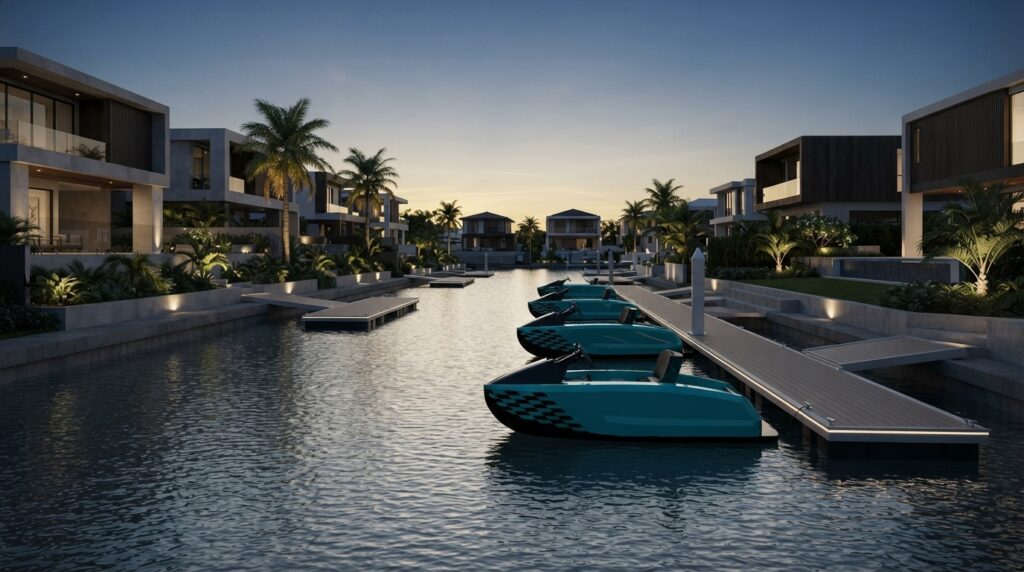
Waterfront property development has always leaned heavily on the appeal of water access as a core selling point, but the practical reality of that access has traditionally been built around larger boat ownership — substantial jetties, deep-water berths, and infrastructure designed for conventional trailer boats and cruisers. As electric mini jet boats become a more established category, forward-thinking developers are beginning to reconsider what genuinely usable water access looks like for a broader range of future residents.
Traditional waterfront estate infrastructure — deep-water jetties, substantial pontoons rated for larger vessels — assumes residents will primarily own conventional boats. As discussed throughout this series, mini jet boats have meaningfully different infrastructure needs: shallower draft requirements, lighter structural demands on jetties and pontoons, and charging access rather than fuel storage and handling infrastructure. Developers who understand this distinction can potentially design more cost-effective, more broadly appealing water access infrastructure than the traditional deep-water jetty model assumes is necessary.
As covered in the article on hull weight, mini jet boats are considerably lighter than conventional runabouts and cruisers, which has direct implications for the structural requirements of residential jetties and pontoons. Lighter craft generally place less structural demand on mooring and lift infrastructure, potentially allowing for more cost-effective jetty and pontoon design without compromising genuine functionality for residents who own this category of watercraft. This is a genuinely relevant consideration for developers balancing construction costs against the amenity value of water access across an entire estate.
Just as the companion article on marinas and boat clubs discusses charging infrastructure as an emerging amenity consideration for shared facilities, waterfront estate developers building private jetty or pontoon infrastructure for individual lots have a genuine opportunity to incorporate charging capability as a standard inclusion, rather than leaving it to individual homeowners to retrofit later. Building appropriately rated electrical infrastructure into jetty design from the outset is considerably more cost-effective than adding it after the fact, and positions a development as genuinely forward-looking for prospective buyers who already own, or are considering, an electric mini jet boat.
As discussed in the article on why mini jet boats suit riverfront and canal-side homes, this category of watercraft appeals to a genuinely different buyer profile than traditional boat ownership requires — buyers who want direct water access and the lifestyle it represents, without necessarily wanting the cost, maintenance and complexity of a larger conventional boat. Developers who design estate infrastructure with this buyer profile specifically in mind — rather than assuming all waterfront buyers want the same deep-water, conventional-boat-oriented infrastructure — can potentially appeal to a broader, more diverse range of prospective residents.
For canal estate developments specifically, the manoeuvrability and compact size discussed in the article on hull length and turning make mini jet boats a particularly natural fit for the often tighter, more constrained waterway dimensions typical of residential canal developments, compared to larger vessels that may find some canal configurations genuinely challenging to navigate comfortably. Developers designing new canal estates, or considering the practical boating experience their canal dimensions will support, have a genuine opportunity to factor this category of watercraft into their design considerations from the outset.
Beyond the physical infrastructure itself, developers have an opportunity to incorporate this category of watercraft into the broader lifestyle positioning of a waterfront development — showcasing the ease, accessibility and quiet enjoyment of electric mini jet boat ownership as part of the estate's overall value proposition, rather than relying solely on traditional imagery of larger boats and more conventional boating lifestyles that may not resonate with every prospective buyer.
It's worth acknowledging that not every resident within a waterfront estate will necessarily choose this category of watercraft — some will still want traditional deep-water infrastructure suited to larger conventional boats. Thoughtful estate design may involve a mixed approach, offering a range of jetty and mooring configurations suited to different watercraft categories, rather than assuming a single infrastructure standard will suit every resident's preferences equally well.
For developments in ecologically sensitive waterway locations, or those seeking genuine sustainability credentials as part of their broader development positioning, incorporating infrastructure that supports electric watercraft specifically — rather than assuming petrol-powered boats as the default — aligns with the kind of environmental positioning discussed in the article on electric propulsion's safety and environmental advantages, offering a tangible, resident-visible element of a broader sustainability narrative for the development.
Developers genuinely exploring this direction benefit from working through a few practical questions early in the design process:
Forward-thinking waterfront property developers have a genuine opportunity to reconsider traditional water access infrastructure assumptions in light of the growing electric mini jet boat category — designing lighter, more cost-effective jetty and pontoon infrastructure, incorporating charging capability as a standard amenity, and positioning developments to appeal to a broader range of prospective buyers who value accessible, low-maintenance water access without the traditional commitment of conventional boat ownership. Developers who work through these considerations thoughtfully, rather than defaulting to traditional infrastructure assumptions, stand to differentiate their developments in an increasingly competitive waterfront property market.