
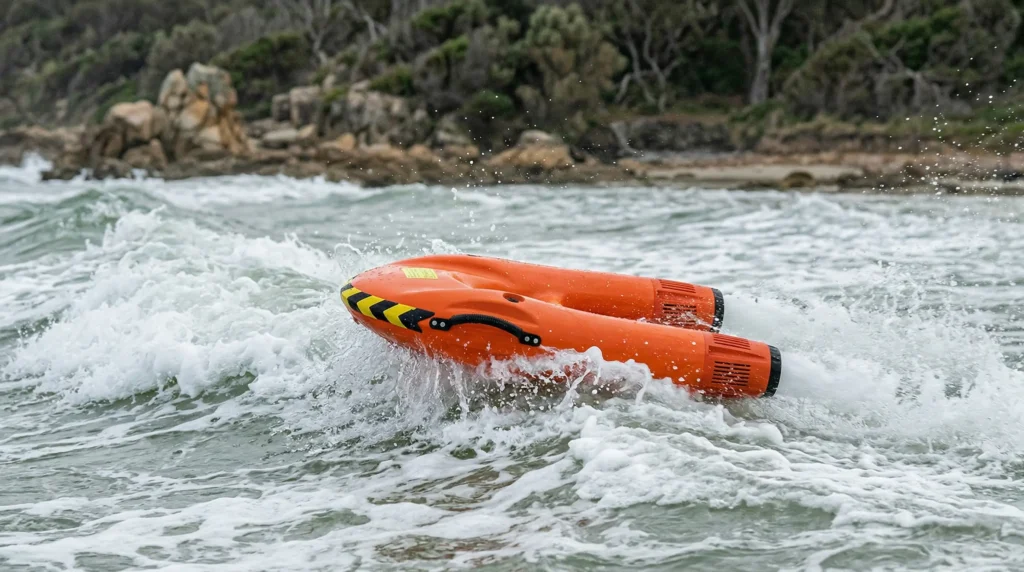
Remote Control Rescue Buoys (RCRBs) are often promoted using calm-water demonstrations, straight-line speed figures, and controlled test environments. While these presentations are useful for basic understanding, they are largely irrelevant to the environments in which Australian rescues actually occur.
In Australia, the most dangerous rescues take place in rough surf and fast-moving rivers — environments defined by instability, unpredictability, and forces that overwhelm poorly designed equipment. This article focuses exclusively on how RCRBs perform in these conditions, what separates effective designs from inadequate ones, and how buyers should evaluate claims made by manufacturers and suppliers.
This is not a marketing comparison. It is a practical analysis grounded in real rescue dynamics, intended for Surf Life Saving Clubs, councils, emergency services, and professional safety operators responsible for deploying equipment where failure has immediate consequences.
Rough water is unforgiving. It strips away theoretical performance and exposes real-world behaviour within seconds.
In surf and fast rivers, RCRBs are subjected to:
A unit that performs acceptably in calm water may become unstable, unresponsive, or ineffective once these forces are present. This is why rough-water performance must be evaluated as a primary buying criterion, not a secondary one.
Australian surf environments are among the most powerful globally due to long-period swells and open ocean exposure.
Key characteristics include:
An RCRB operating in this environment must do far more than simply move forward.
In surf, stability is not optional. An unstable RCRB wastes time and increases risk.
Key stability requirements include:
Poorly balanced units may yaw violently, broach sideways, or flip when encountering broken surf. Each of these outcomes delays rescue and erodes operator confidence.
Stability is achieved through careful hull geometry, mass distribution, and buoyancy placement — not through speed.
Steering authority is one of the first characteristics to fail in rough surf.
Broken water reduces the effectiveness of rudders, control surfaces, and thrust vectors. Inadequate designs may respond slowly or unpredictably to operator input.
Effective RCRBs demonstrate:
In practical terms, this allows operators to drive directly into rips or across broken surf, rather than being swept off course and forced to reposition.
High top speed figures are meaningless if a unit cannot accelerate quickly through turbulence.
In surf rescues:
RCRBs that prioritise thrust and torque over peak speed typically reach casualties faster in real surf conditions. This directly reduces time-to-contact and improves outcomes.
The most challenging phase of any RCRB surf rescue occurs when the victim makes contact.
In rough conditions, victims may:
At this moment, the RCRB must remain:
Units that lose thrust or stability when loaded become liabilities. Effective designs maintain forward motion and directional control even with asymmetrical load.
In heavy surf, visibility can be compromised by spray, foam, and glare. Important considerations include:
A unit that disappears repeatedly in whitewater increases operator stress and slows rescue.
While surf is dominated by wave energy, rivers are defined by directional flow and obstacles.
Australian fast rivers present:
RCRBs must behave differently here than in surf.
In rivers, the primary challenge is holding or crossing current without being swept downstream.
Effective river-capable RCRBs demonstrate:
Units that drift uncontrollably downstream fail to reduce rescue time and may worsen victim positioning.
Unlike surf rescues, where reaching the victim quickly is paramount, river rescues often require controlled approach.
Excess speed increases risk of:
A suitable RCRB allows operators to modulate speed smoothly while retaining thrust authority.
Standing waves, eddies, and boils exert complex forces on small craft. Effective RCRBs:
Poor designs may lose propulsion or become trapped in recirculating features.
In river environments, operators may need to move along banks to maintain line of sight or control. This places importance on:
Loss of control in rivers can place equipment and victims at additional risk.
Rough water places higher continuous demands on propulsion systems. Battery systems must support:
Inadequate battery systems may throttle output or shut down unexpectedly — an unacceptable outcome during active rescues.
In Australian deployments, rough water rescues often occur in hot conditions. Combined stressors include:
Professional-grade RCRBs manage these stresses without performance degradation.
Equipment that behaves unpredictably in rough water demands more training and increases operator hesitation. Conversely, RCRBs with stable, intuitive behaviour:
This is particularly important in volunteer-based organisations and multi-agency responses.
Many buyers rely on supplier demonstrations conducted in protected water. While useful for familiarisation, these tests fail to reveal:
Australian buyers should always evaluate claims through the lens of worst-case operating conditions, not ideal ones.
Marketing materials often emphasise:
Operational reality prioritises:
Understanding this distinction prevents costly procurement errors.
An RCRB that performs well in rough surf and fast rivers will almost always perform well in easier conditions. The reverse is not true.
This is why rough-water performance should be treated as the defining benchmark for Australian RCRB suitability.
Organisations that select RCRBs capable of operating effectively in rough surf and fast rivers gain:
Those that do not risk owning equipment that looks impressive but fails when needed most.