
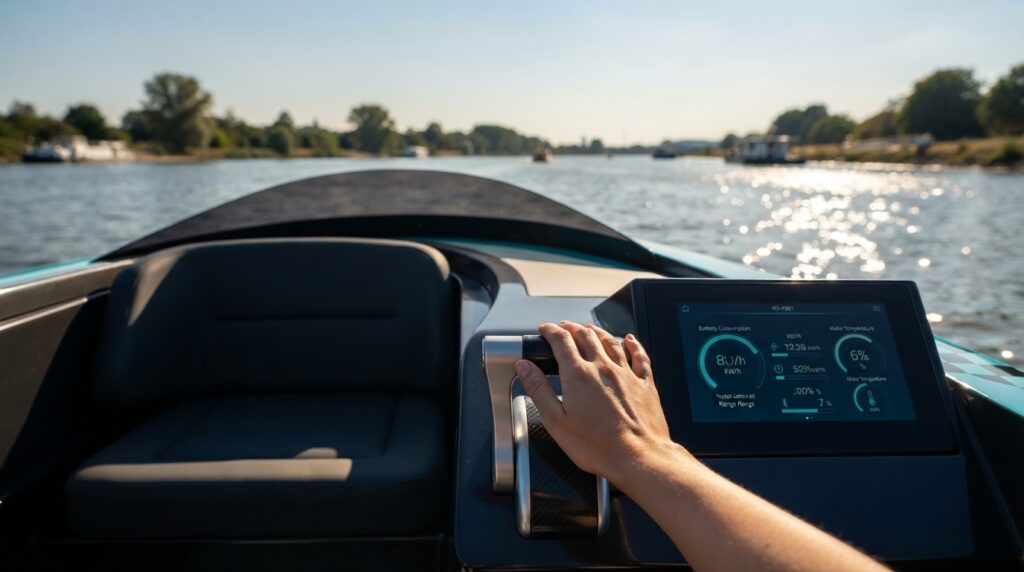
Of all the variables that affect how far an electric mini jet boat can travel on a single charge, speed is the one with the most outsized, and least intuitive, effect. Many riders assume the relationship between speed and energy consumption is roughly proportional — go twice as fast, use roughly twice the energy over the same distance. In reality, the relationship is considerably steeper than that, and understanding why changes how most people would choose to ride if range matters to them.
The drag a hull experiences moving through water increases sharply as speed increases — not in a straight line, but at an accelerating rate, particularly as a boat pushes toward the upper end of its speed range. Overcoming this rapidly increasing drag requires disproportionately more power, and more power sustained over time means disproportionately more energy drawn from the battery.
This means the last increment of speed — pushing from, say, 80% of top speed to 100% — typically costs far more energy per unit of distance covered than the increment from 40% to 60% of top speed. Riders chasing maximum speed are, in energy terms, in the least efficient part of the boat's entire performance range.
As covered in the article on planing, a boat needs to overcome its highest point of drag right at the transition from displacement mode to planing mode — the phase where the bow rises before the hull settles and accelerates away. Once planing, drag actually drops relative to speed compared to the displacement phase, which is part of why planing hulls become more efficient once established on the plane, up to a point.
This creates a somewhat counterintuitive relationship: very low "idle" speeds are efficient in absolute terms but cover little distance per unit of energy; the displacement-to-planing transition is comparatively energy-expensive; a moderate planing speed is often the genuine sweet spot for distance covered per unit of battery energy; and speeds pushing toward the top of the range become progressively less efficient again as drag rises sharply.
Most mini jet boats have an efficient cruising band — typically a moderate planing speed, well below top speed but comfortably above the displacement-to-planing transition — where the boat covers the most distance per unit of battery energy consumed. This band isn't usually published explicitly by manufacturers, but it generally sits somewhere in the middle third of the boat's available speed range, once safely established on the plane.
Riding consistently within this band, rather than alternating between low-speed idling and near-top-speed bursts, is one of the single most effective ways to maximise real-world range without sacrificing a reasonably brisk, enjoyable pace.
It's worth distinguishing between brief, occasional bursts of higher speed — overtaking, crossing wake quickly, or simply enjoying a short stretch of open water — and sustained high-speed cruising held for extended periods. Brief bursts have a comparatively modest effect on overall range, since they represent a small proportion of total energy used across an entire outing. Sustained high-speed cruising, by contrast, compounds the disproportionate energy cost of higher speeds over a much longer period, and has a correspondingly larger effect on total range achieved.
This means riders don't necessarily need to avoid higher speeds altogether to protect their range — the far bigger factor is how much of the total outing is actually spent at those higher speeds, rather than whether they're used at all.
Speed's effect on energy consumption doesn't operate in isolation — it compounds with the other factors covered in related articles. A heavier load (a second passenger and gear) increases the energy cost of any given speed, meaning the efficiency penalty of higher speeds is felt even more acutely when the boat is more heavily loaded. Similarly, choppier water or a headwind increases effective resistance at any given speed, further steepening the energy cost of pushing toward higher speeds under those conditions.
This is why a rider prioritising range should pay particular attention to moderating speed specifically when carrying a passenger or riding in less-than-ideal water conditions — this is exactly when the energy cost of higher speeds is most pronounced.
Understanding the relationship between speed and energy consumption isn't only about maximising distance covered — it directly supports safer trip planning. A rider who understands that sustained high-speed cruising will consume battery capacity considerably faster than moderate cruising is much better equipped to judge how much genuine reserve remains for a return trip, a topic explored further in the companion article on calculating a sensible battery reserve before heading back to shore.
Speed has a disproportionate, non-linear effect on how much energy an electric mini jet boat consumes — pushing toward top speed costs considerably more energy per unit of distance than cruising at a moderate, well-chosen pace within the boat's efficient planing range. Riders who understand this relationship, and who deliberately moderate sustained speed rather than avoiding higher speeds altogether, are best positioned to genuinely maximise real-world range without giving up the enjoyment that comes from occasionally opening the throttle up on a good stretch of open water.