
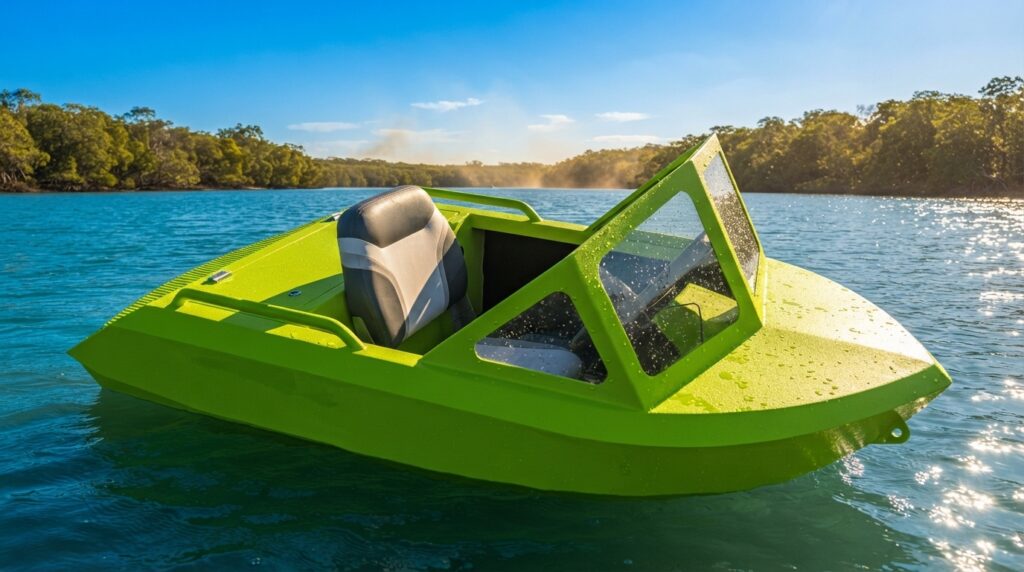
Electric mini jet boats bring together two rapidly developing technologies: compact high-performance watercraft and powerful lithium battery systems.
For Australian buyers, one question deserves far more attention than it usually receives:
Australia presents an unusually wide range of operating conditions. A mini jet boat could be used on a mild winter morning in Melbourne, a hot summer afternoon on the Gold Coast, in tropical North Queensland, on a cool Tasmanian lake or in inland waterways where temperatures can change substantially between morning and afternoon.
Battery temperature matters because lithium batteries are electrochemical systems. Their ability to store energy, accept charge and deliver power can change according to temperature.
The U.S. Department of Energy identifies battery temperature as an important factor affecting available power and energy, efficiency, charge acceptance, reliability, safety and battery life.
That does not mean electric mini jet boats are unsuitable for hot or cold Australian conditions.
It means owners should understand how the battery system works and operate it within the manufacturer's specified limits.
An electric mini jet boat depends on its battery pack to provide substantial electrical power to its propulsion system.
When the throttle is opened, energy stored within the battery is converted into electrical power and delivered to the motor. The motor then drives the jet propulsion system.
The amount of energy required changes according to:
Temperature becomes particularly important because it can influence how efficiently chemical reactions occur inside the battery.
In cooler conditions, internal resistance can increase and available power may temporarily fall.
At excessively high temperatures, battery cells can be placed under greater stress, potentially accelerating ageing if those conditions are repeated over long periods.
Modern lithium battery systems therefore commonly incorporate battery management technology.
Victron Energy, for example, describes lithium battery systems incorporating cell balancing together with temperature and voltage monitoring. Its battery management systems can respond when high or low temperature limits are reached.
The exact temperature limits for a Vector Water Craft mini jet boat should always be taken from the specifications and operating instructions supplied for the particular battery system.
Australian boating conditions differ substantially from many overseas markets.
Someone using an electric boat in northern Europe may be primarily concerned about cold-weather battery performance.
An Australian owner may face almost the opposite problem.
During summer, air temperatures above 30°C are common across large areas of Australia.
In some regions, temperatures can exceed 40°C.
More importantly, the temperature surrounding a battery pack can be higher than the official air temperature.
Consider a mini jet boat:
The battery system can experience conditions quite different from the temperature shown on a weather application.
Australia's combination of strong sunlight and high ambient temperatures therefore makes correct battery storage and thermal management particularly important.
Cold temperatures generally reduce the immediate electrochemical performance of lithium-ion batteries.
The effect is normally temporary.
As temperature falls, chemical reactions inside the battery slow and internal resistance increases.
This can affect:
A battery that performs differently on a very cold morning has not necessarily permanently lost capacity.
As the battery warms back into its normal operating range, much of the temporary performance difference may disappear.
This distinction is important.
Cold temperature can temporarily reduce performance. Long-term battery degradation is a different issue.
Extreme cold is unlikely to be the dominant issue for most Australian mini jet boat owners.
Nevertheless, it can matter.
Potential examples include:
Owners should therefore avoid assuming that every day's battery performance will be identical.
A battery used on a cool 5°C morning may behave differently from the same battery used at 22°C.
The difference may be noticeable in:
For normal Australian recreational boating, however, extreme heat will often warrant at least as much attention as extreme cold.
Cold weather primarily causes temporary performance limitations.
Excessive heat can create a different problem.
Repeated exposure to high temperatures can accelerate chemical ageing within lithium batteries.
The U.S. Department of Energy notes that battery temperature affects both life and safety and identifies thermal management as necessary for maintaining desirable operating temperatures.
Battery manufacturers therefore specify allowable operating, charging and storage temperatures.
These limits can vary significantly according to:
There should therefore never be a generic assumption such as:
"All lithium batteries can safely operate up to a particular temperature."
The manufacturer's specifications for the actual battery must take priority.
This distinction is often misunderstood.
A battery may technically be capable of operating across a wide temperature range.
That does not mean every temperature within that range represents ideal long-term operating conditions.
For example, Victron publishes lithium battery products intended for marine applications with specified charging and discharging temperature ranges, while also incorporating monitoring and battery-management protections.
The practical lesson for an electric mini jet boat owner is straightforward:
Permitted operating temperature is not necessarily the same as optimal operating temperature.
The same principle applies to many machines.
A car engine can operate across a broad range of environmental temperatures, but the vehicle's cooling and management systems are designed to keep important components within a preferred operating range.
Electric propulsion systems work on similar engineering principles.
Mini jet boats are designed to be exciting.
Strong acceleration, sharp turns and high-speed operation are major attractions.
But speed requires energy.
The relationship between boat speed and energy consumption is not linear.
Pushing a hull through water at increasingly high speeds generally requires progressively more power.
That means sustained high-speed operation can place substantial electrical demand on the battery.
The battery may simultaneously be affected by:
A properly designed electric propulsion system takes these factors into account.
Nevertheless, owners should understand why maximum-speed operation can affect both available range and battery temperature.
One of the easiest mistakes is to attribute every change in battery range to weather.
Driving style often has a much greater effect.
Consider two owners using identical boats under identical conditions.
Owner A cruises for much of the trip at moderate speed.
Owner B repeatedly accelerates hard, travels at maximum speed and performs continuous high-performance manoeuvres.
Owner B will generally consume considerably more energy.
That would remain true even if both battery packs began at exactly the same temperature.
Range should therefore be thought of as the result of several factors operating together.
These include:
Temperature + speed + load + water conditions + wind + current + manoeuvring + battery condition.
It is misleading to discuss battery range as though it were one fixed number that can be guaranteed in every situation.
This principle applies to every electric vehicle.
A manufacturer may quote operating time or estimated range based on particular test conditions.
Real-world use can differ.
For a mini jet boat, actual operating time may change according to:
Therefore, a quoted operating time should be understood as a useful performance reference rather than a promise that every owner will achieve exactly the same result every time.
The best comparison is with a petrol-powered boat.
Two identical petrol boats can produce very different fuel consumption depending upon how they are driven.
Electric boats are no different in principle.
Instead of fuel consumption, the owner is managing electrical energy.
Suppose an owner plans an afternoon outing during an Australian summer.
The boat has been sitting outside before launching.
The air temperature is 34°C.
The battery enclosure may already be warm before the craft enters the water.
The owner then launches and immediately begins sustained high-speed operation.
Under these circumstances, the battery management system may need to manage a combination of environmental and internally generated heat.
This does not automatically represent a problem.
Battery systems are designed with operating limits.
But it illustrates why sensible use begins before the boat is launched.
Owners should avoid unnecessary thermal stress when practical.
Storage conditions can matter as much as boating conditions.
An electric mini jet boat may only operate for part of the week or month.
It spends far more time in storage.
Potentially unsuitable storage environments include:
Owners should follow the battery manufacturer's recommendations for storage temperature and state of charge.
It may be tempting to think:
"The boat isn't being used, so temperature doesn't matter."
It still matters.
Calendar ageing occurs whether or not the battery is propelling the boat.
Temperature is only part of battery care.
State of charge also deserves attention.
For many lithium battery chemistries, long periods spent at extreme states of charge can contribute to accelerated ageing, particularly when combined with elevated temperature.
The correct storage procedure depends on the battery manufacturer's instructions.
Owners should therefore resist applying advice from:
to a mini jet boat battery without checking whether the same recommendations apply.
Battery chemistry and management systems differ.
Follow the instructions for the actual battery fitted to the boat.
Charging and discharging are not identical processes.
A battery may have one permissible temperature range for discharge and another for charging.
This is particularly important at low temperatures.
Some lithium battery systems restrict charging when cells become too cold.
Modern battery management systems can prevent or limit charging outside safe parameters.
Victron's marine lithium systems, for example, use temperature monitoring and BMS protection, and its published specifications demonstrate that charging and discharging temperature limits can differ.
Mini jet boat owners should therefore never attempt to bypass a battery management warning merely because they want the boat charged quickly.
The protection exists for a reason.
An electric mini jet boat battery should be charged using the equipment approved for that battery system.
The charger and battery management system work together to maintain appropriate electrical conditions.
Using unsuitable charging equipment can create:
Temperature management may also form part of this process.
A quality charger and battery management system should be treated as an integral part of the propulsion package rather than an accessory.
Modern batteries may automatically:
when a parameter moves outside an acceptable range.
This can sometimes frustrate owners who want the boat to continue operating normally.
But disabling protection is not an intelligent solution.
The BMS exists to protect the battery.
It monitors important parameters such as cell voltage and temperature and can instruct associated equipment to stop charging or discharging when necessary.
If a temperature warning repeatedly occurs, the correct action is to investigate the cause.
A propulsion battery supplying a powerful electric motor generates heat internally.
Good thermal design attempts to control that heat.
Depending upon the specific boat and battery system, thermal management could involve:
The system chosen depends upon engineering requirements.
A compact high-performance boat presents a particularly interesting design challenge because considerable electrical power must be managed within a relatively small space.
Owners should not obstruct cooling arrangements or alter battery compartments without approval.
They can.
Boat covers are extremely useful for protecting a craft from:
But a tightly enclosed dark cover exposed to intense Australian sunlight can also trap heat.
This does not mean the boat should not be covered.
It means owners should consider storage conditions intelligently.
If the craft is being stored outdoors, follow the manufacturer's recommendations regarding:
The objective is both weather protection and temperature management.
Salt water itself is not what reduces battery range simply because the boat happens to be at sea.
However, the marine environment places additional demands on electrical equipment.
Saltwater operation requires appropriate:
After saltwater operation, the manufacturer's rinsing and maintenance instructions should be followed.
Heat, humidity and salt together make proper maintenance particularly important in tropical Australian environments.
One advantage of discussing Australian electric boating nationally is that the country provides very different use cases.
Owners may experience:
Thermal management and sensible storage become particularly important.
Conditions can range from mild winter boating to very hot summer afternoons.
Owners may see considerable seasonal variation.
Moderate conditions dominate much of the year, although summer heatwaves can create considerably higher temperatures.
Cooler conditions are more common, particularly through winter.
Battery performance on cold mornings may differ from warm summer operation.
Cold weather effects may be more noticeable, particularly for craft stored in unheated areas.
There is therefore no single "Australian temperature" for mini jet boat operation.
Electric motors are capable of delivering extremely rapid torque.
That is one reason electric propulsion can feel so responsive.
However, maximum acceleration depends upon the battery being able to supply the required power.
At low temperatures, the battery management system may limit current if necessary.
At excessively high temperatures, protective power limiting can also occur.
Therefore, an owner should not immediately assume a mechanical fault if the boat feels slightly different under unusual temperature conditions.
Check:
and follow the manufacturer's troubleshooting procedure.
Range is essentially a function of:
usable battery energy ÷ average energy consumption.
Temperature can influence both sides of that equation.
If cold conditions temporarily reduce usable battery energy, available range may fall.
If hot conditions cause protective power or battery-management responses, performance can change.
But operating style remains crucial.
A mild day with continuous full-throttle operation may produce shorter range than a much hotter day spent cruising efficiently.
Temperature matters.
It is not the only variable.
Air temperature receives most attention, but water temperature can also influence an electric marine propulsion system.
This is particularly relevant where water forms part of a cooling arrangement.
Cold water may improve heat rejection.
Warm tropical water provides a smaller temperature difference for cooling.
The practical significance depends entirely on the engineering of the particular boat.
Owners do not need to become marine engineers.
They simply need to avoid assuming that two apparently identical outings will always create identical electrical conditions.
A two-person mini jet boat will use more energy moving a heavier total load than the same vessel carrying only one lighter occupant, all other conditions being equal.
Additional load affects:
Therefore, passenger load can influence range alongside temperature.
This is particularly relevant when comparing personal experience with an advertised test figure.
If a manufacturer's test was performed with one operator and an owner regularly carries two adults, the operating conditions are different.
The marine environment differs from road transport.
A car driving 20 kilometres normally travels 20 kilometres over fixed ground.
A boat may be travelling through moving water while being affected by wind.
Suppose an electric mini jet boat travels into:
The propulsion system may need substantially more energy to maintain the same speed.
Returning with the current behind the boat may require less.
This can create noticeable differences between outward and return energy consumption.
A responsible skipper should therefore never base a return journey on the assumption:
"We used 40% of the battery going out, so 40% will definitely get us back."
Conditions can change.
One of the most important principles in electric boating is to avoid planning a trip around using every available percentage point of battery capacity.
A reserve should be maintained for:
This principle is no different from maintaining a fuel reserve in a petrol boat.
Experienced boaters do not deliberately arrive back at the ramp using the final drops of fuel.
Electric boat owners should think the same way.
All rechargeable batteries age.
Over time, maximum usable capacity can gradually reduce.
The rate depends upon factors including:
Temperature is therefore both an immediate performance consideration and a long-term battery-life consideration.
A well-treated battery may retain useful capacity far longer than one repeatedly subjected to unnecessary heat and poor charging practices.
Suppose a mini jet boat owner normally experiences excellent range.
Then on one particular day, the boat seems to consume energy unusually quickly.
That does not automatically mean the battery is failing.
Look first at the conditions.
Was the boat:
One outing is not necessarily a battery-health test.
Patterns over time are more informative.
Electric mini jet boat ownership does not require complicated daily maintenance.
A small number of sensible habits can help.
Check:
Watch:
Follow the manufacturer's instructions regarding:
Follow the specified recommendations for:
It can influence battery behaviour, but actual range also depends heavily on speed, load, wind, current, water conditions and driving style. Extreme or sustained heat can also accelerate long-term battery degradation.
Cold conditions can temporarily reduce available energy and power. Performance generally improves again as the battery returns to a more suitable operating temperature.
Electric mini jet boats can be well suited to Queensland recreational boating, provided the battery and propulsion system are operated within manufacturer specifications. Owners should pay particular attention to summer storage and high-temperature operation.
Follow the manufacturer's instructions. If the battery is above its permitted charging temperature, the battery management system may delay or restrict charging.
Charging and storage conditions should remain within the battery manufacturer's specified limits. Australian sheds can become considerably hotter than outside air temperatures.
Yes. Sustained high-power operation generally consumes considerably more energy than moderate-speed cruising.
No range figure should be treated as identical under every operating condition. Real-world range changes according to load, speed, temperature, wind, current, battery condition and water conditions.
A properly designed BMS can monitor battery temperature and may reduce, stop or otherwise control charging and discharging when limits are exceeded. Victron's lithium systems provide examples of temperature-monitoring and BMS protection used in marine energy systems.
Battery temperature is sometimes presented as though it were a major weakness of electric boating.
That is the wrong way to view it.
Petrol engines also depend upon temperature management.
They use:
Electric boats simply manage temperature differently.
Lithium batteries, motors and electronic controllers are sophisticated power systems. Correctly designed battery management systems continuously supervise important operating parameters.
The owner's role is comparatively simple.
Operate the craft within specification, follow charging instructions, avoid unnecessary extreme-temperature exposure and pay attention to system warnings.
Australia's climate actually provides many excellent conditions for electric recreational boating.
Much of the country offers long boating seasons.
Many regions experience relatively mild winters.
Electric propulsion also offers advantages particularly suited to recreational use, including:
Temperature should therefore be seen as part of responsible ownership rather than an obstacle.
An electric mini jet boat battery is not simply a large version of a household rechargeable battery.
It is the energy source for a high-performance propulsion system.
Its behaviour is influenced by temperature, load, operating style and the surrounding marine environment.
Australian owners should remember five fundamental principles:
For most owners, none of this requires complicated technical knowledge.
It simply means treating the battery as an important part of the boat.
Store it correctly.
Charge it correctly.
Monitor it correctly.
Understand that range will vary.
And maintain a sensible energy reserve whenever heading out on the water.
Used this way, modern electric propulsion provides Australian recreational boaters with an exciting combination of compact size, immediate power and quiet operation.