A deep, practical research guide for Australian buyers, councils, and rescue operators
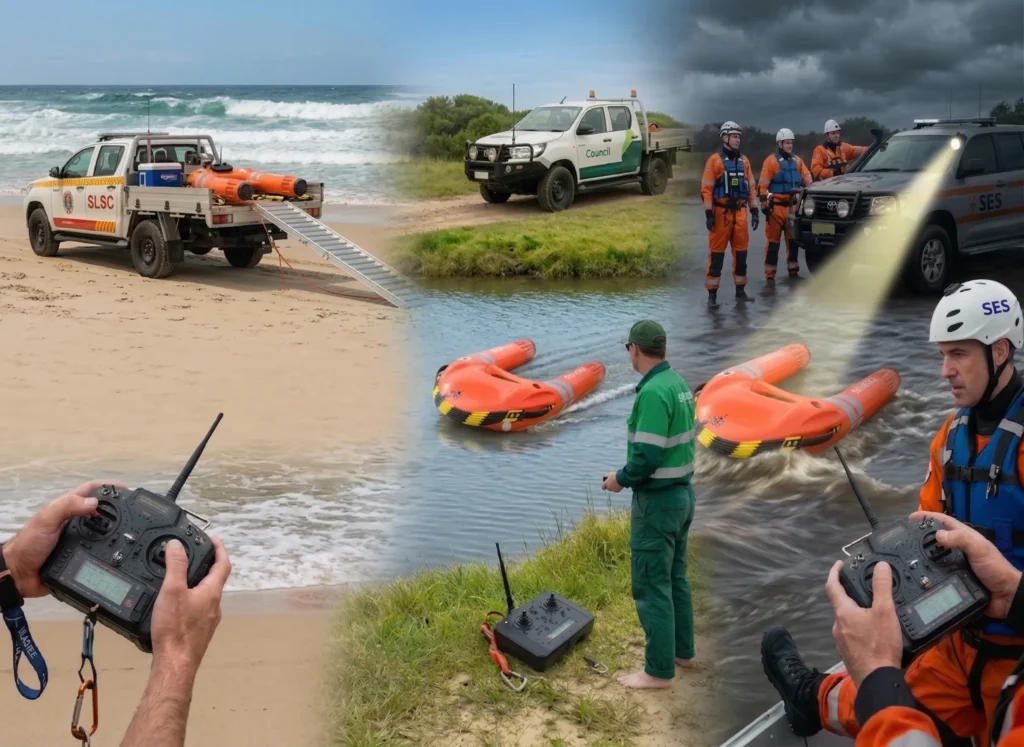
Remote-Control Rescue Buoys (RCRBs) have permanently changed how the first critical moments of a water rescue are handled. Instead of sending another human into danger, an RCRB delivers immediate flotation at speed, under full control, while keeping the rescuer safely on shore or on a vessel.
In surf beaches, unpatrolled waterways, rivers, flood zones, marinas, lakes, and estuaries, the mission of an RCRB is clear and uncompromising:
Get flotation to the person fast. Stabilise the situation. Reduce risk to everyone involved.
This report explains in clear, technical, and operational detail how the Vector Watercraft H3 Ark Remote-Control Rescue Buoy works—from internal systems and propulsion to battery safety, control logic, and real-world deployment.
The intent is not marketing fluff. This is a serious, engineering-led explanation suitable for councils, lifesaving organisations, emergency planners, and professional buyers who need to understand exactly how and why the H3 Ark performs its role.
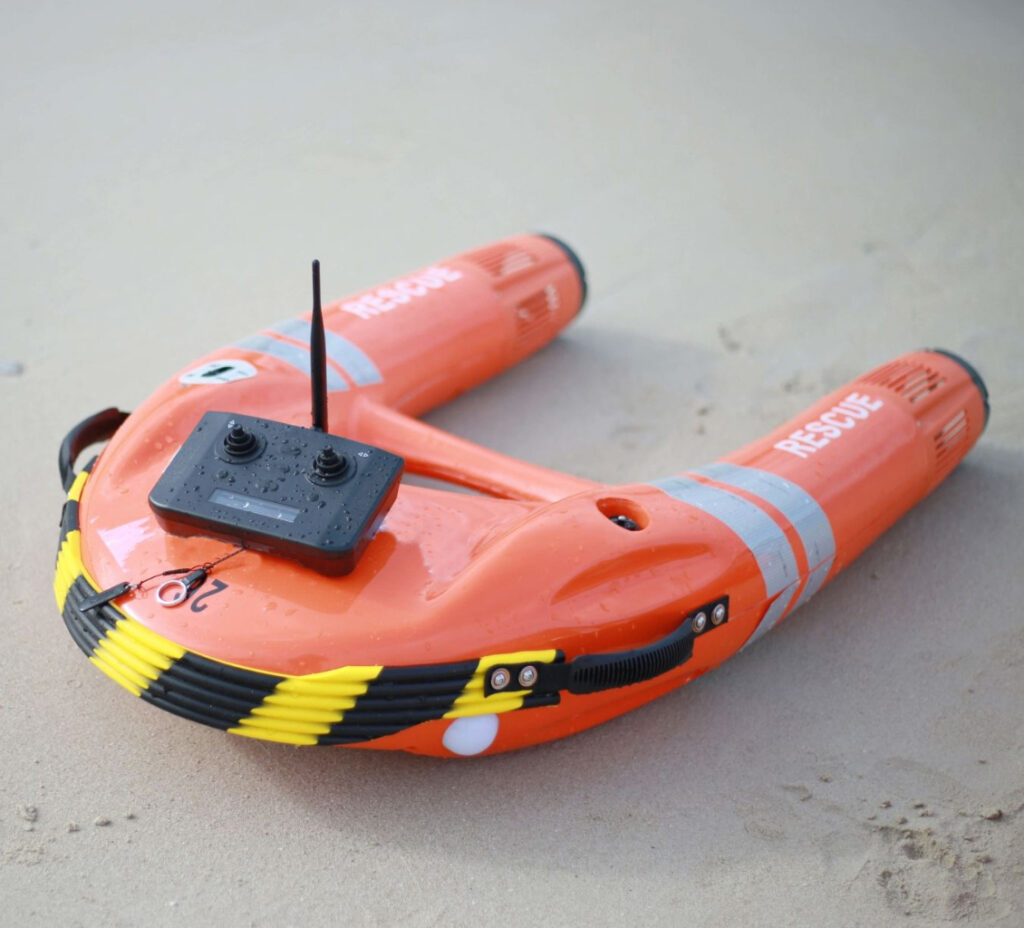
An RCRB is not a toy, and it is not a boat. It is a powered flotation delivery system engineered around three non-negotiable outcomes:
Time is the enemy in any water emergency. The H3 Ark is designed to reach a casualty significantly faster than a human swimmer—especially in rips, currents, floods, or cold water.
Once the casualty makes contact, the device must instantly support their weight and allow breathing to stabilise. Panic subsides only when buoyancy is reliable.
The H3 Ark allows the operator to either:
Critically, it achieves all of this without exposing rescuers to the same danger that caused the emergency.
The Vector Watercraft H3 Ark is best understood as six integrated systems working together:
Each system is engineered to support the others. Failure in one must not cascade into total failure—a core principle in professional rescue equipment.
The hull of the H3 Ark is engineered to do far more than float. It must:
This is achieved through a tough outer shell combined with a closed-cell buoyancy core. Closed-cell foam is essential because it does not absorb water, even if the outer skin is compromised.
The H3 Ark is designed to support well in excess of a single adult, accounting for:
Buoyancy is distributed to prevent nose-diving or excessive roll when a casualty grabs from one side—an extremely common real-world behaviour.
In rough water, flotation alone is not enough. The H3 Ark’s hull geometry is designed to resist inversion and recover orientation if disturbed by waves, chop, or surf turbulence.
This is particularly important in:
A rescue device that flips becomes useless. Stability is not optional.
Propulsion defines:
The H3 Ark uses protected propulsion architecture, deliberately avoiding exposed spinning components near people in distress.
The system generates thrust using enclosed, high-efficiency propulsion, delivering:
By avoiding open propellers, the H3 Ark significantly reduces:
Steering is achieved through differential thrust, allowing the operator to:
The control response is deliberately tuned to avoid over-correction, fishtailing, or sudden torque spikes that could destabilise the casualty.
The H3 Ark is engineered for rescue-relevant speed, not racing. Its performance envelope prioritises:
Loaded performance—when supporting a person—is the metric that matters. The H3 Ark maintains authority even when carrying weight.
The H3 Ark uses a high-quality lithium battery system designed for:
Unlike cheap consumer devices, the battery system is treated as critical safety infrastructure, not an afterthought.
A professional-grade BMS governs the battery, providing protection against:
This ensures predictable behaviour under stress and prevents catastrophic failure.
In real-world rescue scenarios, the H3 Ark is designed to deliver:
Critically, the system is designed never to shut down abruptly mid-rescue.
The battery is housed in a sealed, isolated compartment, ensuring that even if the outer hull is damaged, electrical integrity is preserved.
At its core, the H3 Ark uses a ruggedised electronic control system comprising:
This system translates operator input into smooth, reliable propulsion.
What separates professional rescue equipment from consumer gadgets is software discipline:
Every control decision prioritises predictability over raw response.
The H3 Ark is operated via a dedicated remote control using a robust wireless link designed for open-water line-of-sight use.
Water, waves, spray, and terrain all affect radio performance. The H3 Ark system accounts for this with:
If communication is interrupted, the H3 Ark enters a safe, predictable state, preventing runaway motion or dangerous drift.
A drowning person does not behave calmly. They grab, climb, pull, and push—often irrationally. The H3 Ark is designed accordingly, with:
The goal is instant trust: when the casualty touches the device, buoyancy must be immediate and unmistakable.
The H3 Ark can be deployed from:
It is designed to tolerate impact and immediate operation.
Best practice involves:
Once the casualty is secure:
If conditions prevent safe return, the H3 Ark can hold position while help arrives.
The H3 Ark excels in surf conditions where swimming rescues are dangerous, thanks to its stability and protected propulsion.
Strong thrust, debris tolerance, and predictable handling make it suitable for swift-water and flood response.
Fine control allows safe operation around boats, pylons, and ropes.
Rapid deployment and range allow coverage of large, unpatrolled areas.
Professional rescue equipment must deliver:
The H3 Ark is positioned as rescue infrastructure, not consumer electronics.
The H3 Ark reduces risk—but it does not remove responsibility. Proper training includes:
Used correctly, it saves lives. Used carelessly, any equipment can fail.
Rescue equipment must be ready every time, not most of the time.
The H3 Ark is powerful, but not magic:
Transparency builds trust.
The correct positioning is clear:
“The H3 Ark delivers flotation faster than a swimmer, while keeping the rescuer out of the water.”
That single truth defines its value.
Backed by engineering, battery safety, operational discipline, and proper training, the H3 Ark becomes a force multiplier for water safety, not a gimmick.
The Vector Watercraft H3 Ark Remote-Control Rescue Buoy combines a high-buoyancy, impact-resistant hull with protected propulsion powered by a safety-managed lithium battery system. Controlled wirelessly from shore or vessel, onboard electronics translate operator input into smooth, predictable thrust while enforcing strict safety logic. The device reaches the casualty quickly, provides immediate flotation through integrated handles and stable buoyancy, and allows controlled recovery or stabilisation—all while keeping rescuers out of harm’s way.