
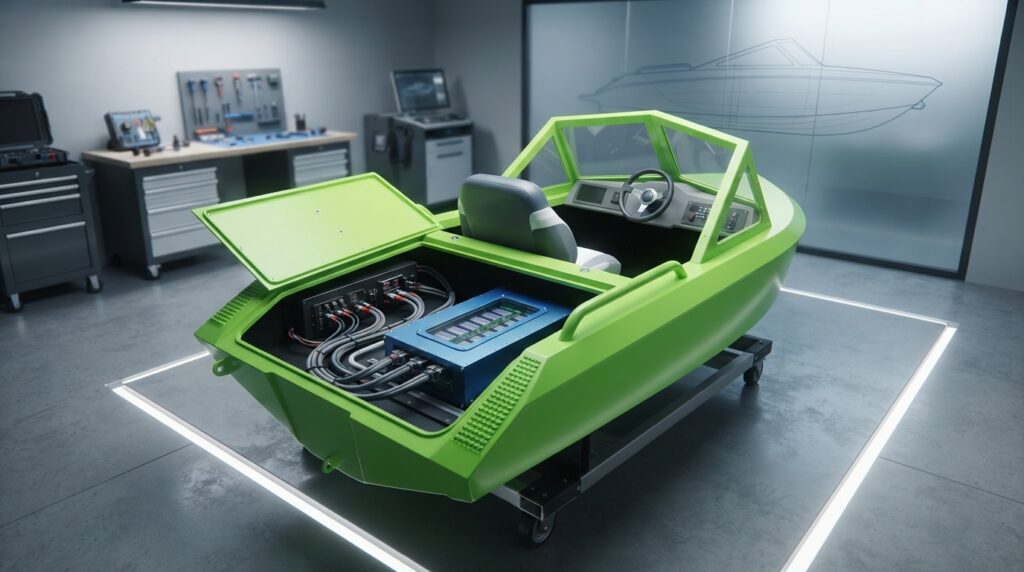
A mini jet boat's battery is typically its single most expensive component, and understandably, most owners want to get as many years of reliable service from it as possible before facing a replacement. While every lithium battery gradually loses some capacity over its working life regardless of how carefully it's treated, the rate of that decline is genuinely influenced by how the battery is charged, stored, and used day to day. This article brings together the practical habits that make the most measurable difference to long-term battery health, drawing on the more detailed discussions of charging, temperature and storage covered elsewhere in this series, into one consolidated, practical guide.
Before covering specific habits, it helps to understand the two broad mechanisms driving battery degradation, since this context makes the practical advice that follows considerably more intuitive rather than feeling like a list of arbitrary rules. The first is calendar ageing — degradation that happens simply from the passage of time, influenced heavily by state of charge and temperature during idle periods, discussed in depth in earlier articles in this series. The second is cycle ageing — degradation that accumulates through actual use, influenced by how deeply the battery is discharged and recharged, how quickly it's charged, and how hard it's worked during use.
Every owner's battery will experience both mechanisms to some degree over its working life, and the practical habits outlined in this article are aimed at moderating both, rather than eliminating degradation entirely, which isn't realistically possible with current lithium battery technology.
As discussed in the earlier article on storage charge levels, lithium batteries experience somewhat more stress when held at a very high state of charge for extended periods. While briefly charging to 100% immediately before a ride where you genuinely need maximum range is perfectly reasonable, habitually charging to 100% and then leaving the boat sitting at that charge level for hours or days before actually riding — simply because it's convenient to always charge fully — introduces unnecessary calendar ageing stress that a more moderate charging habit avoids.
For most typical riding, charging to somewhere in the 80-90% range, reserving a full 100% charge specifically for occasions when you genuinely need the extra range, is a widely recommended practical habit across the broader lithium battery category, and applies just as sensibly to mini jet boats as it does to electric vehicles or laptops.
Similarly, consistently riding until the battery reaches a very low state of charge, then immediately recharging, places more cumulative stress on the battery than maintaining a more moderate discharge pattern. This doesn't mean you need to obsessively avoid ever using a significant portion of your available range — that would defeat much of the purpose of owning the boat — but it's worth avoiding habitually running the battery down to a critically low level as a matter of routine, and instead charging at a reasonably moderate point rather than always pushing to the absolute limit before recharging.
This is particularly relevant for owners who ride frequently and could easily fall into a pattern of always depleting the battery close to empty before each recharge simply out of habit, rather than a genuine need for that much range on most outings.
As discussed in the article comparing fast and standard charging, consistently fast-charging a battery generates more heat and places more stress on individual cells than slower, standard-rate charging. For most owners with a reasonably predictable riding schedule and access to overnight charging time, standard-rate charging from a typical household power supply is both perfectly adequate and gentler on the battery over the long term than habitually relying on a faster charging option purely for convenience.
Faster charging remains a genuinely useful option to have available for occasions when it's actually needed — an unplanned second outing in a single day, for instance — but reserving it for those occasions, rather than making it your default everyday charging approach, is a sensible way to balance genuine convenience against long-term battery health.
As covered in detail in the dedicated article on temperature effects, consistently high temperatures — particularly combined with high state of charge during hot periods — meaningfully accelerate long-term degradation. Simple, practical steps like avoiding unnecessary prolonged direct sun exposure for the battery compartment, choosing shaded storage and charging locations where practical, and being mindful of not charging immediately while a battery is still hot from hard use on a scorching day, all contribute to better long-term battery health, particularly for owners in Australia's hotter regions where this consideration is especially relevant.
As covered in the dedicated storage charge article, any period where the boat won't be used for more than roughly two to four weeks is worth treating as a genuine storage period, with the battery adjusted to a moderate 40-60% charge range rather than left at whatever level it happened to be at when the boat was last used. This is one of the more impactful individual habits an owner can adopt, since extended idle time at either a very high or very low charge represents one of the more significant, avoidable contributors to unnecessary long-term degradation.
Beyond routine riding patterns, it's worth specifically avoiding situations where the battery is allowed to sit at a critically low charge level for an extended period — for instance, running the battery very low during an outing and then not charging it again for several days or longer, rather than charging it back to a moderate level relatively promptly. As discussed in the storage charge article, prolonged time at very low charge carries a more serious degradation risk than the equivalent time at high charge, making this a particularly important habit to avoid, even though an occasional, promptly-resolved low-charge event isn't cause for serious concern.
While this article, and others in this series, draw on broadly established lithium battery industry knowledge that applies reasonably consistently across the category, it's always worth checking whether your specific manufacturer provides guidance that differs from these general recommendations, since specific battery chemistries, management systems, and design choices can occasionally warrant a somewhat different approach for a particular model. Manufacturer-specific guidance, where provided, should generally take precedence over general industry advice, since it reflects direct knowledge of your specific battery system that broader guidance can't fully account for.
Many modern mini jet boat battery systems include software-based management that can be updated over time, sometimes improving charging efficiency, temperature management, or overall battery protection algorithms based on accumulated real-world data and manufacturer refinements since the boat was originally manufactured. Keeping this software current, where updates are available and recommended by the manufacturer, ensures you're benefiting from the most current, refined battery management logic available for your specific boat, rather than running on an earlier, potentially less optimised version indefinitely.
For owners who want a more objective, data-driven sense of how their battery is actually ageing over time, rather than relying purely on subjective impressions of range and performance, it's worth asking whether your manufacturer or an authorised service provider offers periodic battery health assessments — a diagnostic check that can provide a genuine capacity or state-of-health reading, rather than relying solely on day-to-day observation. This is particularly useful as a battery ages into its later years of service, helping an owner make an informed decision about whether continued use, a battery reconditioning option if available, or eventual replacement is the most sensible path forward, based on genuine data rather than guesswork.
Beyond charging and storage habits, it's worth understanding that riding style itself has a genuine, if secondary, influence on long-term battery health, distinct from the charging-related factors already discussed. Consistently aggressive acceleration, particularly repeated hard starts from a standing position, draws high current from the battery in short bursts, which generates more internal heat and places more instantaneous stress on individual cells than a more gradual, moderate throttle application achieving the same eventual speed. This doesn't mean aggressive riding should be avoided entirely — enjoying your boat's genuine performance capability is, after all, a significant part of the appeal of ownership — but it's worth understanding that a riding style consisting entirely of hard, repeated bursts of acceleration places somewhat more cumulative stress on the battery than a more varied riding style incorporating gentler throttle application for a meaningful portion of typical use.
Similarly, sustained high-speed cruising for extended periods draws consistently high current over a longer duration, which can also generate more sustained heat than a more moderate cruising pace. Owners who specifically want to maximise battery longevity might reasonably choose to reserve their boat's full performance capability for shorter bursts of genuine enjoyment, rather than as a sustained default riding style for every outing, while still fully making use of the boat's capability when the occasion genuinely calls for it.
It's worth connecting good battery care practices back to the practical, financial dimension of ownership, specifically resale value. A battery that's been well cared for throughout its working life, retaining a meaningfully higher proportion of its original capacity than a poorly cared-for equivalent of the same age, represents a genuinely more valuable asset at resale time, since prospective buyers of a used mini jet boat — as discussed in the earlier article on buying new versus demonstrator versus used boats — increasingly understand the importance of battery health and are likely to specifically ask about or seek verification of battery condition before purchase.
This means the habits outlined throughout this article aren't purely about extending your own personal enjoyment of the boat, but also about protecting the boat's genuine resale value down the track, should you eventually decide to sell or upgrade. A boat with a well-documented history of sensible charging and storage habits, ideally supported by periodic professional health assessments as discussed above, is generally a considerably more attractive and higher-value proposition to a prospective buyer than an otherwise comparable boat with an unknown or poorly managed battery history.
A few misconceptions are worth directly addressing, since they occasionally lead owners toward counterproductive habits. First, the old nickel-cadmium battery "memory effect," where batteries needed to be fully discharged before recharging to maintain their effective capacity, does not apply to modern lithium batteries used in mini jet boats — deliberately running a lithium battery down to empty on a regular basis provides no benefit and, as discussed above, is actually somewhat counterproductive to long-term health. Second, leaving a battery permanently plugged in and topped up at 100% is not equivalent to good ongoing care, despite superficially seeming like the most "ready to go" approach — as discussed throughout this article, extended time at high charge is one of the more significant avoidable contributors to unnecessary calendar ageing. Third, occasional fast charging for genuine convenience is not something to be feared or avoided entirely — it's specifically habitual, default reliance on fast charging where standard charging would work just as well that's worth moderating, not occasional use when it's genuinely needed.
It's worth setting realistic expectations about what "extending battery life" genuinely means in practice. Good habits, consistently applied, can meaningfully slow the rate of degradation and extend the period over which a battery remains genuinely useful for regular riding, but they can't prevent degradation entirely or make a battery last indefinitely. Most lithium batteries used in this kind of application can reasonably be expected to retain a meaningful majority of their original capacity for several years of typical use, gradually declining thereafter, with the specific timeline depending considerably on the factors discussed throughout this article, as well as genuine variation in cell quality and manufacturing between different battery systems.
Understanding this realistic trajectory helps set appropriate expectations from the outset, rather than either assuming a battery will perform identically to new indefinitely, or conversely becoming unnecessarily anxious about gradual, normal capacity decline that occurs even with genuinely excellent care.
The habits outlined throughout this article deliver considerably more cumulative benefit when adopted from the very start of ownership, rather than introduced partway through a battery's working life after less favourable habits have already been established for some time. This is simply a consequence of how calendar ageing and cycle ageing accumulate — degradation that's already occurred under less favourable early habits can't be reversed by adopting better habits later, even though adopting better habits at any point is still worthwhile for the degradation still to come.
This is part of why it's worth reading through and genuinely internalising this kind of guidance early in your ownership journey, ideally before or shortly after taking delivery, rather than treating it as optional reading to return to at some vague future point. New owners who establish sensible charging, storage and riding habits from their very first few outings are generally better positioned for strong long-term battery health than those who develop less favourable habits early on and only adjust once they've read guidance like this some months or years into ownership.
For households where more than one person rides the boat, it's worth having a shared, basic understanding of good battery care habits across everyone who might charge or use the boat, rather than assuming good habits established by the primary owner will automatically be followed by other family members or friends who occasionally use it. A partner, adult child, or friend who occasionally charges the boat without the same awareness of moderate charging levels, prompt charging after use, or sensible storage practices during gaps in use can inadvertently undermine otherwise excellent habits established by the primary owner.
A simple, brief conversation with anyone else who regularly charges or uses the boat — covering the basics of moderate charging levels, avoiding extended deep-discharge periods, and general awareness of the storage guidance discussed elsewhere in this series — can go a long way toward ensuring the battery genuinely benefits from consistently good care across its entire working life, rather than experiencing inconsistent treatment depending on which household member happened to charge it on a given occasion.
Over time, it's worth paying attention to a few practical indicators that suggest your battery care habits are genuinely paying off, rather than simply hoping for the best without any real feedback. Range that remains reasonably consistent across similar conditions and riding styles from one season to the next, rather than declining noticeably faster than expected for the battery's age, is a good general sign. Charging times that remain broadly consistent, rather than becoming noticeably longer over time under similar conditions, similarly suggest the battery is retaining its capacity and charging efficiency well. And if you've arranged periodic professional health assessments as discussed earlier, a capacity or state-of-health reading that tracks a reasonable, expected decline curve for the battery's age, rather than an unusually steep or accelerated decline, provides genuine data-backed confirmation that your care habits are having the intended protective effect.
Conversely, if you notice range or performance declining considerably faster than seems reasonable for the battery's age, despite generally following the guidance in this article, it's worth raising this directly with your manufacturer or an authorised service provider, since this could indicate either an unusual manufacturing or cell quality issue unrelated to your care habits, or a specific care practice that might benefit from a closer look and some individualised guidance, rather than assuming nothing more can be done.
Extending the working life of an electric mini jet boat's battery comes down to a genuine combination of sensible, consistently applied habits — moderate charging levels for everyday use, avoiding unnecessary fast charging, thoughtful temperature management, appropriate storage charge levels during extended idle periods, and staying current with manufacturer-specific guidance and software updates. None of these habits require dramatic lifestyle changes or significantly reduce the genuine enjoyment of owning and riding the boat; they're simply small, low-effort adjustments that, applied consistently over years of ownership, meaningfully protect what's typically the single most expensive component of the entire boat, helping ensure it continues delivering strong, reliable performance for as long as realistically possible. Establishing these habits early, and sharing them with anyone else who regularly uses the boat, gives the battery the best realistic chance of a long, genuinely productive working life.
Vector Watercraft supplies fully assembled electric mini jet boats to the Australian market, with battery management systems engineered to support genuine long-term battery health, alongside clear, practical guidance for owners on the habits that make the most measurable difference to working life. Backed by a 2-year warranty and dedicated after-sales support, including periodic battery health assessment options, Vector Watercraft is committed to helping Australian owners protect their investment and get the most genuine value from their boat's battery across many years of ownership.