
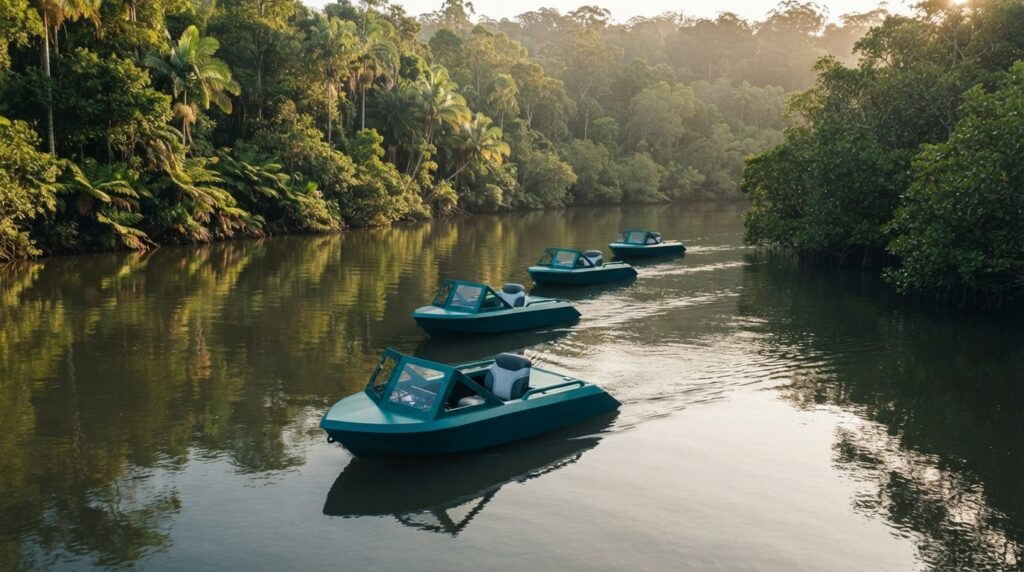
Australia's guided water tour industry has traditionally been built around two ends of a spectrum — larger, high-thrill jet boats delivering adrenaline-focused harbour rides, and slower, larger cruise-style vessels offering scenic, narrated tours. Electric mini jet boats occupy a genuinely different niche between these two established models, and tourism operators exploring this category are finding it opens up experiences that neither traditional approach delivers particularly well.
The established Australian jet boat tour model, well represented in cities like Sydney and on the Gold Coast, centres on high-speed thrill rides — spins, slides and rapid manoeuvres aboard larger, more powerful jet boats. This is a genuinely successful and popular tourism category, but it represents only one style of water-based guided experience. Electric mini jet boats support a different proposition entirely: smaller group sizes, quieter and more intimate exploration, and access to the kind of sheltered rivers, creeks and estuarine environments discussed throughout this series, that larger tour vessels simply aren't suited to reaching.
Several of the characteristics discussed throughout this series translate directly into advantages for a guided tour operation:
Quiet operation supports genuine immersion. For nature-focused or scenic tours specifically — wildlife spotting, mangrove exploration, or quiet river cruising — the near-silent operation of electric propulsion allows guests to genuinely experience the sounds of the environment, rather than a petrol engine's noise dominating the experience throughout.
Shallow-water and narrow-waterway access opens up different destinations. As discussed in the article on river and creek exploration, a mini jet boat's compact size and jet propulsion allow genuine access to waterways that larger tour vessels can't reach, opening up tour routes and destinations that would otherwise be inaccessible to a guided water tour offering.
Simplified operation supports efficient turnaround between tours. The straightforward startup, absence of any warm-up routine, and comparatively simple maintenance requirements discussed in earlier articles all support an operator running multiple shorter sessions across a day with minimal downtime between groups.
Smaller group sizes support a more personal guiding style. Rather than a larger vessel carrying a sizeable group with a single guide addressing everyone via microphone, mini jet boats naturally suit smaller, more intimate group sizes, where a guide can offer a more genuinely personal, conversational style of commentary and interaction.
Tourism operators considering this category need to work through several practical dimensions specific to running a commercial guided tour operation, distinct from private recreational ownership:
Electric mini jet boat tours appear particularly well suited to a specific segment of the broader tourism market: travellers seeking a genuinely distinctive, lower-impact, more intimate water experience, rather than those specifically seeking the high-adrenaline thrill-ride experience that larger jet boat operators already serve well. This includes eco-tourism-minded travellers, couples and small groups seeking a more personal experience, and destinations where quiet, sheltered waterway access is the genuine drawcard rather than speed and spectacle.
This isn't a suggestion that mini jet boat tours should compete directly with established high-speed thrill-ride operators — rather, it represents a genuinely different market position, complementary to rather than competing with the existing category.
For operators in areas with genuine environmental sensitivity — waterways near wildlife habitats, quieter residential canal and riverfront communities, or locations where noise and wake impact are a meaningful community consideration — electric propulsion's reduced noise footprint and lack of exhaust emissions, discussed in the article on electric propulsion's safety advantages, also supports a genuinely credible environmental and community-friendly positioning that resonates with an increasingly environmentally conscious segment of the tourism market.
It's worth being realistic that guided electric mini jet boat tourism is a newer, still-developing category in Australia compared to the well-established larger jet boat and cruise tour industries. Operators exploring this space are, in many cases, genuinely pioneering a new format rather than following a well-worn commercial template, which brings both the opportunity of differentiation and the practical challenge of building market awareness and demand for an experience many prospective guests haven't previously considered or encountered.
Electric mini jet boats represent a genuinely distinct opportunity within Australia's guided water tour landscape — not a direct replacement for established high-speed thrill-ride operators, but a complementary category suited to quieter, more intimate, and more environmentally sensitive experiences that larger vessels can't easily deliver. For tourism operators willing to work through the specific commercial licensing, infrastructure and market-positioning considerations involved, this emerging category offers a genuine point of differentiation in a tourism market that increasingly values distinctive, lower-impact experiences alongside its traditional offerings.