
How Vector Watercraft Is Developing Specialised Secure Containers for RCRBs in Remote Locations – Ensuring Availability When Emergencies Occur
In water rescue, capability without availability is ineffective. Even the most advanced rescue equipment delivers no benefit if it is not immediately accessible at the moment an incident unfolds. Across Australia, many drownings and near-miss events occur in locations that are unpatrolled, remote, poorly lit, or unattended for long periods of the day. In these environments, response time—not intent or equipment quality—determines outcomes.
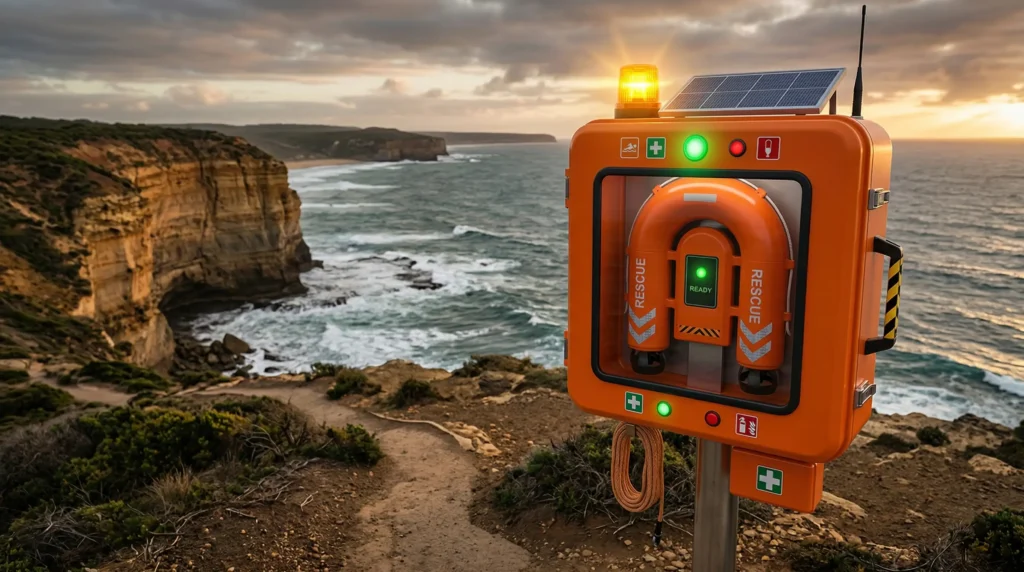
Vector Water Craft recognises that Remote Control Rescue Buoys (RCRBs) reach their full life-saving potential only when they are physically present, protected, visible, and rapidly deployable at the point of need. This understanding has driven the development of specialised secure containers designed specifically for the unattended deployment of RCRBs in remote and semi-remote locations.
These containers are not an afterthought or a generic cabinet solution. They are purpose-designed emergency infrastructure incorporating physical protection, environmental resilience, visibility, security, and public-use logic—while integrating sirens and flashing lights to alert responders and bystanders when an emergency deployment occurs.
This article explains the rationale behind these container systems, how they are being developed, and why they are essential to the next evolution of public-access water rescue capability in Australia.
A significant proportion of Australian water incidents occur:
In these settings, emergency response often relies on a member of the public making a call, waiting for responders to arrive, and hoping conditions remain survivable in the interim. Even well-equipped emergency services face unavoidable delays due to distance, access constraints, and mobilisation time. Vector Water Craft’s specialised container initiative directly addresses this gap by transforming RCRBs from mobile assets into fixed, always-available rescue infrastructure.
It may appear tempting to place an RCRB in a standard cabinet, shed, or locker. In practice, this approach fails across several critical dimensions. Generic storage solutions do not adequately address:
Vector Water Craft has therefore rejected off-the-shelf storage concepts in favour of purpose-engineered containment systems that treat the RCRB as emergency infrastructure, not stored equipment.
The guiding principle behind Vector Watercraft’s container development is simple: An RCRB container must function as part of the emergency response system, not merely house equipment. This philosophy drives every design decision. The container must:
This approach mirrors the evolution of public-access defibrillators, which transitioned from clinical devices to widely recognised emergency fixtures only after their housings, signage, and access logic were properly designed.
Australian conditions are unforgiving. Containers must survive years of exposure without compromising internal equipment. Vector Watercraft containers are being developed to withstand:
Materials selection prioritises:
The objective is long-term durability with minimal maintenance intervention.
One of the most complex challenges in emergency infrastructure is balancing security with immediate access. Vector Watercraft containers are designed to:
This is achieved through:
Importantly, the container is not intended to create barriers during an emergency. It is designed to guide correct behaviour under stress, not impede it.
A defining feature of Vector Watercraft’s specialised containers is the integration of sirens and high-visibility flashing lights. These are not cosmetic additions. They serve several critical operational purposes.
When a container is opened or the RCRB is removed:
This is particularly valuable in:
The alert system ensures that an RCRB deployment never occurs silently or unnoticed.
Sirens and lights also influence bystander behaviour. They:
This reduces confusion and improves coordination in the critical early minutes of an incident.
From an organisational perspective, alert systems provide:
This aligns with governance expectations for publicly deployed emergency equipment.
Container systems must remain operational even in adverse conditions. Vector Water Craft designs containers to function independently of constant external power where required, using:
Reliability takes precedence over complexity. There are no unnecessary digital dependencies that could compromise availability.
Container placement is as important as container design. Vector Water Craft works with stakeholders to identify locations where fixed RCRB availability provides the greatest impact, such as:
Placement decisions are informed by historical incident data, accessibility, and response time modelling.
These containers are not standalone installations. They are designed to integrate seamlessly with broader emergency response planning. Integration considerations include:
This ensures containers enhance—not complicate—existing frameworks.
Effective emergency infrastructure must be intuitive. Vector Water Craft container systems incorporate:
This allows members of the public to act decisively even under stress, without specialist training.
Unattended infrastructure must anticipate misuse. Vector Water Craft addresses this through:
Experience shows that when emergency equipment is clearly identified, monitored, and valued, misuse declines significantly.
While specialised containers represent an upfront investment, they reduce long-term costs by:
From a public-sector perspective, this represents strong value for money and defensible infrastructure spending.
Vector Watercraft designs container systems with scalability in mind. This includes:
As rescue strategies evolve, container infrastructure can evolve with them rather than requiring replacement.
Providing accessible rescue equipment in remote locations reflects a broader commitment to public safety equity. Vector Water Craft views these containers as:
This aligns with modern expectations of responsible water safety management.
Remote Control Rescue Buoys save lives only when they are available at the moment of need. Vector Watercraft’s development of specialised secure containers—with integrated sirens and flashing lights—addresses one of the most persistent gaps in water rescue: time and access.
By transforming RCRBs into fixed, visible, protected, and alert-enabled emergency infrastructure, Vector Watercraft is extending rescue capability beyond patrol hours, beyond staffed locations, and into the places where incidents too often occur unseen.
These containers are not storage boxes. They are the final link between engineering excellence and real-world life-saving outcomes.