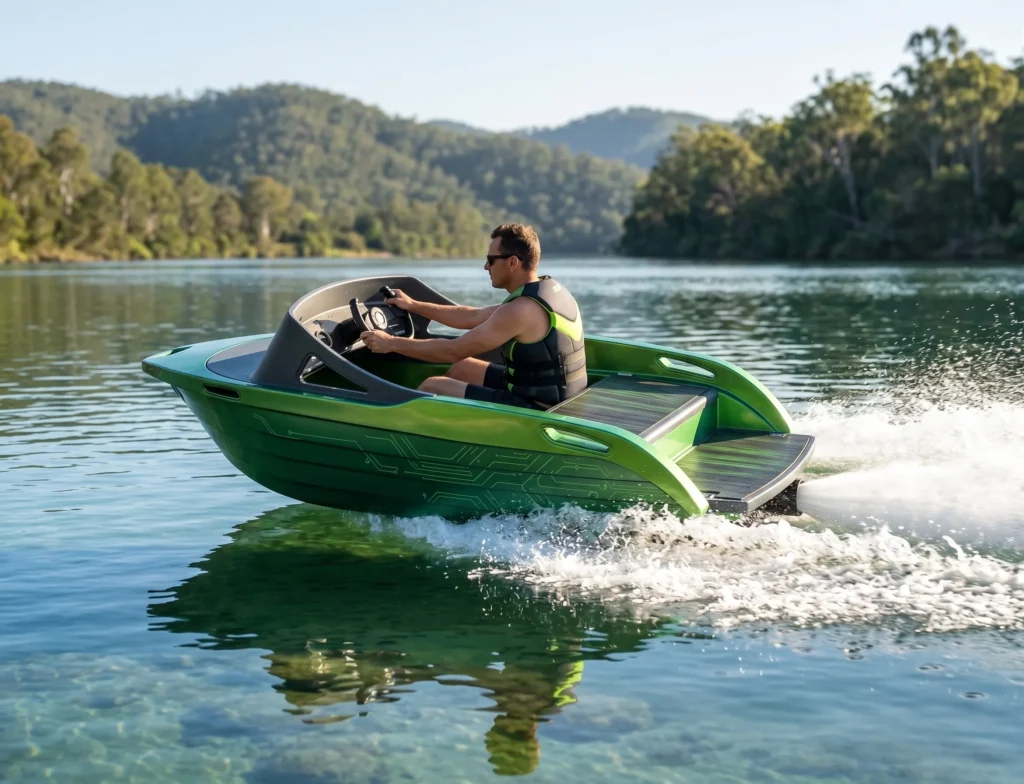
Electric propulsion has quietly transformed several industries over the past decade — from bicycles and motorcycles to cars and personal watercraft. One of the most significant developments in the marine sector has been the emergence of electric mini jet boats, particularly those developed and offered under the Vector Watercraft banner.
These compact craft appear simple at first glance, yet beneath the hull sits a carefully engineered system combining high-output electric motors, advanced lithium battery technology, intelligent electronic controls, and jet propulsion. Unlike traditional petrol-powered boats, there is no combustion engine, no gearbox, and no exposed propeller. Instead, everything is designed as an integrated electric system from the outset.
This article explains how Vector Watercraft mini jet boats are powered, how the propulsion system works, and why this modern approach differs fundamentally from — and in many respects improves upon — conventional small petrol-powered boats.
At the heart of every Vector Watercraft mini jet boat is a fully electric drivetrain. This replaces the familiar petrol engine with a high-power electric motor supplied by a lithium-ion battery system.
Electric propulsion delivers several clear advantages for compact watercraft:
For lightweight hulls operating on lakes, rivers, estuaries, and sheltered coastal waters, electric power is not merely a novelty — it is a logical engineering choice.
Vector Watercraft mini jet boats utilise high-output brushless electric motors. Brushless motors are the industry standard for modern electric marine propulsion because they:
Most Vector Watercraft models operate in the 15–16 kW range, which equates roughly to 20–22 horsepower in petrol terms. The key distinction, however, lies in how that power is delivered.
Electric motors provide maximum torque instantly, rather than gradually building power as engine RPM increases. This gives Vector Watercraft boats their characteristic sharp throttle response and lively acceleration.
Unlike petrol engines, which rely on crankshafts, gear reduction systems, and mechanical transmissions, the electric motor in a Vector Watercraft mini jet boat is typically directly coupled to the jet pump shaft. This reduces mechanical losses, improves reliability, and simplifies the overall drivetrain.
Vector Watercraft mini jet boats are powered by lithium-ion battery systems, similar in principle to those used in electric vehicles, though configured specifically for marine environments.
Lithium-ion batteries provide:
Typical battery capacities range from approximately 3.8 kWh to 5.3 kWh, depending on the model and configuration. While this may seem modest compared to electric cars, it is more than sufficient for a lightweight craft designed for short, energetic recreational sessions.
Many Vector Watercraft models feature removable battery packs, offering practical advantages such as:
This design is particularly appealing for owners without permanent waterfront power access.
A crucial but often overlooked component of the system is the Battery Management System (BMS).
The BMS continuously monitors:
It actively protects the battery from overcharging, excessive discharge, thermal overload, and electrical faults. In a marine environment, a robust BMS is essential for both safety and longevity.
Between the battery pack and the motor sits the Electronic Speed Controller (ESC).
The ESC performs several critical functions:
Unlike a petrol throttle — which indirectly controls power by altering air and fuel flow — an ESC adjusts power electronically and instantaneously.
The ESC is typically integrated with thermal protection limits, emergency cut-off systems, and throttle calibration and fail-safe protocols. This ensures predictable, controlled performance even under demanding conditions.
Vector Watercraft mini jet boats use waterjet propulsion rather than traditional propellers. This approach is ideal for compact electric craft because it:
Water enters the system through an intake grate located on the underside or rear of the hull. The grate is designed to maintain smooth water flow and prevent large debris from entering the pump.
Inside the jet pump housing, the motor drives a high-speed impeller. The impeller accelerates the incoming water, converting rotational energy into high-velocity water flow.
The pressurised water exits through a narrow jet nozzle at the stern. The reaction force generated by this high-speed water stream propels the boat forward.
Vector Watercraft mini jet boats do not rely on traditional rudders.
Steering is achieved by pivoting the jet nozzle left or right, redirecting the stream of water. This design enables:
Many riders describe the experience as similar to steering a go-kart on water.
Depending on configuration, Vector Watercraft jet systems may include a mechanical reverse bucket or electronically managed thrust modulation. These systems allow:
Electric motors excel at low-speed control because torque is available immediately, even at minimal RPM.
Electric motors and controllers generate heat, particularly under sustained high load.
Vector Watercraft mini jet boats typically employ water-assisted cooling systems, drawing cooling water from the jet intake or a dedicated loop. This approach:
Instant torque gives these compact boats impressive off-the-line acceleration relative to their size.
Top speeds generally fall within the 45–55 km/h range, depending on hull design, rider weight, and conditions.
Runtime varies according to riding style:
As with all electric vehicles, aggressive use shortens runtime.
Electric propulsion allows designers to position batteries low in the hull and centralise mass, improving stability and handling. This is particularly important in short hulls, where balance strongly influences ride quality.
Vector Watercraft boats require no fuel tanks, no carburettors or injectors, and no oil changes.
With fewer moving parts, there are fewer potential failure points.
Electric charging is more predictable in cost, typically cheaper than petrol, and easily managed at home.
Routine maintenance generally involves inspecting the jet intake for debris, checking seals and electrical connections, and monitoring battery health. There are no spark plugs, fuel filters, or oil systems to service.
Vector Watercraft mini jet boats produce zero exhaust emissions, operate with minimal noise, and are often permitted on waterways with combustion-engine restrictions. This opens access to lakes, rivers, and environmentally sensitive areas.
These boats are ideal for:
They are not designed for long offshore passages, rough open-ocean conditions, or extended endurance cruising.
Vector Watercraft demonstrates how electric jet propulsion scales exceptionally well for compact watercraft. As battery and motor technology continues to advance, future improvements are likely to include longer runtimes, higher efficiency motors, and smarter electronic control systems.
Vector Watercraft mini jet boats are not petrol boats adapted to electric power. They are purpose-designed electric vessels, built around high-output brushless electric motors, advanced lithium-ion battery systems, integrated electronic controls, and compact, efficient waterjet propulsion.
The result is a clean, responsive, low-maintenance craft that represents a clear shift away from traditional small-engine marine design. For riders who value modern engineering, simplicity, and immediate performance, the Vector Watercraft electric jet propulsion system is not merely an alternative — it is the future of compact recreational boating.