
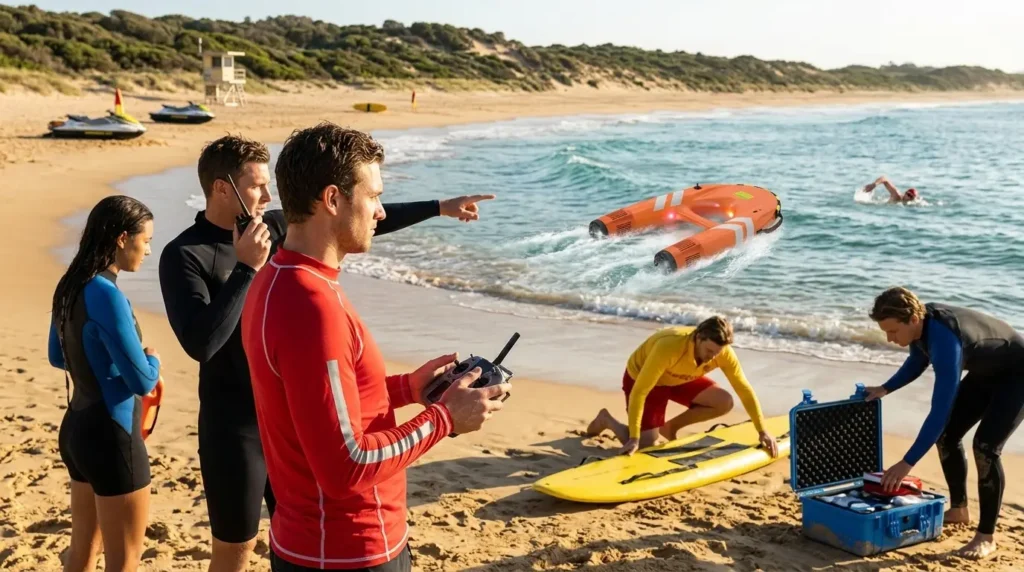
Emergency response outcomes are rarely determined by equipment alone. They are determined by how well that equipment is integrated into existing response frameworks, training protocols, command structures, and decision-making processes. A Remote Control Rescue Buoy (RCRB) that is not embedded into an organisation’s Emergency Response Plan (ERP) risks being underutilised, misunderstood, or deployed too late to make the critical difference it is designed to deliver.
Vector Water Craft recognises that RCRBs are not replacements for existing rescue assets such as lifeguards, rescue boards, IRBs, or helicopters. Instead, they function as force multipliers—bridging the gap between incident detection and physical rescue, particularly in the vital first minutes when time, fatigue, and conditions work against traditional response methods.
This article provides a detailed guide to integrating Vector Water Craft RCRBs into established emergency response plans across councils, surf life saving clubs, marine authorities, and government agencies. It focuses on operational logic, command integration, decision pathways, and practical deployment scenarios rather than abstract theory.
Many emergency organisations acquire new equipment without fully embedding it into their response doctrine. This often leads to:
Vector Water Craft RCRBs are most effective when they are formally recognised within emergency response documentation, not treated as optional or experimental tools. Integration ensures that when an incident occurs, the question is not “Should we use the RCRB?” but rather “Who deploys it, when, and how?”
To integrate RCRBs properly, it is essential to understand their role in the rescue timeline. Most water rescues follow a predictable sequence:
RCRBs operate most effectively between stages 1 and 3—often reaching the victim well before a swimmer, boat, or helicopter can be mobilised. They are particularly valuable when:
By explicitly positioning RCRBs in this early-response window within ERPs, organisations gain a measurable improvement in response speed.
The first step in integration is documentation. Emergency Response Plans should explicitly reference RCRBs under appropriate sections, such as:
This recognition legitimises RCRBs as standard tools rather than discretionary options. Key elements to document include:
Clear documentation reduces hesitation during real incidents.
One of the most common integration failures occurs at the command level. RCRBs must sit clearly within the command hierarchy, whether under:
The ERP should specify who authorises deployment, who operates the unit, and how communication is maintained during deployment. Because RCRBs are remotely operated, command clarity is essential to prevent conflicting instructions or unsafe overlap with swimmers or vessels. Vector Water Craft designs RCRBs for simple, intuitive control, but organisational clarity remains critical.
Emergency response plans should define deployment triggers rather than relying on subjective judgement alone. Examples of predefined triggers include:
By embedding these triggers into ERPs, organisations ensure RCRBs are deployed early rather than as a last resort. Early deployment aligns directly with improved survival outcomes.
Surf Life Saving Clubs represent one of the most natural integration environments for RCRBs. Within SLSC operations, RCRBs complement rescue boards, IRBs, jet skis, and lifeguard swimmer rescues. ERP integration may include:
RCRBs reduce risk to lifesavers by allowing flotation to reach victims without immediate human exposure to dangerous conditions.
Local councils increasingly face responsibility for public safety across beaches, rivers, lakes, and flood-prone areas. Integrating RCRBs into council emergency response plans supports:
Councils benefit from RCRBs because they do not require immediate trained swimmers, can be deployed by trained staff or authorised personnel, and provide visible reassurance to the public. ERP integration often places RCRBs within broader disaster response frameworks rather than standalone beach operations.
For SES, marine police, and other agencies, RCRBs add a layer of capability that reduces risk to responders. Integration considerations include:
RCRBs should be referenced in water rescue SOPs, flood response annexes, and multi-agency coordination plans. Because Vector Water Craft RCRBs are electrically powered and highly manoeuvrable, they are well suited to confined or hazardous environments.
One of the key advantages of Vector Water Craft RCRBs is minimal training overhead. Integration into training frameworks typically includes initial familiarisation sessions, scenario-based drills, and periodic refresher exercises. RCRB training does not replace existing rescue training—it complements it. ERP updates should reflect required operator competency levels, training frequency, and assessment criteria to ensure consistency across personnel and shifts.
Clear communication protocols are essential. Emergency Response Plans should specify:
Because RCRBs are often the first asset to reach a victim, communication between operator and incident controller is critical for situational awareness.
RCRBs are particularly effective in multi-casualty incidents, where traditional rescues become sequential and slow. ERP integration should address the use of RCRBs to stabilise multiple victims, holding patterns while additional resources arrive, and coordination with incoming assets. This capability can prevent secondary drownings while responders mobilise.
Formal integration also improves risk management. By defining RCRB use within ERPs, organisations reduce ad-hoc decision making, operator confusion, and unsafe overlap with swimmers. Vector Watercraft RCRBs are designed to be inherently safe, but procedural clarity ensures safe outcomes in complex scenarios.
When RCRBs are integrated into formal response plans, they become visible symbols of preparedness. This supports public confidence in local authorities, clear messaging about rescue capabilities, and reduced panic during incidents. Community awareness programs often reference equipment listed in official plans, reinforcing legitimacy.
Integration is not static. Emergency Response Plans should be reviewed regularly to incorporate lessons from deployments, adjust triggers and protocols, and reflect new infrastructure locations. Vector Watercraft supports ongoing refinement by designing RCRBs that adapt easily to evolving response strategies.
From a governance perspective, integrated RCRBs demonstrate proactive risk mitigation, responsible asset utilisation, and alignment with modern rescue methodologies. This can support funding approvals, grants, and stakeholder confidence.
Vector Watercraft RCRBs deliver their greatest value when they are not treated as optional tools, but as embedded components of a coordinated emergency response system. By formally integrating RCRBs into Emergency Response Plans—through documentation, training, command structures, and decision pathways—organisations dramatically improve response speed, reduce responder risk, and increase survival outcomes. Integration transforms RCRBs from equipment into capability—and capability into lives saved.