
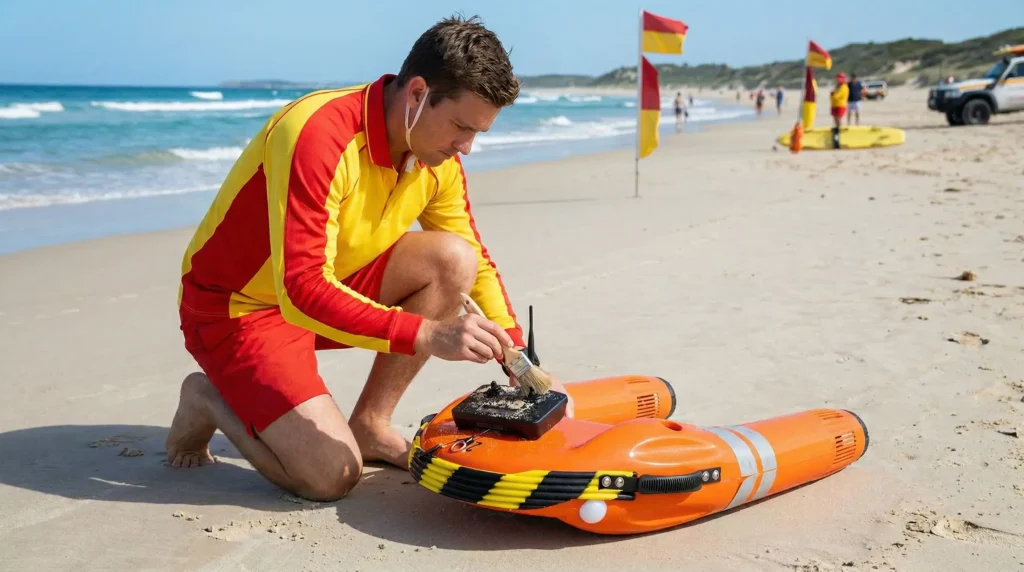
Remote Control Rescue Buoys (RCRBs) are not discretionary equipment. They are emergency assets designed to perform under pressure, in hostile environments, and often in the first critical minutes of a rescue when human safety hangs in the balance. For councils, surf life saving clubs, marine authorities, emergency services, and private operators, the long-term ownership of an RCRB is therefore not simply a matter of cost efficiency—it is a matter of public trust, duty of care, and operational readiness.
Vector Watercraft approaches RCRB design and ownership from the same philosophy long applied to professional maritime equipment: reliability first, simplicity where possible, and maintenance regimes that are realistic for real-world operators. Unlike consumer gadgets, an RCRB must be ready after months of inactivity, perform without hesitation, and withstand repeated exposure to salt water, sand, sun, heat, and mechanical shock.
This article provides a comprehensive, practical guide to maintaining Vector Watercraft RCRBs over the long term. It explains what routine care is required, what is not required, how costs are controlled over time, how reliability is preserved, and why a well-maintained RCRB can remain operational for many years with minimal intervention.
Before discussing maintenance schedules, it is important to understand the environment in which RCRBs operate. This environment defines the engineering decisions behind Vector Watercraft designs and explains why certain maintenance practices are essential.
RCRBs are typically deployed in:
Saltwater is corrosive, sand is abrasive, UV degrades plastics and seals, and heat accelerates battery wear. Vector Watercraft RCRBs are engineered specifically to withstand these conditions, but no professional equipment is entirely maintenance-free. The goal is not elimination of maintenance—it is predictable, low-effort, high-reliability maintenance.
Vector Watercraft RCRBs are designed from the outset to minimise long-term ownership complexity. Several core design principles directly reduce maintenance requirements compared to cheaper or consumer-grade alternatives.
Fully Sealed Propulsion Systems
The electric motor and propulsion system are sealed to prevent saltwater ingress. This eliminates many of the failure modes seen in exposed or semi-sealed systems, such as corrosion of motor shafts, bearing seizure, and electrical shorts.
Corrosion-Resistant Materials
Structural components use marine-grade polymers and corrosion-resistant metals where required. There are no untreated steel fasteners or vulnerable exposed joints that require constant lubrication or replacement.
Modular Internal Architecture
Key internal components—battery, control electronics, and drive assemblies—are modular. This allows servicing or replacement without dismantling the entire unit, reducing downtime and service costs.
Simplicity Over Complexity
Vector Watercraft avoids unnecessary complexity. Fewer moving parts means fewer wear points, fewer seals, and fewer potential failures over long service lives.
One of the most common concerns from councils and emergency organisations is whether RCRBs require specialist technicians or frequent servicing. The answer, by design, is no.
Routine maintenance is straightforward and can be carried out by trained staff with minimal technical background.
After-Use Maintenance
After any deployment, whether in training or a real rescue, the following steps are recommended:
This process typically takes less than ten minutes and dramatically extends the service life of seals, housings, and propulsion components.
Battery Charging and Care
Vector Watercraft RCRBs use high-quality lithium battery systems designed for emergency applications.
Best practice includes:
Unlike petrol equipment, there are no fuel stabilisers, no carburettors, no oil changes, and no emissions issues.
Monthly Visual and Functional Checks
Once per month, operators should:
This ensures the unit remains deployment-ready without significant labour or downtime.
An annual inspection provides confidence that the RCRB remains fully operational and compliant with internal safety procedures.
This inspection typically includes:
Vector Watercraft designs these inspections to be non-intrusive. In most cases, no parts replacement is required annually unless the unit has experienced heavy operational use.
Battery longevity is a central concern in any electric rescue equipment. Vector Watercraft addresses this through conservative battery management, robust thermal design, and realistic performance margins.
Expected Battery Lifespan
Under normal operational and maintenance conditions, RCRB batteries typically provide:
Because RCRBs are not used daily like recreational equipment, battery wear is significantly lower than in consumer electric vehicles.
Replacement Planning
Battery replacement is predictable rather than reactive. Organisations can plan replacement as part of capital expenditure cycles rather than emergency repairs. This predictability is a key advantage over petrol-powered rescue craft, which often suffer from unpredictable mechanical failures.
The remote control system is mission-critical. Vector Watercraft designs these systems for reliability, not gimmicks.
Key considerations include:
Maintenance is limited to:
There are no software subscriptions, cloud dependencies, or proprietary lock-ins that complicate long-term ownership.
Proper storage significantly extends the life of any rescue asset. Recommended storage conditions include:
Vector Watercraft RCRBs are tolerant of harsh environments, but sensible storage reduces wear and improves readiness.
Maintenance outcomes improve dramatically when operators are familiar with the equipment. Vector Watercraft supports:
When staff understand the equipment, minor issues are identified early, preventing escalation into failures.
One of the strongest arguments for Vector Watercraft RCRBs is their long-term cost profile. Compared to petrol-powered rescue craft:
Over five to ten years, total cost of ownership is typically far lower than traditional alternatives, while reliability remains high.
Emergency equipment often sits unused for long periods. This is where many systems fail. Vector Watercraft RCRBs are engineered specifically for standby reliability. Sealed systems, stable battery chemistry, and minimal mechanical complexity ensure the unit works when called upon—even after months of inactivity.
Long-term ownership is supported by clear documentation. Best practice includes:
These records support internal governance, insurance requirements, and operational accountability.
In emergency response, complexity kills reliability. Vector Watercraft deliberately avoids systems that require:
This philosophy ensures that RCRBs remain usable, affordable, and dependable throughout their service life.
Vector Watercraft RCRBs are not disposable equipment. They are long-term rescue assets designed to remain operational, affordable, and reliable over many years of service. Through intelligent design, conservative engineering, and realistic maintenance requirements, long-term ownership becomes straightforward rather than burdensome. For organisations responsible for public safety, this translates into confidence—confidence that when an RCRB is deployed, it will perform exactly as intended.