
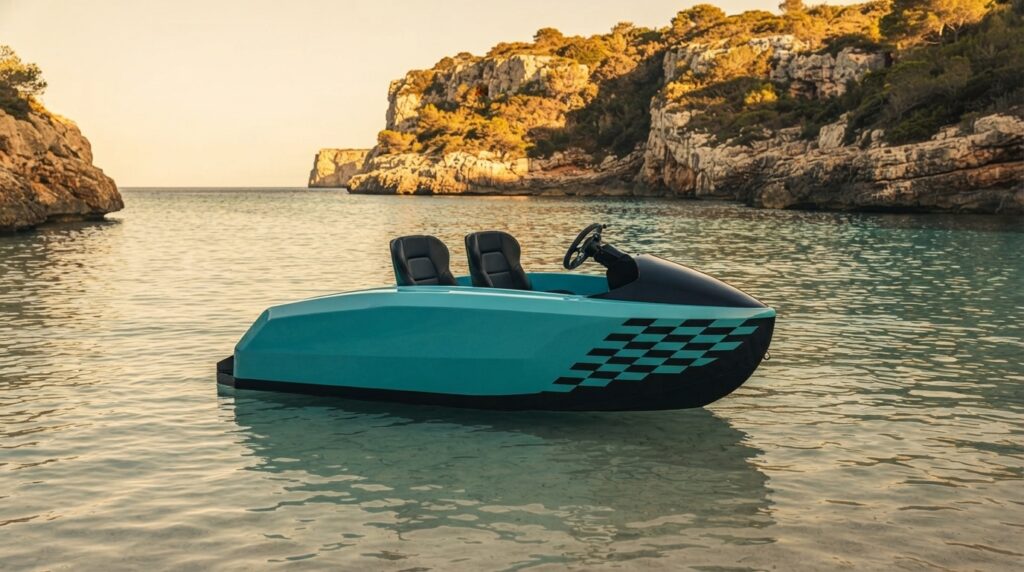
A lot of recreational boating decisions are made with a family of four or five in mind, which can make the process feel oddly mismatched for couples who mostly want to get out on the water together, just the two of them. Mini jet boats, by their inherent size and design, are naturally well matched to exactly this use case — and understanding why helps couples evaluate whether one genuinely suits their needs better than a larger, more generalist boat would.
It's a common instinct to buy a boat sized for the largest group that might occasionally use it, rather than the group that will typically use it. For couples whose boating is genuinely, predominantly a two-person activity — with larger group outings being the exception rather than the rule — this instinct often leads to buying more boat than is actually needed most of the time, at a real cost to the practical advantages smaller boats offer, discussed throughout the articles on hull weight, transport and manoeuvrability.
A mini jet boat sized appropriately for two people, rather than a larger boat kept mostly for the rare occasion a bigger group comes along, tends to deliver a better day-to-day ownership experience for couples whose boating really is a two-person activity most of the time.
As discussed in the dedicated article on beam width, this measurement has a direct effect on how much shoulder room and seating comfort two occupants actually experience. For couples specifically, it's worth paying attention to beam width and seating layout together, since a boat technically rated for two passengers can still feel cramped if the beam is narrow relative to the seating arrangement. Testing or carefully reviewing seating comfort with two adults aboard, rather than assuming any "two-person" rated boat will feel equally comfortable, is a worthwhile step before purchasing.
As covered in the article on how carrying a passenger changes range and performance, a boat's solo-rated performance and range figures shift meaningfully once a second person is aboard. For couples who will predominantly use the boat two-up, it's more useful to evaluate a boat's realistic two-up performance and range than its solo figures, since the solo figures may not reflect the couple's actual typical usage pattern at all.
This is worth specifically asking about or testing directly — a boat that feels lively and delivers generous range solo might feel considerably more modest two-up, and couples buying specifically for shared use should weight their comparison toward the two-up figures accordingly.
Many couples plan to share operating duties, rather than having one person exclusively at the helm. A boat's manoeuvrability, throttle responsiveness and low-speed handling — discussed in the articles on beam width, motor controllers and turning behaviour — all affect how easy and confidence-inspiring the boat is for a second, potentially less experienced operator to take the helm comfortably. A boat with smooth, forgiving low-speed control, as discussed in the motor controller article, tends to suit couples planning to share operating duties better than a boat tuned for maximum responsiveness at the expense of low-speed precision.
A few additional practical factors are worth considering specifically for couples:
It's worth being honest that not every couple's needs are met by the smallest available option. Couples who regularly host guests, plan to occasionally take out a small group of friends or family, or want extra deck space for gear on longer outings may find a boat slightly larger than the absolute minimum two-person size better suits their broader pattern of use. The key question remains matching the boat to genuinely typical use, whatever that turns out to be for a specific couple, rather than defaulting to either the smallest or largest option without deliberate thought.
Mini jet boats are naturally well suited to couples whose boating is predominantly a shared, two-person activity, offering a genuine match between boat size and typical occupancy rather than the common mismatch of buying for an occasional larger group. Paying specific attention to two-up performance and range, seating comfort for two, and manoeuvrability suited to shared operating duties — rather than relying on solo-rated figures or generic "two-person capacity" ratings — helps couples choose a boat genuinely matched to how they'll actually use it, most of the time, together.