
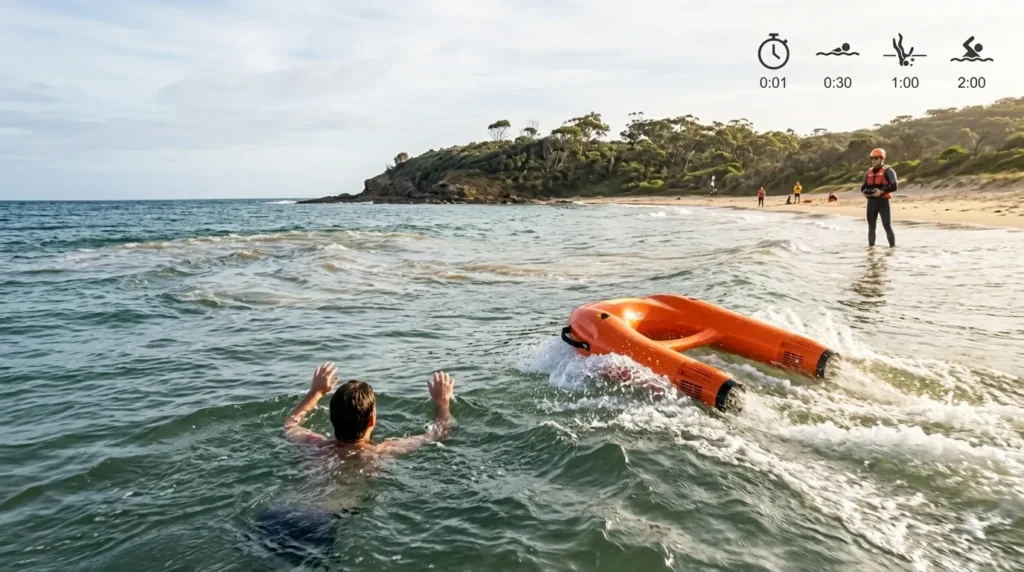
Most people imagine drowning as loud and obvious—arms waving, shouting, splashing. In reality, drowning is often quick, silent, and misunderstood. People in trouble may be vertical in the water, unable to call out, conserving breath, slipping under repeatedly. In surf, they may disappear behind waves. In rivers, they can be swept sideways and out of sight.
That’s why the phrase “minutes matter” is not a slogan. It’s a practical warning: the gap between trouble and tragedy can be short, and the first response often comes from whoever happens to be nearby.
In many Australian incidents, the timeline looks like this:
Professional rescue services are excellent, but they are not omnipresent. Even when a call is made immediately, response takes time: recognising the emergency, calling, dispatching, arriving, setting up, entering the water, reaching the casualty, and returning them to a safe place.
Remote Control Rescue Buoys are designed to target that critical gap: the time before help arrives.
The first minute is usually lost to confusion:
An RCRB reduces decision friction. It gives an immediate action:
That’s the core value: it makes the first response simpler and faster.
Throw rescues can be fast, but they depend on accuracy and conditions. In wind, surf, or current, a thrown device can miss. A rope can fall short. A bystander can misjudge distance.
An RCRB provides something different: controlled delivery. You can make corrections. You can follow drift. You can place the buoy beside the casualty. In many real-world environments, that control is what makes the difference.
A hard lesson in water safety is that bystanders drown trying to rescue others. Strong swimmers overestimate their ability. Clothes and shoes become dead weight. Cold water shocks the body. Currents overpower. Exhaustion arrives quickly.
A remote-control device helps keep the rescue chain safer:
Old rescue wisdom says: “Reach, throw, row, go”—in that order. RCRBs fit neatly into “throw” and “row” without the same limitations.
Rips often pull people away from shore. The casualty can’t make progress. Panic sets in. An RCRB can be driven directly into the rip, reaching the person faster than a swimmer fighting the same current.
Tidal flow can be deceptively strong, especially around sandbars. People get swept sideways. An RCRB can track and intercept drift.
Floodwater incidents are especially dangerous: debris, strong current, limited visibility. Entering the water is often a poor choice. A remote device can provide flotation without risking another life.
Falls from pontoons or boats happen quickly. The casualty may be injured, disoriented, or caught by current. A device can be launched immediately from the nearest safe edge.
Duty-of-care settings demand rapid response and risk control. A remote device can support staff response while lifeguards or trained personnel manage the recovery.
When someone is drowning, the body is fighting to breathe. Panic increases oxygen demand. Muscles seize. Coordination collapses. A person cannot “calm down” because they don’t have the oxygen to think.
Flotation changes the mental state almost instantly. The moment a casualty can rest their weight on something, their breathing can stabilise. That stabilisation alone can buy precious time until help arrives.
In an organised setting (council beach safety, club patrol, marina staff), the rescue works best when roles are clear:
RCRBs are most effective when used as part of that classic, disciplined approach.
Even trained rescuers fatigue. In surf, a board or ski rescue can be physically demanding. A remote device allows multiple attempts and repeated deployments without exhausting personnel, especially in multi-casualty or extended incidents.
If the purpose is first-response speed, then buyers should demand:
In short: the device must be treated like a fire extinguisher—not decorative, not forgotten, always ready.
If you are a club, council, resort, or marina, a sensible implementation includes:
Old-fashioned preparedness wins rescues. New tools simply extend what good organisations already do: plan, practise, maintain.
Remote Control Rescue Buoys matter because they solve the hardest part of many drownings: the early gap before professional rescue can physically reach the person. If you can deliver flotation in that gap—fast, safely, and repeatedly—you increase the odds of survival and reduce the chance that another would-be rescuer becomes a casualty.
In water rescue, you don’t get extra time. You earn it—by being ready, and by getting flotation there first.