
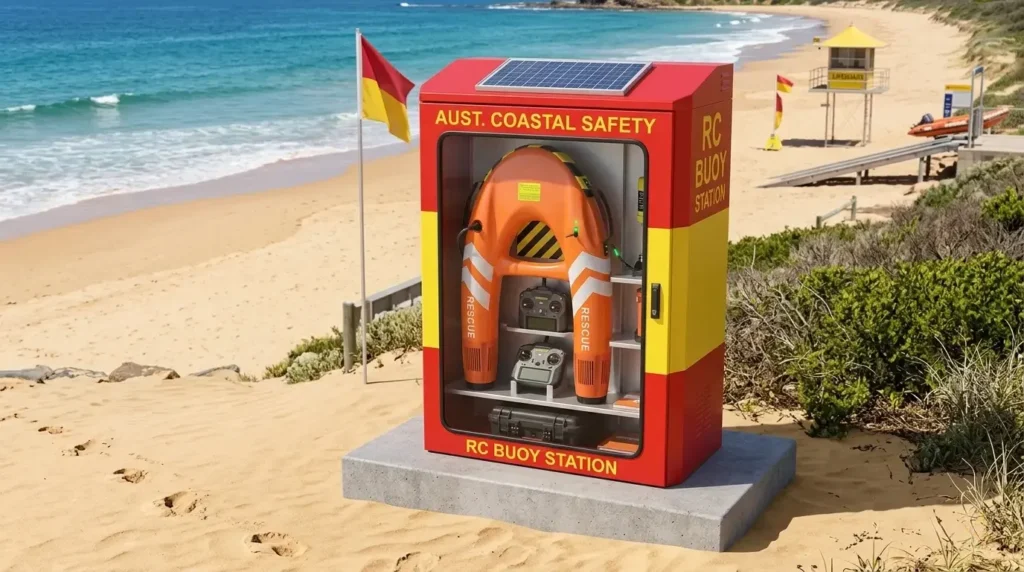
Remote Control Rescue Buoys (RCRBs) are increasingly recognised as a valuable addition to modern aquatic rescue capability. Much of the discussion surrounding these devices focuses on technical specifications such as speed, battery life, flotation capacity, and remote-control range. While these features are important, they do not, on their own, determine whether an RCRB will save a life.
In Australian conditions, the real effectiveness of an RCRB is determined by operational readiness — how well the device is planned, positioned, accessed, understood, and integrated into an existing rescue framework. This article examines deployment planning from a practical, operational perspective, with a focus on councils, Surf Life Saving Clubs (SLSC), government authorities, and emergency services operating across Australia’s diverse aquatic environments.
Australia has invested over decades in aquatic safety infrastructure, training, and education. The consistent lesson from coronial findings, safety reviews, and rescue reports is that time and access are decisive factors in survival.
A rescue device that is:
will not deliver its intended benefit, regardless of how advanced the technology may be. Operational readiness ensures that an RCRB transitions from being a “capability on paper” to a functional first-response asset capable of immediate deployment.
Australia’s aquatic risk profile is unlike that of most other countries. Deployment planning must account for:
Drowning incidents frequently occur outside patrolled hours, at unpatrolled locations, in calm-looking but hazardous water, or when bystanders attempt rescues beyond their capability. RCRBs are uniquely suited to this environment when they are already in place and immediately available.
Before placement decisions are made, authorities should clearly define the operational objectives of the RCRB deployment. In most Australian contexts, these objectives include:
Every deployment decision should support these outcomes.
One of the most common deployment errors is placing rescue equipment where it is convenient rather than where it is needed.
Historical incident data, rather than anecdotal assumptions, should guide placement decisions. In many cases, a single well-placed RCRB can cover multiple risk scenarios within a defined area.
Australian authorities typically choose between fixed-location deployment and mobile asset deployment.
| Deployment Model | Best Suited For | Primary Advantages |
|---|---|---|
| Fixed Deployment | Councils, public beaches, river access points, tourist precincts. | Immediate availability, predictable access, strong public visibility, consistent readiness. |
| Mobile Deployment | Surf Life Saving Clubs, marine rescue units, event safety teams. | Flexibility, targeted coverage, integration with active patrols. |
While mobile units offer flexibility, they rely on personnel being present. For many Australian locations, fixed deployment provides greater overall coverage, particularly outside patrol hours.
Access to an RCRB must be fast, intuitive, and stress-proof. During emergencies, fine motor skills and complex decision-making degrade rapidly. Best-practice access principles include:
Australian public safety frameworks generally accept that emergency access must never be slowed by over-engineering security, provided vandalism risks are managed sensibly.
A critical planning decision is whether the RCRB is intended for trained responders only, or trained responders plus members of the public. In many Australian drowning incidents, the first person on scene is not a professional rescuer. Public-access deployment allows for early flotation delivery, a reduction in unsafe swimming rescues, and immediate action while emergency services are contacted. Clear signage and education are essential to support this model, but experience shows that public empowerment saves lives when devices are designed correctly.
An RCRB should form part of a layered response system, not a standalone solution. Deployment plans should explicitly define:
This structured approach mirrors long-established Australian emergency response doctrine and reduces confusion during critical moments.
RCRBs do not require extensive training, but familiarity matters.
Training should focus on launch procedures, basic remote control handling, maintaining visual contact with the casualty, and safe recovery positioning. Short, practical sessions are sufficient to dramatically improve confidence and effectiveness.
An informed community becomes part of the rescue system. Public awareness initiatives may include:
Visibility alone can deter unsafe behaviour and encourage early reporting of incidents.
A deployment plan that ignores maintenance is incomplete. Routine checks should include:
Australian coastal environments are harsh. Salt, UV exposure, heat, and sand can degrade equipment quickly if not managed proactively.
Deployment planning must account for:
Protective enclosures and thoughtful placement significantly extend service life and ensure reliability when conditions are at their worst.
In regional Australia, emergency response times can extend significantly. In these areas, RCRBs often represent the only immediate rescue capability. Deployment planning for regional locations should prioritise self-contained operation, minimal reliance on infrastructure, clear public instructions, and strong visibility. For many councils, RCRBs offer an affordable way to meet duty-of-care obligations where traditional patrols are impractical.
Success should not be measured only by rescue counts. Other indicators include:
These qualitative outcomes reflect genuine improvements in public safety.
Proper deployment planning strengthens governance by demonstrating proactive risk management, supporting defensible safety decisions, reducing reliance on untrained rescues, and aligning with Australian workplace and public safety obligations. Clear procedures protect both organisations and individuals involved in rescue efforts.
Well-planned deployments allow for expansion as incident data evolves, integration with new technologies, incremental upgrades rather than replacement, and data-driven relocation if required. This conservative, staged approach reflects long-standing Australian public safety investment principles.
Remote Control Rescue Buoys are powerful tools, but tools do not save lives — systems do. In Australian conditions, where distance, unpredictability, and time pressure define aquatic emergencies, operational readiness determines outcomes. Strategic placement, intuitive access, basic training, routine maintenance, and integration with emergency protocols transform RCRBs from static assets into true first-response lifesaving systems. When deployment is planned properly, the RCRB is not simply present — it is ready. That readiness is what ultimately saves lives.