
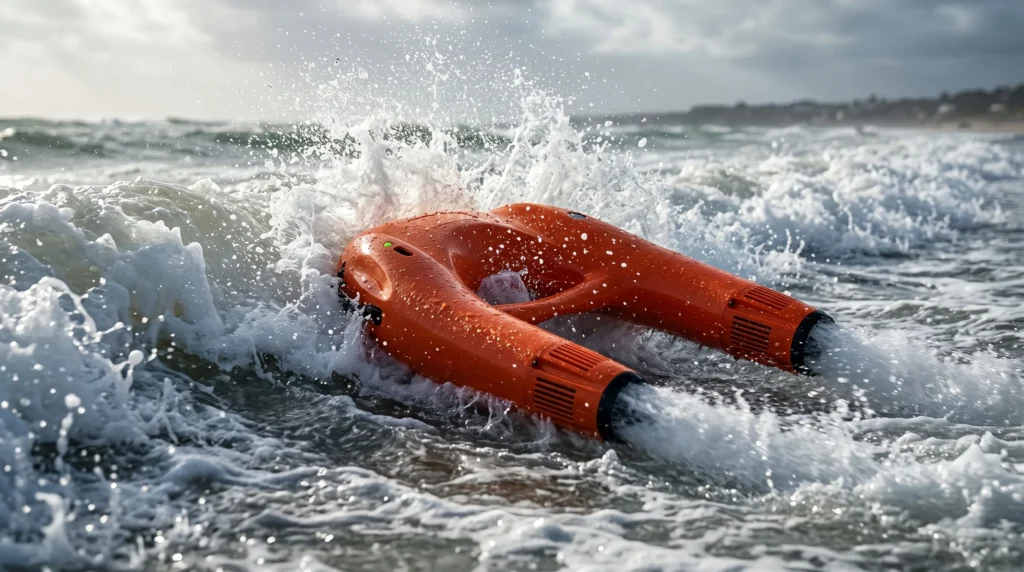
Remote Control Rescue Buoys (RCRBs) are often sold on numbers. Top speed. Motor wattage. Battery size. Remote range. On paper, these specifications appear to offer certainty and allow buyers to compare models objectively.
In reality, many of the most commonly advertised specifications are poor predictors of rescue effectiveness, particularly in Australian conditions. Worse still, an over-reliance on headline figures can lead organisations to select equipment that performs well in marketing material but underperforms when deployed in surf, rivers, and real emergencies.
This article strips away the marketing layer and examines which specifications genuinely matter, how they interact, and why speed alone is often the least important number in professional rescue decision-making.
Specifications are not inherently misleading. The problem arises when numbers are:
In rescue equipment, performance is system-based, not component-based. Speed, thrust, control, battery behaviour, and stability all interact dynamically. No single figure tells the full story. Australian buyers must therefore move beyond “spec sheet comparison” and understand what each number actually means operationally.
The majority of advertised speed figures for RCRBs are no-load speeds measured in calm water. This is a best-case scenario that rarely reflects rescue conditions.
In real rescues:
As a result, actual operating speed is often significantly lower than advertised top speed.
Speed only matters if it can be used effectively. In surf or fast rivers, excessive speed can:
Rescue outcomes depend on time-to-contact, not peak velocity. Time-to-contact is shaped by deployment speed, acceleration, control authority, and operator confidence — not headline speed figures.
Thrust is the force that moves the RCRB through water against resistance. It determines:
Unlike speed, thrust is rarely quoted clearly because it is harder to market and harder to measure in isolation.
Australian rescue environments frequently require RCRBs to:
In these scenarios, a unit with strong thrust but moderate top speed will outperform a faster unit with weak thrust.
Acceleration is the real-world manifestation of thrust. In rescues, acceleration matters because:
RCRBs that accelerate decisively reach victims faster despite lower top speeds.
Control is the most critical factor in rescue effectiveness — and the hardest to express numerically. Control encompasses:
A unit that is fast but difficult to control is slower in practice than a slightly slower unit with excellent handling.
Steering authority refers to how effectively a unit responds to directional input when external forces are acting on it. In Australian conditions, these forces include:
Effective steering authority allows operators to hold a precise line into rips, correct drift quickly, approach victims accurately, and maintain control when loaded. Steering systems that work well in calm water may lose authority entirely in aerated or turbulent flow.
Speed, thrust, and control cannot be evaluated independently. They form a triangle in which:
Professional-grade RCRBs are designed to balance all three — with control as the governing priority. This balance is what allows operators to use available power effectively rather than fighting the equipment.
Motor power is often advertised as a wattage figure. While useful, wattage alone tells little about rescue suitability. Two motors with the same rated power can behave very differently depending on:
In rescue contexts, usable torque at low and medium speeds matters far more than peak power output.
Torque determines how effectively power is converted into thrust. High torque enables:
Low-torque systems may achieve high speed in calm water but struggle once resistance increases. This is why torque-focused designs tend to outperform speed-focused designs in Australian rescues.
Power delivery is mediated by electronic controllers, not just motors and batteries. High-quality control electronics provide:
Poor electronics can cause lag between input and response, sudden power drop-offs, or inconsistent handling under stress. In rescue situations, unpredictability is unacceptable.
Battery capacity is commonly expressed as a runtime figure. However, capacity does not equal output capability. Rescue-relevant battery performance depends on:
A battery with large capacity but poor high-load performance may underperform during actual rescues.
How mass is distributed within an RCRB significantly affects control. Poor weight distribution can cause:
Well-balanced units maintain consistent handling across speed ranges and load conditions.
The instant a victim grabs the RCRB is the most revealing test of its design. At that moment:
Units that rely on speed rather than thrust and control often fail here — losing forward motion or becoming difficult to steer. Professional-grade units maintain controllability and progress even when heavily loaded.
In consumer markets, bigger numbers sell. In rescue equipment, bigger numbers can hide deficiencies. Examples include:
Australian buyers should always ask how specifications translate into behaviour in adverse conditions, not how impressive they look on paper.
For councils, Surf Life Saving Clubs, and emergency services, specifications are part of procurement defensibility. Decision-makers should seek:
Vague or evasive answers are red flags.
A practical approach to evaluating RCRB specifications includes:
This systems-based perspective aligns far more closely with rescue realities.
Australia’s surf and rivers punish misaligned design priorities. Units that rely on speed without thrust, power without control, capacity without output, or marketing without engineering will fail faster here than in calmer environments. This makes Australia an unforgiving but honest testing ground for rescue equipment.
Organisations that understand what specifications actually matter gain:
Those that do not risk investing in equipment that looks impressive but performs poorly when lives depend on it.