
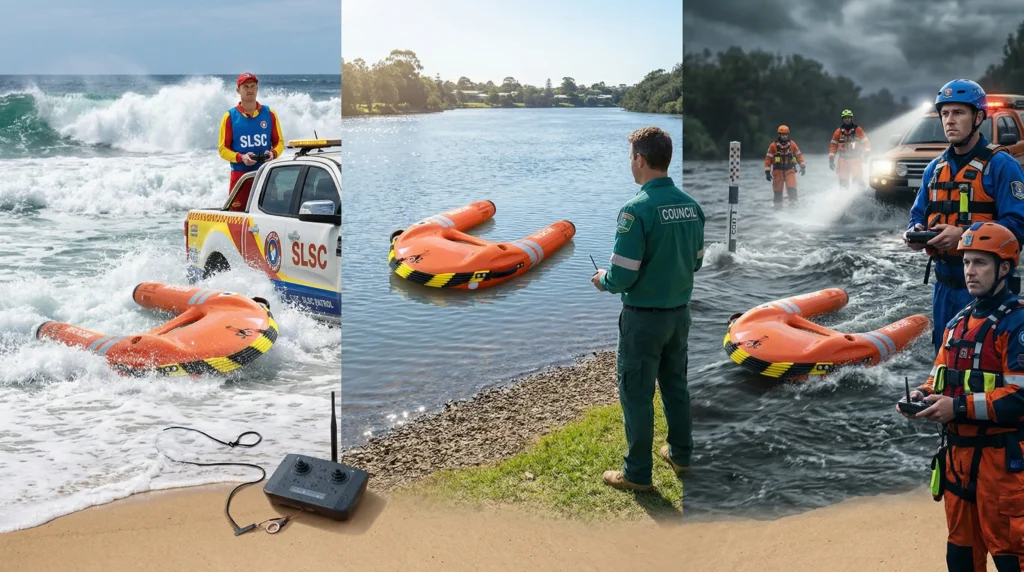
Remote Control Rescue Buoys (RCRBs) are now firmly established as legitimate rescue assets rather than experimental devices. However, the way they are purchased, justified, deployed, and governed varies significantly between Surf Life Saving Clubs, local councils, and emergency service organisations. Understanding these differences is essential, because the same piece of equipment can succeed in one environment and fail in another purely due to mismatched procurement expectations.
This article examines the buying considerations unique to Australian Surf Life Saving Clubs, councils, and emergency services, with a focus on governance, duty of care, operational reality, and long-term sustainability. It is written for decision-makers, committee members, procurement officers, and senior operational staff who must justify not only what they buy, but why they buy it.
An RCRB does not operate in isolation. It sits inside a system that includes:
A device that is technically capable but mismatched to organisational structure can create risk rather than reduce it. For this reason, buying considerations must begin with who is buying, not just what is being bought.
Surf Life Saving Clubs (SLSCs) operate in some of the most challenging rescue environments in Australia. They are also unique in that they are largely volunteer-based, with varying levels of experience, training frequency, and operational availability.
Key realities include:
For Surf Life Saving, an RCRB must integrate seamlessly into existing patrol operations without increasing cognitive load or decision delay.
An RCRB must be deployable by a single operator, quickly, without procedural complexity. If a device requires multiple setup steps or troubleshooting before use, it will be bypassed in real emergencies.
Controls must be immediately understandable, even for operators who have not used the device recently. Volunteer turnover means reliance on deep muscle memory is unrealistic.
Clubs must prioritise control and stability in broken water over headline speed figures. A unit that behaves unpredictably in whitewater undermines trust and slows adoption.
Training time is limited. A suitable RCRB allows meaningful competency to be achieved with realistic training hours and refresher intervals.
Surf clubs often lack specialist technicians. Equipment must tolerate sand, salt, and frequent handling, with straightforward maintenance routines.
Surf Life Saving operates under intense public scrutiny. Equipment decisions are often examined after incidents.
Clubs must therefore consider:
An RCRB that demonstrably reduces swimmer rescues by personnel entering the water strengthens both operational outcomes and governance defensibility.
Councils occupy a fundamentally different position. They are not rescue organisations per se, but they own and manage public spaces where water risk exists.
Councils are responsible for:
When councils invest in RCRBs, the decision is usually framed around risk reduction, not frontline rescue heroics.
Councils should focus on how an RCRB reduces risk exposure rather than chasing maximum performance metrics. Reliability, readiness, and predictability matter most.
In some deployments, councils may consider RCRBs as part of semi-public rescue infrastructure. This increases the importance of robustness, tamper resistance, and clear operating protocols.
Councils typically prefer solutions that do not require constant specialist oversight. Maintenance schedules must be realistic within council operational structures.
Council purchases are often subject to audit. Clear documentation, specifications, and standards alignment are critical.
Councils must consider total cost of ownership over years, not just initial purchase price. Cheap equipment that fails early creates political and financial risk.
If a council installs rescue equipment, it implicitly acknowledges awareness of water risk. That awareness creates obligation.
Councils must therefore ensure that:
Selecting professional-grade RCRBs with clear operating limits helps councils manage this exposure responsibly.
Emergency services operate under the highest expectations of reliability and accountability. When emergency services deploy equipment, failure is rarely tolerated.
Emergency services typically engage RCRBs in:
These environments are complex, unpredictable, and often life-critical.
Emergency services require equipment that performs repeatedly under high load and extended operations.
Equipment must integrate into formal operating procedures, asset registers, and maintenance systems.
Operators may receive more training than volunteers, but expectations are also higher. Equipment must reward skill without punishing minor errors.
RCRBs may be used alongside boats, helicopters, drones, and rescue swimmers. Control predictability and clear operating envelopes are essential.
Emergency services require assured support, parts availability, and clear warranty frameworks.
Emergency services must be able to answer:
Professional-grade RCRBs with documented performance characteristics support this requirement.
While Surf Life Saving, councils, and emergency services may purchase the same category of equipment, their drivers differ:
Understanding these distinctions prevents misaligned purchases.
All three groups face budget constraints. However, focusing solely on upfront price is one of the most common procurement errors.
Value should be assessed in terms of:
An RCRB that prevents even one rescuer injury or fatality justifies its cost many times over.
Training is not optional. The nature of training differs by organisation, but every buyer must consider:
A device that cannot be trained effectively within the organisation’s structure is a poor fit regardless of performance claims.
Rescue incidents attract attention. Equipment choices are scrutinised after events, not before them.
Organisations should consider:
Choosing well-designed, professional-grade equipment protects not just lives, but reputations.
The correct RCRB purchase is not about finding a “best” device in absolute terms. It is about finding the best fit for:
This strategic alignment is what separates successful deployments from well-intentioned but ineffective purchases.
From a Vector Watercraft’s perspective, RCRBs should be viewed as system components, not standalone devices. Their effectiveness depends on:
When Surf Life Saving Clubs, councils, and emergency services approach RCRB acquisition with this mindset, outcomes improve measurably.