
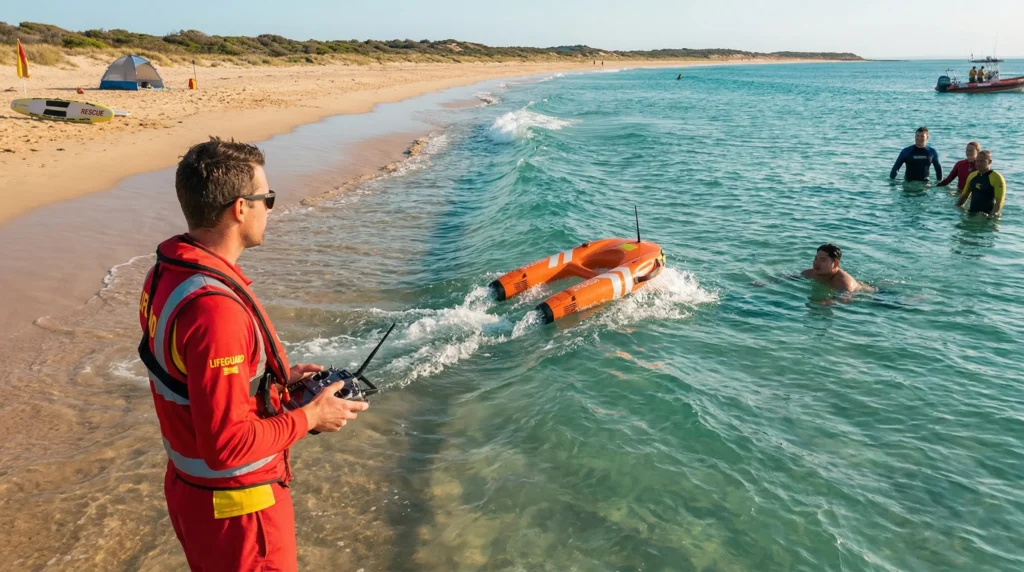
Remote Control Rescue Buoys (RCRBs) are only as effective as the people who deploy them. Unlike purely passive rescue equipment, RCRBs introduce a controlled, powered intervention into dynamic environments. This makes training not just important, but central to success.
In Australia, where RCRBs are increasingly adopted by Surf Life Saving Clubs, councils, emergency services, and professional event operators, the difference between success and failure is rarely the device itself. It is almost always the quality, realism, and consistency of training.
This article sets out a practical, Australian-specific framework for training staff to use Remote Rescue Buoys effectively — not as novelty tools, but as dependable, integrated rescue assets.
RCRBs are deceptively simple. From the outside, they appear to require little more than a remote control and line of sight. This simplicity can create false confidence.
In real rescues, operators must manage:
Without structured training, these factors compound rapidly. Poorly trained operators hesitate, over-correct, lose situational awareness, or abandon the device altogether. Well-trained operators, by contrast, use RCRBs decisively and confidently — achieving faster stabilisation and safer outcomes.
Effective RCRB training is not about turning staff into expert pilots. It is about achieving reliable operational competence. Core training objectives should include:
Competence means the operator can perform these tasks consistently under stress, not just during calm practice.
Australian rescue organisations operate under unique conditions that shape training requirements. These include:
Training programs must therefore be efficient, repeatable, scalable, environment-specific, and documentable. A training model that relies on frequent, long sessions or specialist instructors is rarely sustainable.
The first stage of training should focus on familiarisation, not mastery. Key elements include:
This stage should be conducted in controlled water to allow operators to build confidence without environmental distraction. However, familiarisation must be explicitly framed as insufficient for operational readiness to prevent complacency.
The next training phase should focus on control fundamentals. Operators must learn to:
Speed should be deliberately de-emphasised at this stage. Operators who learn to control first perform better when speed becomes necessary.
One of the most common training failures occurs at the moment of casualty contact. Operators must be trained to:
This requires scenario-based training, not just free driving. Training should explicitly address panic behaviour, including grabbing, pulling, and uneven loading.
Once a casualty engages the RCRB, handling characteristics change. Training must include:
Operators who have not experienced this during training often freeze or over-compensate during real rescues.
Training should follow a progressive exposure model:
Skipping steps increases risk and reduces confidence. Importantly, not all operators need to be trained to the highest environmental level; organisations should define deployment thresholds based on verified training levels.
Real rescues are stressful. Training that never introduces stress creates false confidence. Stress inoculation techniques include:
These elements should be introduced gradually and ethically, without compromising safety.
RCRBs do not operate in isolation. Training must include coordination with swimmers, board or IRB crews, shore-based coordinators, and incident controllers. Key integration skills include:
Poor integration can negate the time advantage RCRBs provide.
Not every staff member needs to be an RCRB operator. Effective organisations define clear roles, such as:
RCRB skills degrade without use. Australian organisations should plan for initial qualification followed by regular short refreshers, scenario-based drills, and seasonal re-certification. Short, frequent sessions are more effective than infrequent long ones.
Training must be documented, particularly for councils and emergency services. Records should include training dates, participants, scenarios covered, competency sign-off, and refresher schedules. This supports governance, audit, and incident review processes.
Training effectiveness should be measured by deployment time consistency, control accuracy under stress, casualty stabilisation speed, operator confidence, and a measurable reduction in unnecessary rescuer water entries.
Well-trained operators make fewer errors, hesitate less, and recover faster from unexpected events. From an organisational perspective, training reduces incident severity, lowers injury risk, strengthens the duty-of-care position, and improves public trust.
In rescue operations, training is not an overhead. It is a risk-reduction investment. From a VWC perspective, RCRBs deliver their full value only when embedded in competent human systems. Good equipment paired with strong training saves lives.