
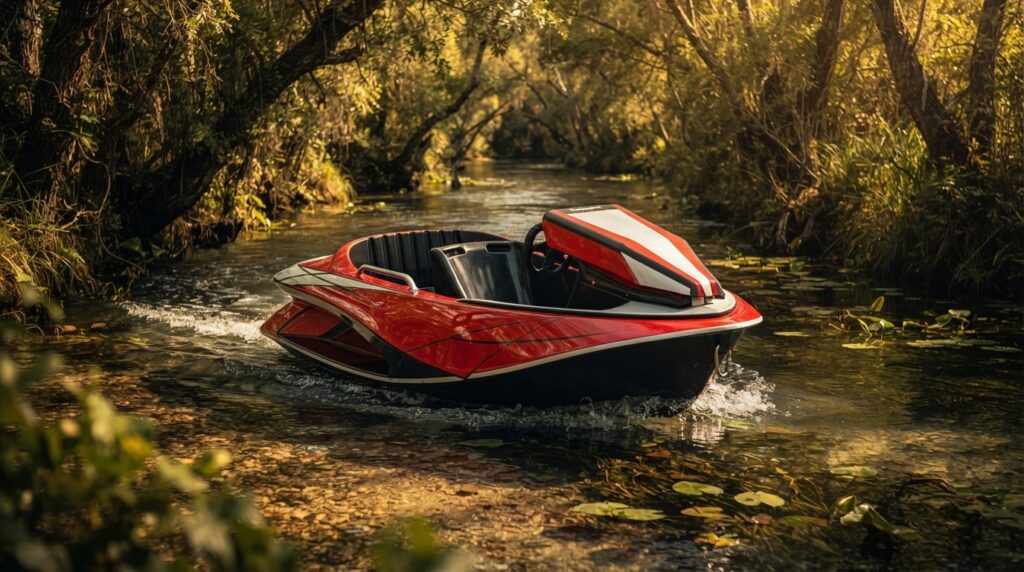
There's a particular kind of waterway exploration that larger boats simply can't do — nosing up a narrowing creek to see where it leads, following a river past the point where most boat traffic turns back, or ducking into a sheltered inlet too shallow or too tight for anything but the smallest craft. This is precisely the territory where mini jet boats earn their keep, and understanding why helps explain their growing popularity among Australians drawn to this kind of unhurried, exploratory boating.
It's a common assumption that a bigger boat means access to more of the water, but for river, creek and sheltered inlet exploration, the relationship often runs the opposite way. As discussed in the article on hull length and turning, a shorter, more manoeuvrable hull can navigate tighter bends, narrower channels and shallower stretches that a larger vessel would need to approach cautiously or avoid entirely. The waterway that "ends" for a typical runabout, at a certain narrowing or shallowing, often continues on quite a bit further for a genuinely compact craft.
This means a mini jet boat doesn't just offer an easier, more casual version of the same boating experience as a larger boat — it genuinely opens up different stretches of water altogether, including places many boat owners have simply never seen because their vessel was never suited to getting there.
Rivers and creeks frequently feature variable depth — sandbars, shallow riffles, submerged logs and debris — that pose a genuine risk to a conventional propeller-driven boat. As touched on in the article on fishing suitability, jet propulsion's lack of an exposed, submerged propeller considerably reduces this risk, allowing more confident exploration of shallower stretches that would otherwise require extreme caution or simply be avoided altogether.
This isn't a guarantee against all grounding or impact risk — care and attentive navigation remain essential in shallow or debris-prone water regardless of propulsion type — but it does meaningfully expand the range of water that can be explored with reasonable confidence.
Part of the appeal of river and creek exploration is the experience itself — spotting wildlife, enjoying a quiet, scenic stretch of water, or simply appreciating the change from the more open, busier waters most boating happens on. Electric propulsion's near-silent operation supports this experience directly, allowing a genuinely peaceful approach to quieter waterways without the noise of a petrol outboard disturbing birdlife, other water users, or simply the general tranquillity that makes this kind of boating appealing in the first place.
Exploring narrower, less-travelled waterways does come with some practical considerations worth planning around:
Sheltered inlets — the quieter bays, coves and backwaters tucked away from a river or bay's main boating traffic — offer a genuine sense of escape without requiring a long journey to reach genuinely remote water. A mini jet boat's manoeuvrability and shallow-water confidence make these inlets considerably more accessible than they would be to a larger boat, which often has to stay in the deeper, more open water that makes up the inlet's main channel.
This is part of why mini jet boats appeal particularly to owners looking for a low-key, restorative style of boating — the goal isn't necessarily to cover the most distance or reach the most dramatic destination, but to genuinely explore and enjoy quieter corners of familiar waterways that are otherwise easy to overlook.
One of the genuine pleasures of this style of boating is the gradual accumulation of local knowledge — which creeks are worth exploring at high tide, which sheltered inlets offer good anchoring for a picnic stop, which stretches of river open up into particularly scenic or wildlife-rich sections. This kind of knowledge builds naturally with a boat that's easy and low-friction enough to take out regularly, which connects directly to the broader appeal of mini jet boat ownership discussed in the article on riverfront and canal-side homes — a boat that's genuinely convenient to use gets used often enough to build this kind of familiarity with local waterways.
For anyone new to this style of boating, a sensible approach to a first exploratory outing includes:
Mini jet boats are particularly well suited to the specific pleasures of river, creek and sheltered inlet exploration — their compact size and shallow-water confidence open up stretches of water that larger boats simply can't reach, while quiet electric operation supports the genuinely peaceful experience that makes this kind of boating appealing. For owners drawn to unhurried, exploratory boating rather than simply covering open water at speed, this is one of the settings where a mini jet boat's specific strengths translate most directly into a genuinely enjoyable, distinctive experience.