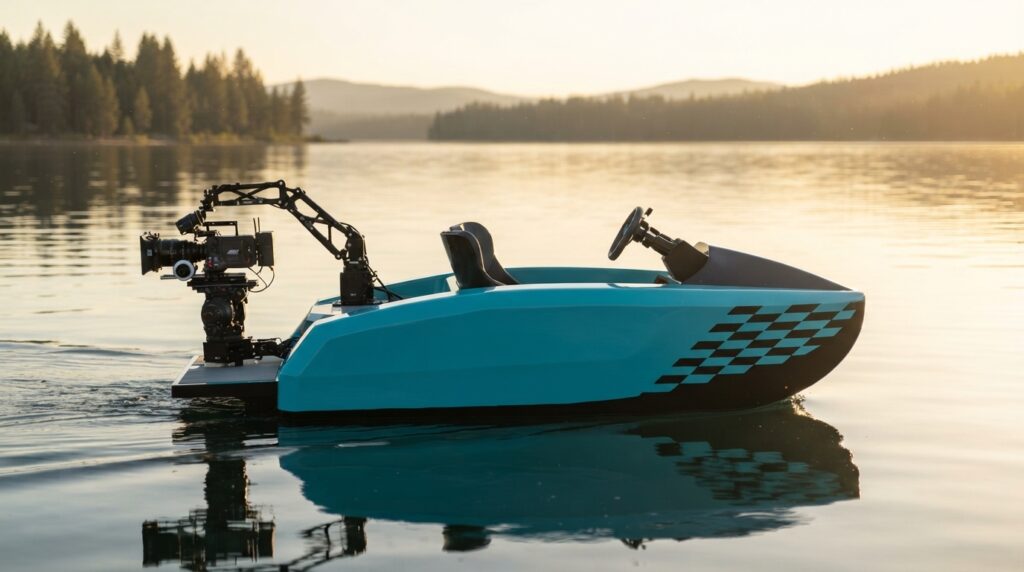
Water-based film and photography production has always faced a particular set of practical constraints — getting a camera operator, equipment and sometimes talent safely and reliably close to the action, without the production vessel itself becoming a visible or audible intrusion into the shot. Electric mini jet boats are increasingly being recognised by production crews as a genuinely useful tool for exactly this kind of work, for reasons that connect directly to the characteristics discussed throughout this series.
Traditional camera and production support boats are often larger vessels, chosen historically for their stability and equipment capacity, but they come with real drawbacks for certain kinds of water-based production work: petrol engine noise that can interfere with on-water audio recording or require extensive post-production cleanup, wake that can disturb the very water surface being filmed, and a larger visual footprint that can be difficult to keep out of frame during tight or intimate shots.
As discussed throughout this series, electric propulsion's near-silent operation offers a direct, practical advantage for film and photography work specifically. Productions capturing on-water audio, or filming scenes where ambient sound matters to the finished piece, benefit considerably from a support or camera boat that doesn't introduce a persistent engine noise into every take. This can meaningfully reduce the post-production audio work required, or in some cases enable genuinely usable production audio that would otherwise be compromised by a petrol vessel's noise.
As covered in the article on hull length and turning, a mini jet boat's tight turning radius and responsive handling support the kind of precise, repeatable positioning that camera work often requires — following a specific line alongside a subject, holding a steady position relative to moving action, or quickly repositioning between takes. This responsiveness can be a genuine practical advantage over a larger, less manoeuvrable vessel when a director or camera operator needs precise, repeatable positioning shot after shot.
The shallow-water access and manoeuvrability discussed in the article on river and creek exploration also translate into genuine production value — access to visually interesting, less conventional filming locations that a larger production vessel simply couldn't reach. Narrow river bends, shallow estuary flats, or tight inlet locations that offer distinctive visual character become accessible for productions willing to use a genuinely compact, capable support vessel.
For productions specifically filming water surface conditions, reflections, or scenes where a clean, undisturbed water surface matters to the shot, a mini jet boat's comparatively modest wake, discussed in the hull weight article, is a genuine practical advantage over a larger, heavier vessel that would disturb the water surface more significantly, particularly in tighter or more sheltered filming locations.
Mini jet boats can serve several distinct roles within water-based film and photography production:
Productions considering this category of watercraft for on-water work should think through a few practical factors specific to production logistics:
As awareness of electric mini jet boats grows within the film, television and commercial photography industries, this category of watercraft is likely to see increasing use for the specific kind of production work where its combination of quiet operation, manoeuvrability and shallow-water access offers a genuine practical advantage over traditional camera boat options — while remaining a complementary tool rather than a wholesale replacement for larger vessels in productions requiring greater equipment capacity or open-water capability.
Electric mini jet boats offer genuine, practical advantages for film, photography and media production work on water — quiet operation supporting cleaner production audio, manoeuvrability enabling precise camera positioning, shallow-water access opening up distinctive filming locations, and reduced wake supporting cleaner water surface shots. For production companies and crews working on water-based content, understanding and considering this category of watercraft as a genuine production tool, rather than defaulting purely to traditional camera boat options, can open up creative and practical possibilities that conventional petrol-powered vessels simply can't offer in the same way.