
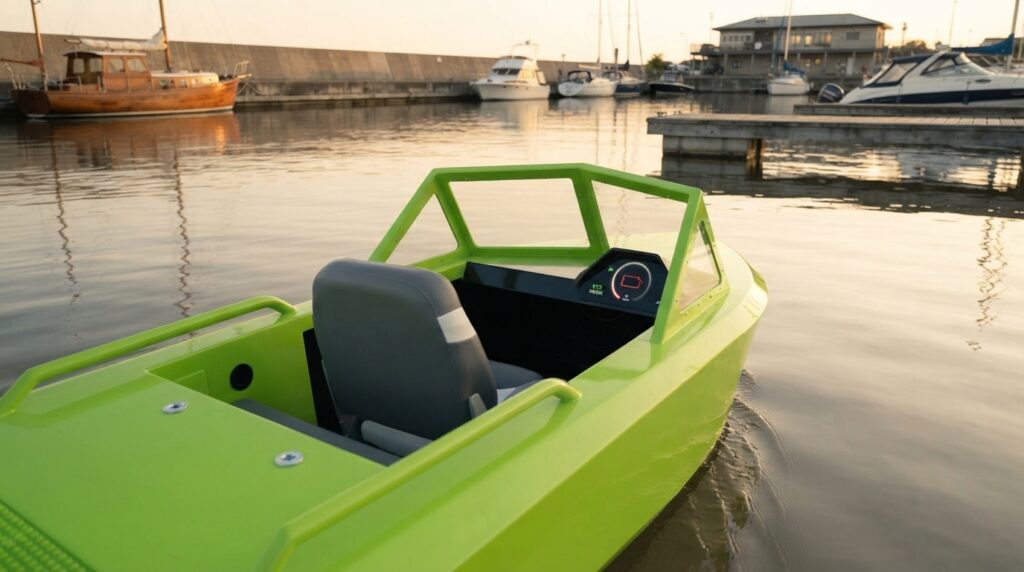
One of the more common questions from prospective and new electric mini jet boat owners is what actually happens if the battery runs low while still out on the water — a genuinely reasonable concern for anyone used to the more familiar experience of a petrol tank simply running dry. The good news is that a well-designed electric mini jet boat handles a low battery in a considerably more graceful, predictable way than most people expect, with several stages of warning and moderated performance built in well before any genuine risk of being stranded.
Rather than delivering full power right up until the battery is completely empty and then abruptly cutting out, well-designed systems generally use a staged approach: a first, gentle notification at a moderate remaining charge level, flagging that it's worth being mindful of the return journey; a more prominent warning at a lower level, suggesting it's time to genuinely start heading back; and a final, more conservative power-limiting stage at a genuinely low level, deliberately reducing speed and acceleration to preserve enough charge for a safe, controlled return.
A sudden, complete loss of power while underway — particularly at speed or in less sheltered water — would represent a genuine safety concern, potentially leaving a rider without steerage at a hazardous moment. Gradual power limiting gives continued control and manoeuvrability at reduced performance, allowing a deliberate return rather than an abrupt loss of propulsion. A boat behaving this way is functioning exactly as intended, not malfunctioning.
Most systems noticeably reduce both top speed and acceleration in the final stage, sometimes quite significantly. This can feel like a surprising step down if you haven't experienced it before. Understanding this as a genuinely helpful safety feature, and familiarising yourself with your boat's specific behaviour, helps you recognise it correctly rather than being caught by surprise.
Warning thresholds are typically set with a genuine safety margin, meaning there's usually still meaningful reserve capacity remaining once you reach the warning stages — not the absolute final moment before failure. That said, this margin exists as a safety buffer, not an invitation to routinely ride until the last possible moment. Treating early warnings as a genuine prompt to head back is both safer and, as discussed in earlier articles, better for the battery's long-term health.
In most well-designed systems, the boat will lose propulsion entirely once truly depleted, though basic safety systems like lights may continue functioning for some period depending on the design. This underscores why carrying basic safety equipment — a paddle or alternative propulsion, a means of calling for assistance, appropriate flotation devices — remains just as important for an electric mini jet boat as any other vessel, even though genuinely running out should be a rare, avoidable event given the warning systems in place.
Most modern boats provide a real-time range or remaining-distance estimate beyond a simple percentage indicator. This is inherently somewhat approximate but gives considerably more actionable information than a bare percentage. Estimates typically become more accurate as a ride progresses, since the system has more real-time consumption data to work with.
Experienced riders often develop an intuitive sense for subtle changes in throttle response as charge runs low, even before a formal warning triggers. This is considerably less reliable than the formal system and shouldn't be relied on as a primary safety strategy, but it's a genuine supplementary awareness that builds naturally over time.
For groups riding together, it's worth planning around the most range-limited boat rather than assuming everyone reaches low charge simultaneously — particularly relevant when mixing different power tiers, since a 70kW boat's occupant may have considerably more remaining range at any given point than a 15kW boat's occupant.
A petrol engine typically provides very little advance warning before running dry, and stops abruptly and completely once it does, with no equivalent reduced-power stage. In this specific respect, a well-designed electric mini jet boat's staged handling arguably offers a more graceful, controlled experience than the traditional petrol equivalent.
A first, gentle notification means begin factoring your return into your remaining plans, without necessarily turning back immediately if it's well within a comfortable margin. A more urgent, second-stage warning is worth treating as a firmer prompt to head back directly, without further delay. Respecting this escalation as intended is the core skill this whole system supports.
The specific percentages and power-limiting behaviour at each stage vary between manufacturers, reflecting genuine differences in battery management design philosophy and how conservatively thresholds are set. This is why understanding your own specific boat's documented behaviour matters more than assuming a generic industry standard.
For new owners, it's worth considering a deliberate, low-risk familiarisation outing early in ownership — close to home, calm conditions, no time pressure — specifically to experience each warning stage firsthand rather than encountering it for the first time on a longer, more consequential outing.
Genuine emergency preparedness extends well beyond understanding your battery management system — checking conditions before heading out, informing someone of your plans, carrying appropriate communication equipment, and understanding basic self-rescue procedures are all part of sound general boating practice regardless of how well-designed the low-charge handling is.
A well-designed electric mini jet boat handles a low battery through a deliberate, staged approach specifically designed to give riders ample time and continued control to respond sensibly, well before any genuine risk of being stranded. Understanding this behaviour, treating early warnings as genuine prompts, and planning with a sensible reserve margin all but eliminate the risk of ever genuinely running out of charge on the water.
Vector Watercraft supplies fully assembled electric mini jet boats to the Australian market, engineered with a clear, staged low-charge warning and power-management system. Backed by a 2-year warranty and dedicated after-sales support, Vector Watercraft provides clear documentation on exactly how each model's low-charge behaviour works.
I need 17 on right
Fast charging is a genuinely appealing feature for electric mini jet boat owners — the ability to top up a battery considerably quicker than standard household charging allows can transform how flexibly a boat fits into a busy day. But like most genuinely useful trade-offs, fast charging isn't simply a strictly better version of standard charging. It comes with real benefits, genuine risks, and a meaningful relationship to long-term battery health that's worth understanding properly before deciding how heavily to rely on it.
Fast charging generally refers to delivering a meaningfully higher rate of power to the battery than a standard household outlet can provide — often achieved through a higher-capacity charger accessory, a dedicated higher-power circuit, or three-phase power where available. The higher the power delivered, the faster a given amount of energy can be pushed into the battery, all else being equal.
"Fast" and "standard" aren't strictly defined, universal categories — what counts as fast charging for one manufacturer might be closer to standard for another. The genuinely important distinction isn't the label, but the underlying principle: charging at a meaningfully higher rate than baseline involves real trade-offs worth understanding regardless of exactly where that line falls for your specific boat.
Reduced downtime between outings — spending less time waiting for a charge, which matters for owners wanting multiple outings in a single day.
Greater flexibility for spontaneous plans — shrinking the planning window a standard overnight or daytime charge would otherwise require.
A useful buffer for unexpectedly heavy use — an unplanned second outing, or wanting to top up before an occasion where maximum range genuinely matters.
Increased heat generation and cell stress. Charging at a higher rate generates more heat and places more instantaneous stress on individual cells than the same charge delivered gradually — the core reason fast charging carries a genuine, if generally modest, long-term battery health trade-off.
Potentially accelerated long-term capacity fade with habitual use. The genuine concern isn't occasional fast charging, which well-designed systems handle safely, but habitual, default reliance on it over an extended period.
Cost considerations. Fast charging typically requires a dedicated charger accessory or a higher-capacity circuit installed by a licensed electrician — genuine additional cost beyond the boat's base price.
Temperature-related limitations still apply. A battery already elevated in temperature from hard use or hot ambient conditions will typically have its charging rate automatically moderated regardless of the charger's maximum capability.
A well-designed battery management system doesn't allow unrestricted fast charging regardless of conditions — it actively monitors temperature, state of charge and overall condition throughout, moderating the actual rate as needed. This means the practical risk of acute damage from a single fast-charging session is generally low. The more relevant concern is the cumulative effect of consistently choosing the higher-stress option over an extended period, when standard charging would have worked just as well.
Use fast charging when you genuinely need it — an unplanned second outing, a tighter-than-usual window, or a specific occasion needing meaningfully more range without the luxury of a full standard charge window.
Default to standard charging for your typical, planned routine — the normal overnight or comfortable daytime charge, where there's no genuine time pressure.
This captures the real value fast charging offers without accepting the cumulative trade-off of using it as an everyday default.
An owner who rides once or twice a week with ample charging time available most occasions may find dedicated fast charging infrastructure delivers limited genuine value. An owner who rides frequently, sometimes multiple times a day, or has a genuinely tighter schedule, is likely to find it delivers considerably more frequently-used value, potentially justifying the cost more readily.
Fast charging is one factor among several determining overall battery longevity. An owner who fast charges occasionally but otherwise follows sensible moderate charging levels, avoids habitual deep discharge, and manages temperature and storage thoughtfully is likely to see considerably better outcomes than an owner who fast charges habitually while neglecting these other practices.
When current flows into a battery during charging, some resistance within the cell converts a portion of that electrical energy into heat rather than useful stored charge — a basic characteristic of how batteries function. The rate of heat generation increases disproportionately as charging current increases, meaning doubling the charging rate typically increases heat generated by considerably more than double. This is why fast charging isn't simply "the same process but quicker" — it's meaningfully different in terms of internal heat and stress, even though the end result looks identical.
Manufacturers vary considerably in how they've approached fast charging capability. Some design battery systems with fast charging as a core, fully supported capability, incorporating more robust cooling specifically to handle the additional heat gracefully. Others offer it as a secondary option layered onto a system primarily designed around standard charging, with potentially less sophisticated thermal management. Asking directly whether fast charging was a core design consideration or a secondary capability gives useful context for how much weight to place on manufacturer claims about its safety and impact.
A weekend rider with the boat charged overnight has essentially no genuine need for fast charging in their typical routine, but might reasonably reach for it on the rare occasion of an unplanned second outing. An owner running occasional guided tours, needing to turn the boat around multiple times a day, represents a genuinely different use case where fast charging becomes a central, frequently-used part of the operation — for this owner, investing properly in fast charging infrastructure and accepting the somewhat greater cumulative trade-off makes considerably more practical sense.
It's worth checking whether your manufacturer's warranty terms treat fast charging any differently from standard charging. Some manufacturers fully support it with no special conditions, provided genuinely compatible equipment is used. Others specify conditions — a maximum recommended frequency, or a requirement to use only approved accessories — with warranty coverage potentially affected if not followed. This is worth clarifying directly and in writing before purchase, particularly if you anticipate relying on it more than occasionally.
It's worth distinguishing between a manufacturer-approved fast charger, tested specifically for compatibility with your boat's battery management system, and a generic third-party accessory that might superficially appear compatible but hasn't been validated. Using an uncertified charger carries genuine risks beyond the standard trade-offs — including the charger and battery management system not communicating correctly about safe parameters. Sourcing fast charging equipment directly from your manufacturer, or a source they specifically recommend, is meaningfully safer than a cheaper generic alternative matched purely on power output specifications.
As electric mini jet boats become more common, some marinas, boat ramps and caravan parks are beginning to explore higher-power charging infrastructure for this kind of use. Where genuinely available, it can offer meaningful convenience for owners travelling away from home. It's worth approaching any public or third-party infrastructure with the same caution discussed above — confirming compatibility where possible rather than assuming any available higher-power outlet is automatically safe to use.
Fast charging offers genuine, valuable benefits — reduced downtime and greater flexibility — but comes with a real, if generally modest, trade-off in increased heat generation and cell stress that can meaningfully affect long-term battery health if relied upon habitually rather than used when genuinely needed. The most sensible approach keeps fast charging available for situations that genuinely call for it, while defaulting to gentler standard-rate charging for typical, planned sessions.
For the great majority of recreational owners, this is a genuinely minor consideration relative to other factors covered throughout this series — choosing the right power tier, riding within your genuine skill level, and following sensible general charging and storage habits all have a considerably larger cumulative influence on your overall experience and battery health. Fast charging is a genuinely useful tool worth understanding properly, but it shouldn't become a source of ongoing anxiety for owners who use it sensibly and occasionally.