
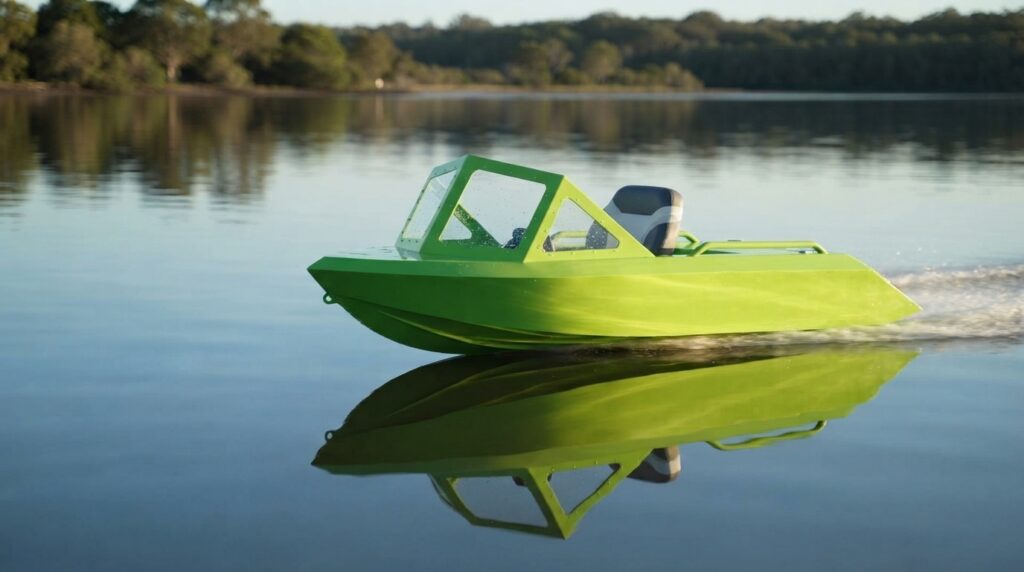
A mini jet boat is a small thing by design. Most models on the market today run somewhere between 1.8 and 2.5 metres in length — a single-seat, jet-ski-like hull that fits in the tray of a ute or the back of a large SUV, with no trailer, no boat ramp queue and no towing endorsement required. That compactness is the whole point of the category, and it is also the reason electric propulsion has moved from a novelty to the obvious default for this class of watercraft faster than almost anywhere else in recreational marine equipment.
To understand why, it helps to start with what a mini jet boat is actually being asked to do, and how differently a petrol drivetrain and an electric drivetrain go about doing it.
Petrol-powered personal watercraft were designed around internal combustion because, for decades, there was no realistic alternative. A small two- or four-stroke engine, a fuel tank, an exhaust system, a cooling loop and an intake all have to be packaged inside a hull, and in a full-sized jet ski there is enough volume to do this without much compromise. Shrink that hull down to under two and a half metres, though, and the packaging problem changes shape. Every litre of fuel tank, every centimetre of exhaust routing and every kilogram of engine block is now competing directly with rider space, battery-equivalent stowage and the buoyancy margin the hull needs to stay stable at speed.
Electric propulsion sidesteps most of that problem. A brushless electric motor driving a jet pump has a fraction of the moving parts of a combustion engine — no pistons, no valves, no exhaust, no spark plugs, no fuel system, no gearbox in the conventional sense. What replaces all of that is a motor, a controller, a battery pack and a jet impeller, and all four of those components pack far more efficiently into a compact hull than an equivalent petrol drivetrain does. That is the first reason electric has become the natural fit for this specific format: it is not that electric is simply "better" everywhere, it is that the mini jet boat's small hull rewards a drivetrain with fewer, denser components, and that is precisely what electric propulsion offers.
The most persistent misconception about electric watercraft is that going electric means giving something up in performance. In practice the opposite is often true, at least in the way that matters most on the water. Electric motors deliver full torque from zero RPM, which on a jet-driven hull translates into immediate, linear acceleration the moment the throttle is applied — no flat spot while a petrol engine builds revs, no lag while a torque converter or gearbox catches up. Riders typically describe it as a smoother, more controlled kind of power delivery: strong and continuous rather than a sudden surge followed by a plateau.
Current mini jet boat platforms on the Australian market illustrate the range this now covers. Entry-level single-seat models are commonly built around a 15 kW motor on a 48 to 72 volt system, capable of around 40 to 50 km/h depending on load and mode, while performance-oriented platforms extend to 25 kW and beyond, with some ranges now offering dual-mode output as high as 72 kW across their line-up and top speeds pushing past 55 to 60 km/h. That is comfortably in the same performance bracket as a small petrol jet ski, and in a hull this size, the instant torque of an electric motor often makes it feel quicker off the mark than the numbers alone suggest.
The heart of any electric mini jet boat is its battery pack, and this is where the difference between a well-engineered platform and a poorly engineered one becomes most obvious. The category has settled almost universally on lithium battery chemistry — typically a ternary lithium or lithium-ion pack in the 3 to 5 kWh range for entry-level craft — chosen for its energy density relative to weight, since every kilogram of battery in a 1.8 to 2.5 metre hull has a proportionally larger effect on handling and buoyancy than it would in a larger boat.
Two things matter more than the raw kWh figure once you are comparing platforms: thermal management and water ingress protection. Running a 15 to 25 kW motor continuously through a jet pump generates real heat, and the better-engineered platforms pair the motor with an active water-cooling circuit rather than relying on passive air cooling, which allows sustained high-speed running without the power derating that a hot motor would otherwise force. Water ingress protection is the second, and arguably more important, differentiator. A battery and controller sitting low in a small hull, close to spray and occasional swamping, needs a proper IP-rated enclosure and a battery management system that can isolate the pack the moment a fault is detected. This is not a cosmetic spec — it is the difference between a boat that survives years of Australian conditions, from saltwater coastal use to dusty inland lakes, and one that fails quietly within a season or two.
Hull construction has diversified alongside the electric drivetrain. Where an early generation of these boats leaned heavily on ABS or HDPE rotational-moulded plastic for cost and simplicity, the current range spans that same lightweight polymer construction through to composite polymer builds and marine-grade aluminium hulls, the latter chosen specifically for the combination of low weight and structural rigidity that suits a jet-propelled, electrically powered platform. The right material depends on how the boat will be used — a rotomoulded hull is forgiving of the odd knock at a rental fleet or lake resort, while an aluminium hull suits an owner chasing sharper handling and a longer service life.
Where electric propulsion earns its keep most obviously, though, is not on the water at all — it is in everything that happens between rides. A petrol outboard or jet-ski engine comes with a servicing schedule: oil changes, spark plugs, fuel filters, impeller checks, carburettor or injector cleaning, and the seasonal ritual of stabilising or draining fuel before a boat sits idle over winter. Skip enough of that and the engine tells you about it, usually at the worst possible moment.
An electric drivetrain removes almost all of it. There is no oil to change because there is no oil. There is no fuel system to maintain because there is no fuel. There are no spark plugs, no carburettor, no exhaust to corrode, and no winterisation ritual beyond storing the battery at a sensible charge level. What remains is closer to the maintenance profile of a well-built electric bicycle than a marine engine: keep the hull clean, keep the electrical connections dry and corrosion-free, and charge the battery through a normal cycle. For an owner who wants to use the boat on a warm Saturday afternoon without a pre-season service appointment, that difference in ongoing effort is not a minor convenience — for many buyers it is the decisive factor in the purchase.
This also reshapes the economics of ownership over time. Petrol is a recurring cost that scales with use and fluctuates with fuel prices; electricity, particularly for an owner charging from home power, is markedly cheaper per hour of running time and far more predictable. Servicing costs follow the same pattern — fewer components subject to wear means fewer receipts from a marine mechanic across the life of the boat. None of this means an electric mini jet boat is free to own; batteries are a wear item with a finite cycle life, typically rated at several hundred charge cycles before capacity begins to noticeably decline, and that eventual replacement should be part of any honest ownership calculation. But set against a petrol engine's ongoing consumables and servicing bill, the total cost of ownership curve for a well-built electric platform tends to be considerably flatter.
It is worth being direct about the trade-off electric propulsion does bring, because pretending otherwise does buyers no favours: run time is shorter than a full tank of petrol, and topping up is not a two-minute stop at a bowser. A typical entry-level battery pack delivers somewhere between 30 and 90 minutes of run time depending on how hard the throttle is used, with lighter, lower-speed cruising extending that considerably further than sustained wide-open running. For most recreational use — an hour or two on a lake, a session pulling a small tube, an afternoon at a family gathering — a single charge or a spare battery swap comfortably covers the day. For an owner planning back-to-back hours of continuous high-speed running, a second battery pack, charged in advance, is the practical answer, and it is one of the first questions worth asking a supplier before buying.
Charging itself is straightforward on a domestic power supply, typically drawing from a standard household outlet over several hours, which suits the way most owners actually use these boats: charge overnight, load the boat in the morning, and head to the water without needing a marina fuel dock at all. That last point matters more than it might first appear — one of the genuine advantages of the compact, electric mini jet boat format is that it removes the boat ramp and the trailer from the equation entirely for many owners, since a sub-70 kilogram hull can be lifted into a ute tray by two people and launched from a beach or a jetty rather than a formal ramp.
Because a mini jet boat is still classified as a personal watercraft in the eyes of Australian maritime law, the same licensing framework that applies to a full-sized jet ski generally applies here too, and it is worth understanding before, not after, a purchase. The requirements differ meaningfully from state to state. In New South Wales, a PWC driving licence is required to operate one at any speed, in addition to a general boat licence. Queensland similarly requires a PWC licence, or the presence of a licensed operator on board, from the age of sixteen. Victoria requires a marine licence with a PWC endorsement, and that endorsement can no longer be issued to a restricted or provisional licence holder — it applies to riders sixteen and over. Western Australia requires a Recreational Skipper's Ticket. South Australia and Tasmania each have their own frameworks worth checking directly with the relevant state maritime authority, and the Northern Territory remains the one jurisdiction without a recreational PWC licensing requirement at all. A correctly fitted AS 4758 Level 50S lifejacket is mandatory for every person on board, in every state, regardless of licensing status.
None of this changes because the propulsion happens to be electric rather than petrol — a mini jet boat is still a powered vessel on the water, and it is still subject to speed limits, restricted zones such as swimming areas and marine parks, and the same common-sense rules around alcohol and safe operation that apply to any other watercraft. Buyers who assume the smaller, quieter, electric format sits outside these rules are mistaken, and a reputable supplier should make that clear at the point of sale rather than leaving a new owner to discover it from a maritime officer on the water.
There is a genuine environmental argument for electric propulsion in this category, and it is worth stating without overselling it. A small petrol engine running at high RPM in shallow, often sheltered water — lakes, estuaries, canal systems, the kind of protected water a mini jet boat is frequently used on — is not a trivial source of localised exhaust and fuel residue, particularly across a fleet of boats used repeatedly in the same confined area. Removing the combustion engine removes that source entirely at the point of use. It does not make the boat's total environmental footprint zero; battery manufacturing and end-of-life disposal carry their own considerations, and the electricity used to charge it is only as clean as the grid it comes from. But for the specific, common use case of recreational boating on inland lakes and sheltered coastal water, the shift from a two-stroke or small four-stroke engine to an electric drivetrain is a straightforwardly cleaner outcome at the water's edge, which matters both to the immediate ecosystem and to the growing number of local authorities taking a closer look at emissions and noise on popular waterways.
Because the mini jet boat category spans everything from a single-seat weekend toy to a commercial rental fleet asset, the right electric platform looks different depending on who is buying it and why, and this is where the specification sheet needs to be read against the intended use rather than against the biggest number on the page.
A family buying their first boat for a lake house is usually better served by a lower-powered, single-seat platform in the 15 kW range, built on a rotomoulded or composite polymer hull that can absorb the odd bump from a learner without expensive repair. Stability and predictable throttle response matter more here than outright top speed, and the running costs of a smaller battery pack suit occasional, seasonal use. A rider chasing sport performance, on the other hand — someone who already owns a jet ski and wants a smaller, sharper, more agile electric equivalent — is better matched to the higher-output end of the range, where 25 kW motors, dual-speed modes and a lighter aluminium hull deliver the kind of acceleration and handling that a casual rider simply does not need and would find harder to control.
Commercial and rental operators sit in a category of their own. A boat that is going to be launched, ridden hard, and re-launched by a different, often inexperienced rider several times a day needs to be judged less on peak performance and more on how forgiving and repeatable it is under repeated stress — battery swap speed between sessions, the robustness of the hull against fenders and other boats at a jetty, and how easily a damaged component can be sourced and replaced without taking the boat out of service for weeks. This is precisely where the gap between a properly engineered platform and a lightly adapted one shows up fastest, because a rental fleet exposes every weakness in a battery enclosure or a motor mount within the first season, not the tenth.
None of this is a reason to default to the most expensive model in a range. It is a reason to have an honest conversation with a supplier about how the boat will actually be used — how many hours a week, in what water conditions, by which riders — before deciding which motor output, hull material and battery configuration actually earns its price, rather than assuming that more power or a bigger number on the spec sheet is automatically the better buy.
Everything above explains why electric has become the default assumption for a modern mini jet boat. It does not mean every electric mini jet boat on the market is equally well built. The category has grown quickly, and the gap between a genuinely engineered platform — proper thermal management, a real IP-rated battery enclosure, a battery management system built for marine conditions, a hull material matched to its intended use — and a lightly adapted novelty product is wide. A poorly built electric boat, with an underspecified motor pushed too hard or a battery enclosure that was never really designed for water exposure, can underperform a good petrol equivalent, both in longevity and in the moments that matter most, like a battery fault at speed.
That is really the question a serious buyer should be asking today. It is no longer "should I consider an electric mini jet boat instead of a petrol one" — for this size and class of watercraft, the electric drivetrain's advantages in packaging, torque delivery, ownership cost and low-water-impact use are compelling enough that the question has largely answered itself. The real question is which electric mini jet boat is engineered well enough to be worth owning for the next decade: which manufacturer has actually solved the thermal and water-ingress problems that a small, high-output electric platform presents, rather than simply fitting a motor and battery into a hull and calling it done.
Vector Watercraft is Australia's specialist supplier of electric mini jet boats, assessing every platform it represents for build quality, water ingress protection, thermal management and long-term serviceability before it is offered to Australian buyers. Further model specifications and buyer's guides are available at vectorwatercraft.com.au.