
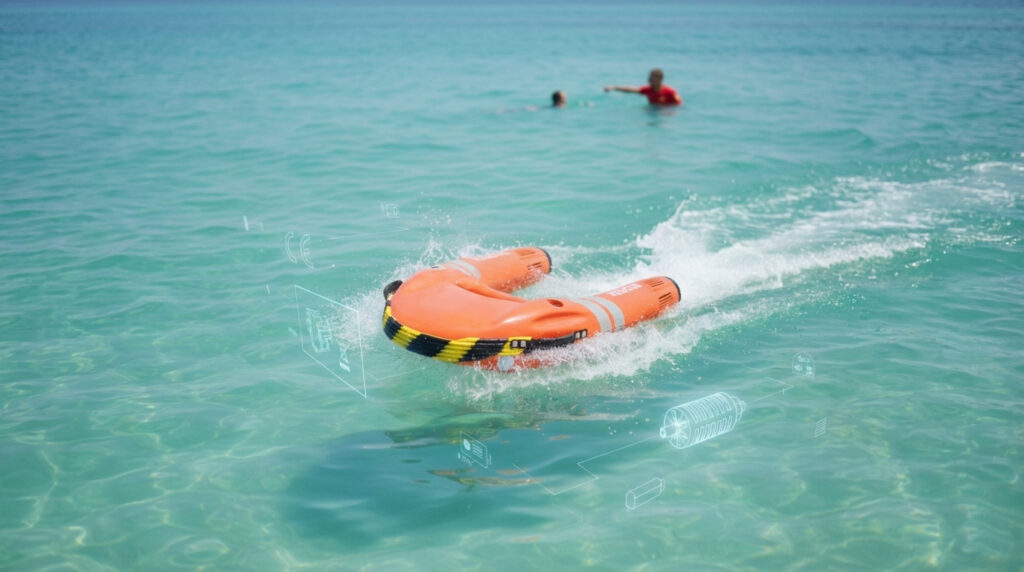
When Remote Control Rescue Buoys (RCRBs) are discussed, attention is often drawn to visible features: speed, shape, flotation, or battery runtime. Yet the single most critical system inside any RCRB is the motor and its associated control architecture. This is the system that determines whether the device responds instantly or hesitates, maintains thrust or fades, survives repeated high-load operation or fails prematurely.
In Australia, where rescue equipment is exposed to extreme environmental stress and intense scrutiny, motor standards are not an abstract technical detail. They are a core determinant of reliability, safety, compliance, and procurement defensibility.
This article explains why European motor standards matter in rescue equipment, how they differ from loosely regulated alternatives, and why Australian Surf Life Saving Clubs, councils, and emergency services should treat motor standards as a non-negotiable consideration.
A fundamental mistake in some procurement decisions is treating RCRBs as a variation of consumer watercraft rather than as life-saving equipment. Consumer electric propulsion systems are typically designed for:
Rescue equipment operates under a different set of assumptions:
European motor standards evolved within industries that share these expectations — medical devices, industrial machinery, transport systems, and safety-critical equipment. Their relevance to rescue equipment is therefore direct, not incidental.
The term “European motor standards” is often misunderstood. It does not refer to branding or country of origin alone. It refers to a framework of engineering, testing, documentation, and compliance that governs how motors and their control systems are designed and validated.
In practice, this framework includes:
For rescue equipment, this translates into motors that behave predictably across operating conditions and over time.
Rescue motors are rarely operated gently. They are expected to:
European-standard motor systems are typically designed around continuous and peak load envelopes that are clearly defined and tested. By contrast, non-standard or lightly regulated motors may quote impressive peak outputs without being designed to sustain them safely. In rescue contexts, a motor that overheats, throttles unexpectedly, or fails under load is worse than no motor at all.
Heat is one of the most common causes of electric motor failure — and one of the least visible. In Australian conditions, RCRB motors face:
European motor standards place significant emphasis on thermal modelling, protection, and derating behaviour. This means that when a motor approaches thermal limits, it behaves predictably and safely rather than catastrophically. This predictability is essential for rescue equipment. Operators must never be surprised by sudden power loss.
Rescue equipment operates in close proximity to people in the water. Electrical safety is therefore paramount. European standards typically address:
For Australian councils and agencies, this matters because electrical incidents involving rescue equipment expose organisations to serious liability. Choosing motors and controllers built to rigorous safety standards reduces this risk materially.
The motor itself is only one part of the system. Control electronics govern how power is delivered, how inputs are interpreted, and how faults are managed. European-standard systems tend to feature:
In rescue scenarios, these characteristics translate into predictable handling, even when conditions are chaotic. Poorly designed control systems may exhibit lag, surging, or erratic behaviour — all of which increase rescue time and operator stress.
For organisations deploying multiple RCRBs, consistency matters. European-standard manufacturing processes emphasise:
This means that two units of the same model behave similarly. In training and operations, consistency reduces cognitive load and improves outcomes. Operators can switch between units without recalibration or relearning.
After a serious incident, questions are asked. Documentation becomes critical. European-standard systems typically provide:
For Australian organisations, this documentation supports:
Equipment lacking this documentation creates uncertainty and legal exposure.
One of the most persistent myths in procurement is that higher-standard equipment is “more expensive”. While European-standard motor systems may carry higher upfront cost, they often deliver:
Over the lifecycle of rescue equipment, this often results in lower total cost of ownership. Cheap motors that fail early or unpredictably impose hidden costs in downtime, retraining, reputational damage, and risk exposure.
Australian councils and agencies operate under procurement frameworks that emphasise:
Selecting equipment built around recognised international standards aligns with these expectations. In contrast, selecting poorly documented or unproven motor systems can be difficult to justify if challenged.
Beyond legal and operational considerations lies an ethical one. Rescue equipment is deployed with the implicit promise that it will function when needed. That promise carries moral weight. Using motors and control systems designed to rigorous safety standards honours that responsibility.
They are not. Differences in design philosophy, testing, and quality control produce dramatically different outcomes under stress.
They are about process, safety, and accountability — not logos.
Short bursts at maximum load are among the most demanding operating conditions for any motor.
Operators trust equipment that behaves predictably. That trust translates into:
Motor systems that surge, lag, or behave inconsistently erode that trust. European-standard systems tend to inspire confidence through consistency.
Organisations that prioritise motor standards gain:
Those that do not risk owning equipment that fails quietly, unpredictably, or catastrophically — often at the worst possible moment.
From a VWC perspective, rescue equipment should be judged by its weakest point, not its strongest marketing claim. Motor systems are that point. By focusing on European motor standards, VWC aligns RCRB selection with: