
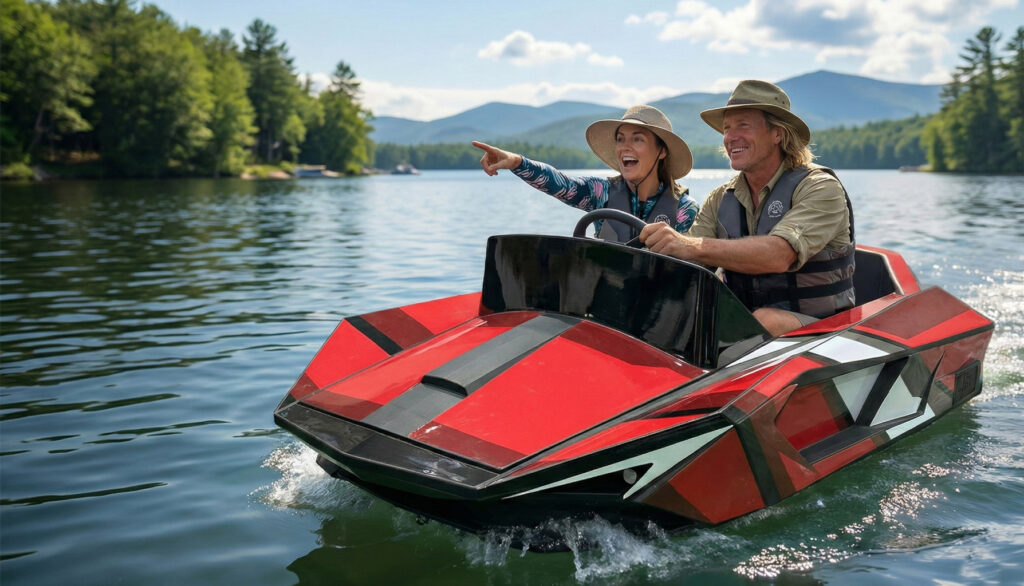
For decades, Australian families wanting on-water fun have faced a compromise. Traditional petrol jet skis promise speed and excitement, but they come with noise, bulk, trailers, fuel, maintenance, and a learning curve that often excludes children, older family members, or cautious first-time riders.
Small runabouts offer stability but require ramps, towing vehicles, registration complexity, and ongoing costs that discourage spontaneous use. Mini Jet Boats (MJBS) have emerged as a new category that sits squarely between these options—retaining the excitement of powered watercraft while prioritising safety, control, and genuine family accessibility. For families, this is not about extreme performance. It is about confidence, predictability, shared use, and peace of mind.
This article explains, in practical terms, why MJBS are uniquely suited to families, how their electric propulsion and hull design improve safety, and why ease of use is one of their strongest but least understood advantages.
A Mini Jet Boat is not a downsized jet ski. It is a distinct craft with a seated or semi-seated position, a stable hull, enclosed propulsion, and electric torque delivery. This difference matters enormously when the user group includes children, teenagers, parents, and grandparents.
Key distinctions include:
From a family perspective, these elements combine to reduce risk, shorten learning time, and expand who can safely participate.
One of the most critical safety advantages of MJBS is the absence of exposed propellers. Traditional boats and some personal watercraft rely on external prop systems that present obvious hazards around swimmers, shallow water, and beach launches.
Mini Jet Boats use fully enclosed jet drives, drawing water in from beneath the hull and expelling it through a controlled nozzle. This design:
For parents, this single feature alone is often decisive.
Unlike petrol jet skis, where speed is often abrupt and excessive for family use, MJBS deliver speed progressively. Electric motors produce torque instantly, but software-controlled delivery smooths acceleration. This means:
Parents can set expectations confidently, knowing the craft responds consistently every time.
Most jet skis rely on rider balance. When the rider shifts unexpectedly, the craft reacts instantly. Mini Jet Boats rely on hull stability, not rider athleticism. Benefits include:
For families, stability is not a luxury—it is essential.
Electric propulsion changes how control feels on water. There is no clutch engagement, no rev build-up, and no lag. Throttle input equals immediate but smooth response. This allows:
For parents teaching teenagers or supervising younger riders, this level of control is invaluable.
MJBS steering systems are tuned for linear response, not aggressive carving. While capable of tight turns, they prioritise:
This is particularly important in Australian family locations such as rivers, estuaries, and protected bays where traffic density can change quickly.
Electric MJBS decelerate smoothly when throttle is reduced. There is no engine inertia continuing to push the craft forward. This results in:
Families benefit from a craft that behaves intuitively.
One of the most practical benefits of MJBS is trailer-free ownership. Lightweight construction allows many models to be:
This removes a major barrier for families who want spontaneous outings rather than planned expeditions.
Electric MJBS typically involve:
No fuel priming. No choke. No warm-up. No exhaust fumes. For families, this simplicity reduces frustration and increases usage—craft that are easy to use are used more often.
Noise is often overlooked in safety discussions, but it matters. Loud petrol craft:
Electric MJBS are markedly quieter, allowing:
Families often include users with mixed experience levels. MJBS reduce the learning curve by:
Most first-time users become comfortable within minutes rather than hours.
Parents can supervise progression in a controlled manner:
This makes MJBS suitable for teaching responsible watercraft behaviour, not just thrill riding.
Unlike stand-up or aggressive jet ski postures, MJBS provide a seated or semi-seated position that improves:
Australian waterways are increasingly shared spaces. MJBS behave predictably around kayaks, paddleboards, swimmers, and small boats—an essential trait when children are present.
Many Australian family outings occur in shallow estuaries, lakes, and tidal flats. Enclosed jet propulsion allows MJBS to operate where prop craft cannot.
Electric systems reduce exposure to:
For families, this translates to lower upkeep and fewer failure points.
MJBS are not single-user toys. They are shared assets. Their design supports:
“Are They Powerful Enough?”
Yes—electric torque delivers strong low-speed and mid-range performance, which is exactly where family use occurs.
“Are They Safe Around Children?”
Their enclosed propulsion, stable hulls, and predictable control make them among the safest powered watercraft available when used responsibly.
“Will We Outgrow It?”
Families often find MJBS remain useful even as children grow, because access, convenience, and simplicity continue to matter.
No watercraft is inherently safe without responsible use. MJBS support good habits by making:
Mini Jet Boats are not replacing jet skis. They are filling a gap that jet skis never addressed properly—family-centric powered watercraft. They prioritise:
When safety, control, and ease of use are evaluated honestly—without marketing hype—Mini Jet Boats emerge as one of the most sensible innovations in recreational watercraft in decades.
They reflect how families actually use waterways, how parents think about risk, and how modern electric technology can enhance enjoyment without compromising responsibility. For families wanting confidence, simplicity, and genuine on-water enjoyment, MJBS are not a compromise—they are a logical step forward.