
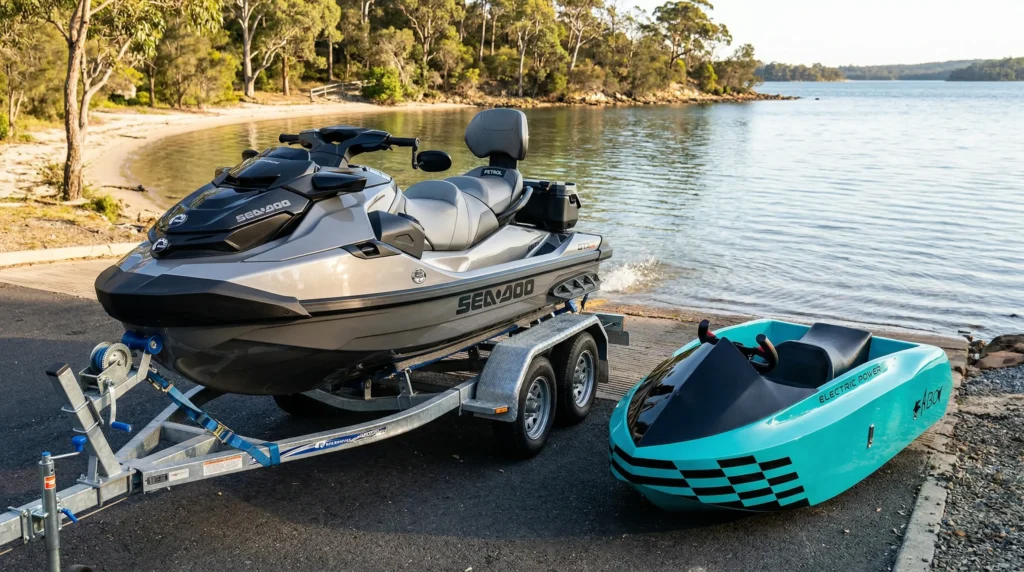
For decades, full-size petrol jet skis have dominated Australia’s personal watercraft landscape. They became synonymous with speed, power, and excitement on the water, and for a long time they were the only realistic option for Australians wanting a powered recreational craft without stepping into full boat ownership. However, the Australian market has changed, and so have the expectations of buyers.
Electric Mini Jet Boats (EMJBs) are not a passing trend or a niche experiment. They represent a fundamental shift in how Australians think about ownership, access, cost, safety, and practicality on the water. Rather than chasing extreme specifications designed for marketing brochures, EMJBs focus on how watercraft are actually used in Australia: short, frequent sessions in shared waterways, often close to home, with minimal fuss.
The result is a category of personal watercraft that aligns far more closely with modern Australian lifestyles than traditional petrol jet skis ever could.
Full-size petrol jet skis evolved in a very specific direction. Over time, manufacturers competed on engine size, horsepower, acceleration, and top speed. While this escalation delivered impressive performance, it also introduced layers of complexity that many Australian owners quietly struggle with.
A modern petrol jet ski typically involves:
Individually, these factors are manageable. Collectively, they create friction. That friction reduces spontaneous use, increases ownership stress, and ultimately leads many owners to use their craft far less than they expected when they purchased it.
Electric Mini Jet Boats approach the problem from the opposite direction. Instead of asking how to maximise raw performance, they ask a more practical question: how do Australians really use personal watercraft?
The answer is clear when usage patterns are examined honestly. Most recreational use in Australia occurs:
EMJBs are designed precisely for these conditions. They prioritise stability, predictability, ease of transport, and ease of use rather than extreme speed or aggressive handling characteristics.
One of the most significant advantages of Electric Mini Jet Boats is the ability to operate without a trailer. This single design decision fundamentally changes the ownership experience.
Trailer ownership introduces a cascade of secondary requirements: storage space, registration, maintenance, reversing skill, tow vehicle compatibility, and compliance with local parking rules. In many Australian suburbs, trailers are actively discouraged or regulated by councils and body corporates.
Many EMJBs can be transported in a ute tray, van, or large SUV. This eliminates the trailer entirely and with it the largest psychological and logistical barrier to frequent use.
For Australian owners, trailer-free ownership means the difference between planning a day around the craft and simply deciding to go for a ride.
Australian housing has changed dramatically over the past two decades. Blocks are smaller, garages are tighter, and shared living arrangements are more common. Storage is no longer abundant or flexible.
A full-size jet ski and trailer combination can easily exceed six metres in total length. For many households, this is not just inconvenient; it is impossible.
Electric Mini Jet Boats are far more compatible with modern storage realities. They can often be stored in garages, under carports, along side fences, or in compact outdoor spaces without dominating the property or triggering compliance issues.
This practical compatibility is one of the strongest drivers of EMJB adoption, even among buyers who previously owned petrol jet skis.
Noise is increasingly one of the most sensitive issues affecting watercraft use in Australia. Residential development along waterways has expanded, and tolerance for loud recreational craft has declined accordingly.
Petrol jet skis, even when compliant, generate noise that travels far across water. This leads to complaints, restrictions, and in some cases outright bans in certain locations.
Electric Mini Jet Boats operate with minimal noise. This has real, practical benefits:
Quiet operation is not a luxury feature in Australia; it is increasingly a prerequisite for long-term access.
A common misconception is that electric watercraft sacrifice performance. In practice, electric propulsion changes how performance is delivered rather than diminishing it.
Electric motors provide instant torque. There is no lag, no warm-up period, and no power curve that depends on engine speed. For EMJBs, this means:
In the environments where Australians most commonly ride, this form of performance is more usable and more enjoyable than raw top speed.
Full-size petrol jet skis can be intimidating, particularly for new riders, older users, or shared family ownership. High power, heavy mass, and abrupt throttle response can create anxiety rather than confidence.
Electric Mini Jet Boats typically feature:
This makes them accessible to a much broader range of Australians, including those who may have been hesitant to own a petrol jet ski. Confidence leads to more frequent use, and more frequent use leads to higher perceived value.
The upfront purchase price of a petrol jet ski rarely reflects its true cost over its ownership life. Servicing, fuel, storage, insurance, and depreciation continue regardless of how often the craft is used.
Electric Mini Jet Boats significantly reduce these ongoing costs. There is no fuel system to maintain, no oil changes, no exhaust components, and far fewer moving parts overall. As a result, ownership costs are more predictable and less sensitive to usage patterns.
For Australians who value financial clarity and low ongoing commitment, this is a decisive advantage.
Australia’s climate is particularly harsh on petrol engines used intermittently. Heat, saltwater exposure, and long periods of inactivity increase the likelihood of fuel degradation, corrosion, and mechanical issues.
Electric drivetrains eliminate many of these vulnerabilities. Fewer components mean fewer failure points, and sealed systems are far more tolerant of intermittent use.
For many owners, this translates into reliability not just in mechanical terms, but in peace of mind.
Environmental awareness is increasingly shaping recreational access in Australia. Councils, water authorities, and communities are placing greater emphasis on protecting waterways.
Electric Mini Jet Boats produce zero emissions at the waterline and eliminate the risk of fuel spills. This alignment with environmental expectations does not just reduce guilt; it reduces the likelihood of future restrictions that could limit use.
In practical terms, EMJBs are better positioned for the regulatory environment Australia is moving toward.
Across Australia, consumers are embracing the idea that smaller, smarter products can deliver better experiences than larger, more complex alternatives. This trend is visible in housing, vehicles, and energy systems.
Electric Mini Jet Boats reflect this philosophy. They remove excess size, excess noise, and excess complication while retaining the core pleasure of personal watercraft ownership: freedom, movement, and enjoyment on the water.
For many Australians, this represents an upgrade, not a compromise.
Australia has already embraced electric vehicles, battery-powered tools, and renewable energy at a rapid pace. Electric Mini Jet Boats fit naturally into this broader transition.
As battery technology continues to improve and familiarity grows, the advantages of EMJBs will compound rather than diminish. Early adopters are not taking a risk; they are aligning with a clear and accelerating trajectory.
Electric Mini Jet Boats are not attempting to replace petrol jet skis on their own terms. They are redefining what personal watercraft ownership should look like in modern Australia.
They offer:
For a growing number of Australians, the question is no longer whether Electric Mini Jet Boats can compete with petrol jet skis. It is why anyone would willingly accept the complications of the old model when a smarter alternative already exists.