
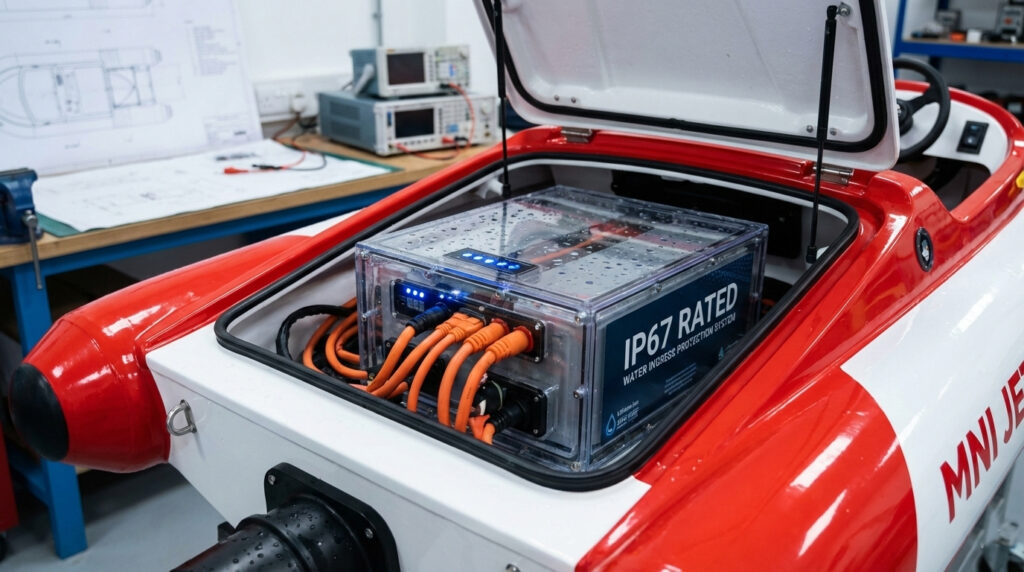
In electric Mini Jet Boats (MJBS), the battery is not just a power source. It is the single most critical system in the entire craft. It determines performance, runtime, reliability, safety, longevity, and — most importantly — risk.
Unlike petrol watercraft, where fuel is external, replaceable, and mechanically isolated, electric MJBS integrate high-energy battery systems directly into the hull. This makes battery enclosure design and water ingress protection central to whether a mini jet boat is genuinely seaworthy or merely floating electronics.
In Australia, where MJBS are exposed to saltwater, heat, UV, spray, wash-down practices, and unpredictable usage patterns, this distinction becomes even more important. This article explains how battery enclosures in MJBS are designed, what IP ratings actually mean in real-world conditions, how water ingress really occurs, and how professional-grade MJBS differ fundamentally from consumer-level electric craft marketed as “boats”.
Lithium battery systems are safe when properly engineered, but they demand respect. A battery pack stores a large amount of energy in a compact space. If that energy is released unintentionally due to water ingress, short-circuiting, or thermal runaway, the consequences can be severe.
This is why professional electric MJBS design starts with a single question: How do we absolutely protect the battery from water, impact, vibration, heat, and misuse over many years? Consumer products often ask a different question: How do we make this cheaper and lighter right now? The difference between those two mindsets defines the entire category.
Many buyers imagine water ingress as a dramatic event — capsizing, submersion, or collision. In reality, most water damage occurs slowly and invisibly. Common ingress pathways include:
Professional MJBS assume all of these will happen at some point and design accordingly.
An IP (Ingress Protection) rating is a standardised classification that describes how well an enclosure resists solid objects (first digit) and liquids (second digit). For example, IP65, IP67, or IP68. Higher numbers indicate greater protection.
Many buyers assume: “If it says IP67, it’s waterproof.” That is incorrect. IP ratings are tested under controlled laboratory conditions, applied to individual components rather than entire systems, and are not lifetime guarantees. A battery pack may be IP67, but if the enclosure is compromised, cable penetrations are poorly sealed, or mounting causes flex, the rating becomes meaningless.
These are resistant to splashing but have limited dust protection and are not suitable for marine exposure. They carry a high long-term ingress risk and are often found in recreational electric toys or entry-level craft not designed for saltwater longevity.
These offer better splash resistance and protection from water jets, but are still vulnerable to immersion, pressure changes, and condensation. They are acceptable only when combined with additional protective strategies.
These provide protection against immersion to defined limits. They require exceptional sealing discipline and must be supported by enclosure design, not just a component rating. Professional MJBS do not rely on an IP number alone; they design systems that assume water will try to get in.
In professional MJBS, the battery enclosure is structurally reinforced, isolated from hull flex, protected from impact loads, and designed to survive trailering, launching, and retrieval stresses. Consumer craft often mount batteries in thin plastic housings or non-reinforced compartments, leading to seal fatigue and micro-leaks over time.
Professional MJBS use redundant sealing rather than single gaskets. This may include primary compression seals, secondary labyrinth seals, O-ring backed interfaces, and sealant-reinforced fasteners. If one seal degrades, another still protects the system.
Cables are one of the highest-risk ingress points. Professional systems use marine-rated glands, strain relief to prevent movement, and potting or encapsulation where required. Consumer systems often run cables directly through housings or rely on simple friction or glue.
Even perfectly sealed enclosures can fail due to condensation. Condensation occurs due to temperature changes between day and night or battery heating during operation followed by cooling. It does not require liquid water entry; it forms internally from trapped humidity.
Consumer craft almost never address condensation properly.
Saltwater is conductive, corrosive, and persistent. Even microscopic salt crystals can create conductive paths, corrode terminals, and degrade seals. Professional MJBS assume salt exposure is unavoidable and that rinsing will sometimes be skipped, so enclosures are designed accordingly.
Lithium battery fires are rare when systems are properly engineered. The real risk comes from water ingress causing short circuits, corrosion creating resistance heating, or damaged cells from vibration. Professional MJBS mitigate these risks through robust enclosures, cell isolation, advanced Battery Management Systems (BMS), and thermal monitoring.
MJBS operate in dynamic environments including chop and wake impact. Professional battery systems are shock-isolated and securely restrained to avoid point loading. Poor mounting leads to internal cell damage and seal failure.
A common failure point in consumer MJBS is service access. If battery access requires breaking seals or reusing gaskets, the enclosure will eventually fail. Professional MJBS design serviceability into the enclosure with controlled access points and replaceable seals.
Consumer-level craft typically feature single-layer sealing, marketing-driven IP claims, and minimal condensation control. In contrast, professional-grade MJBS feature multi-layer enclosure design, conservative engineering margins, and documented protection strategies. The difference is structural, not subtle.
Buyers should ask hard questions: What is the enclosure IP rating for the whole system? How are cable penetrations sealed? How is condensation managed? Can seals be replaced during service? Manufacturers who answer confidently usually have professional systems.
As electric watercraft adoption increases, insurers and regulators will pay closer attention to battery safety and ingress protection. MJBS with professional battery enclosure design will face fewer insurance issues and be easier to certify.
Expect continued evolution in integrated structural battery compartments and smarter BMS systems. Battery protection will increasingly define which MJBS brands survive long-term.
In electric Mini Jet Boats, battery enclosures are the core safety system. Professional-grade MJBS treat water ingress protection as a multi-discipline engineering problem involving structural design, materials science, and thermal management. Consumer-level craft treat it as a marketing line item. For Australian buyers, understanding this design is the difference between owning a true watercraft and owning a liability.