
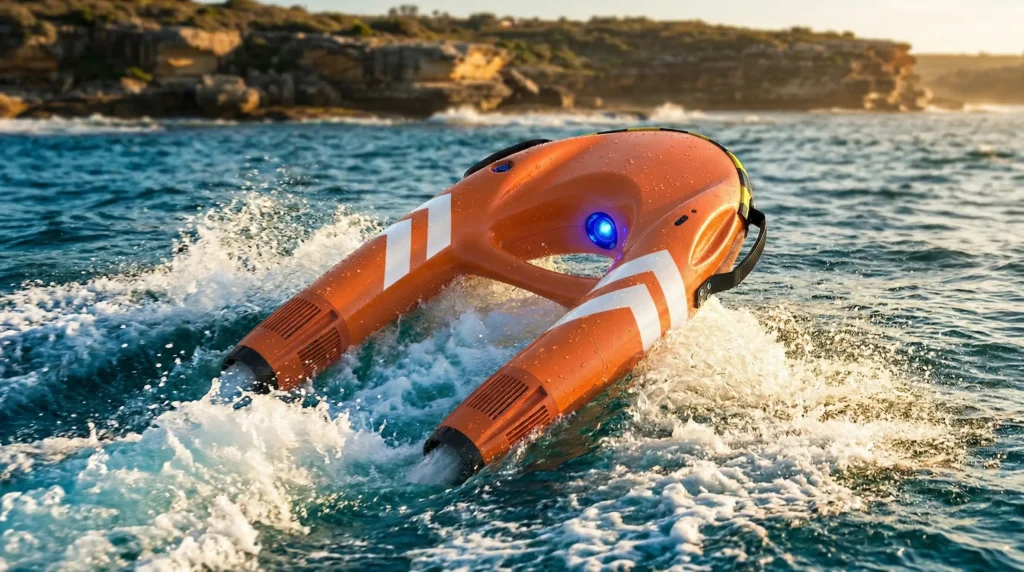
Battery performance is one of the most misunderstood aspects of Remote Control Rescue Buoys (RCRBs). Runtime figures are often quoted confidently, yet rarely explained in a way that reflects how rescue equipment is actually used in Australian emergencies. The result is a gap between expectation and reality — a gap that can undermine operational planning, training, and confidence at the moment the equipment is most needed.
This article addresses battery runtime and power management from a real-world emergency perspective, not a marketing one. It explains how batteries behave under rescue loads, how Australian conditions affect performance, and how organisations should plan, train, and procure with power management firmly in mind.
Battery runtime is frequently expressed as a single figure — for example, “45 minutes” or “one hour.” In isolation, this number is almost meaningless. Runtime depends on multiple interacting factors, including:
In emergency scenarios, RCRBs rarely operate at steady, low output. They operate in short, intense bursts under load, followed by repositioning and re-engagement. Any runtime estimate that does not account for this pattern is misleading.
Understanding battery performance begins with understanding the rescue duty cycle.
A typical RCRB rescue involves:
This pattern places significantly higher demand on the battery than steady cruising.
In Australian surf or river rescues, continuous high-load operation is common. Batteries must therefore be evaluated on their ability to deliver power repeatedly, not just their theoretical capacity.
Two batteries with identical energy capacity can behave very differently in rescue scenarios.
Key distinctions include:
Rescue operations demand high power output and voltage stability. A battery that cannot maintain voltage under load may cause:
This is unacceptable in emergency contexts.
In rescue scenarios, the battery must support:
Batteries designed for consumer devices or recreational use may perform well at low load but struggle under these conditions.
Professional-grade RCRBs require battery systems designed for high discharge rates with appropriate thermal and electrical protections.
Australia’s climate introduces additional complexity to battery performance.
High ambient temperatures affect batteries by:
RCRBs stored in sheds, vehicles, or outdoor enclosures may experience elevated temperatures even before deployment.
Battery systems must therefore be evaluated not just for performance in ideal conditions, but for thermal resilience.
While water can provide some cooling during operation, this benefit is often overstated.
Key considerations include:
In hot Australian summers, a battery that begins operation warm may reach critical thresholds sooner than expected.
Modern RCRBs rely on power management systems to protect batteries and electronics.
These systems govern:
Well-designed systems behave predictably, gradually reducing output if limits are approached. Poorly designed systems may shut down abruptly, creating dangerous loss of propulsion during a rescue.
Derating refers to the controlled reduction of output to protect components.
In rescue equipment, derating must be:
Sudden loss of power without warning is unacceptable.
Australian buyers should understand how an RCRB behaves as battery limits are approached — not just how long it runs under ideal conditions.
Single-casualty rescues do not fully represent operational reality.
In some incidents, RCRBs may be required to:
This places cumulative demand on the battery. Operational planning must therefore consider usable runtime, not maximum runtime.
After each rescue engagement, time may be required for:
These periods may involve low power draw, but they do not reset battery state.
Training should teach operators to manage power consciously, avoiding unnecessary high-thrust use when not required.
Battery performance is inseparable from charging strategy.
Key readiness considerations include:
Poor charging practices degrade batteries long before they fail outright.
Australian organisations must decide whether to rely on:
Each approach has implications for:
For many operations, spare batteries provide faster turnaround and greater resilience, provided battery swapping is simple and safe.
Batteries are not passive components. Training must include:
This is particularly important for volunteer-based organisations.
Battery performance degrades over time, even if runtime appears adequate initially.
Degradation affects:
Organisations must plan for battery replacement cycles and monitor performance trends rather than waiting for failure.
Councils and emergency services should formalise battery management through documented policies covering:
This supports governance and reduces risk.
Runtime figures should inform planning, not define expectations.
Australian buyers should always assume that:
Conservative planning improves resilience.
Operators who understand battery behaviour:
Those who do not may hesitate or overcompensate.
Trust in rescue equipment is built on predictability.
When operators know how the RCRB will behave as power is consumed, they operate more decisively. Uncertainty undermines trust — and trust is essential in emergencies.
Organisations that take battery runtime and power management seriously gain:
Those that do not risk discovering battery limitations during live incidents.
From a VWC perspective, power management is not a technical footnote. It is a frontline capability.
RCRBs that manage power intelligently, predictably, and safely are more effective, more trusted, and more suitable for Australian rescue operations.