
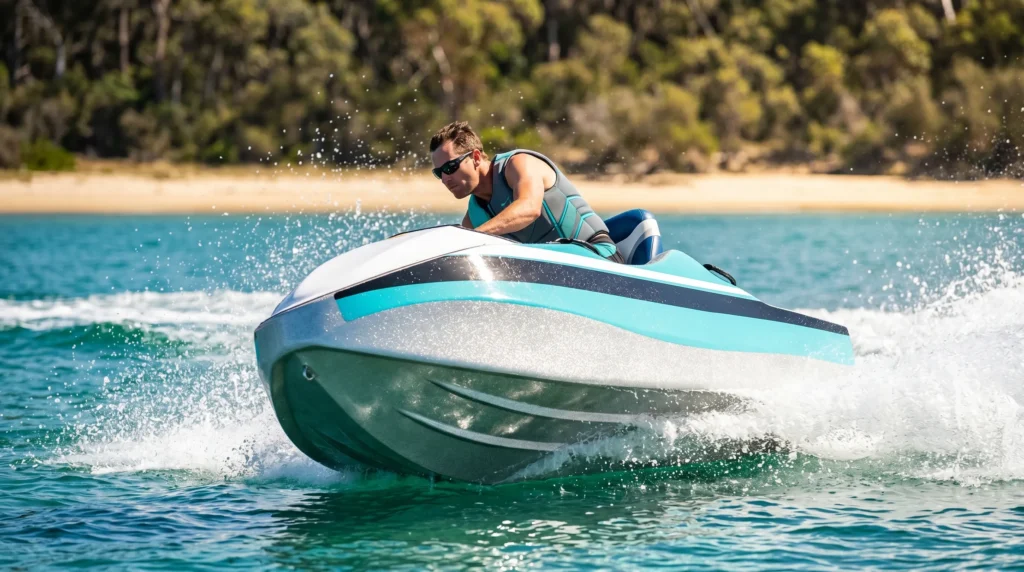
In any watercraft—large or small—the hull is the foundation. Engines, batteries, and electronics may define capability, but it is the hull that determines how a boat actually behaves on water. In Mini Jet Boats (MJBS), where compact dimensions and lightweight construction magnify every design choice, hull design becomes even more critical.
For Australian buyers, misunderstanding hull design is one of the most common reasons for disappointment after purchase. Two MJBS may appear similar on paper, yet behave entirely differently on rivers, estuaries, bays, or near-shore coastal waters. This article explains the major hull types used in MJBS, how they influence performance, safety, and comfort, and what buyers must assess before making a decision.
This is not a styling discussion. It is about physics, practicality, and suitability for Australian waterways.
In full-size boats, mass can mask poor hull choices. In MJBS, it cannot. Because MJBS are:
Every hull characteristic—shape, deadrise, chines, strakes, and keel profile—has an immediate and noticeable effect. Hull design directly affects:
Ignoring hull design is equivalent to buying a vehicle without understanding whether it is front-wheel drive, rear-wheel drive, or all-wheel drive.
Flat-bottom hulls are among the most common entry-level designs in small watercraft.
Flat-bottom hulls are best suited to calm rivers, sheltered lakes, and low-speed environments. For buyers prioritising simplicity and ultra-shallow access, they can be appropriate—but they are not ideal for variable Australian coastal conditions.
The shallow-V hull is one of the most common and versatile designs in MJBS.
Shallow-V hulls are well suited to estuaries, rivers with variable conditions, and bays or sheltered coastal zones. For many Australian buyers, this hull type represents the best all-round compromise.
Deep-V hulls are traditionally associated with offshore boats, but scaled-down versions are increasingly appearing in premium MJBS.
Deep-V MJBS hulls are suited to open bays, near-shore coastal waters, and conditions where chop is common. They reward experienced operators but may feel less stable to first-time users when stationary.
Some MJBS employ tunnel-style hulls or modified jet channels to optimise water flow to the jet intake.
When executed properly, tunnel hulls can significantly improve jet efficiency—particularly important in electric MJBS where energy efficiency matters.
Chines are the edges where the hull bottom meets the sides. Their shape matters greatly.
Hard Chines: Sharp edges that provide strong lateral stability and defined cornering behaviour.
Soft or Rounded Chines: Smoother transitions that offer a gentler ride and less abrupt handling.
In MJBS, hard chines improve stability at rest and during turns. Well-designed chines deflect spray away from occupants, whereas poor chine design leads to wet rides and unpredictable lean. Buyers should assess not just the presence of chines, but how cleanly they are formed and integrated into the hull.
Strakes are longitudinal ridges running along the hull bottom. Their functions include increasing hydrodynamic lift, improving directional stability, and reducing wetted surface area.
In MJBS, strakes help the boat plane earlier, improve straight-line tracking, and enhance steering response. However, poorly placed strakes can introduce excessive drag, hard riding characteristics, and increased noise and vibration. Strake design must match hull length, weight, and intended speed range.
The keel is the backbone of the hull. Shallow Keels offer excellent manoeuvrability, reduced draft, and easier beaching. Pronounced Keels provide improved tracking, better straight-line stability, and reduced side-slip.
In MJBS, a balanced keel profile is essential. Too shallow and the craft feels loose; too deep and it loses agility—particularly in confined waterways.
Proportions matter. Wider Beams offer greater stability at rest and more interior space, though they may have slightly increased drag. Narrower Beams provide better efficiency and improved handling at speed, but offer reduced initial stability. MJBS designers must strike a careful balance; Australian conditions favour hulls that feel stable when boarding, yet remain efficient underway.
Hull design cannot be evaluated in isolation from weight placement. Electric MJBS rely on centralised battery placement, low-mounted mass, and even longitudinal balance. A well-designed hull paired with poor weight distribution will still perform badly. Buyers should look for manufacturers who treat the hull and power system as a unified design, not separate components.
Many buyers test stability by standing still. This is only half the story. Stability at rest is influenced by beam width, chine shape, and hull bottom profile. Stability underway is determined by deadrise, strakes, and keel design. A hull that feels stable at rest but behaves unpredictably underway is not a good compromise—especially for family use.
Jet propulsion places unique demands on hull design. Key considerations include how water is channelled to the intake, how the hull resists side-slip during turns, and how thrust is translated into directional change. Good MJBS hulls track cleanly through turns, maintain jet efficiency, and avoid sudden loss of grip. Poor hulls feel skittish and require constant correction.
While shape is critical, material execution matters. MJBS hulls are commonly constructed from fibreglass composites, rotationally moulded polymers, or advanced reinforced plastics. Buyers should assess thickness and reinforcement, stress points around the jet intake, and resistance to repeated beaching. A light hull must still be durable—especially given the “launch anywhere” nature of MJBS.
Australia presents unique challenges: shallow estuaries, variable river flows, coastal chop, and sandy or muddy bottoms. The ideal MJBS hull handles short, steep chop, tracks well in wind-affected waterways, and operates safely in shallow water. This rules out extreme designs optimised for only one condition.
The most frequent errors include choosing hulls based on appearance alone, prioritising flat-water performance only, ignoring how hulls behave under load, and assuming all jet boats handle the same. An informed buyer evaluates hull design first—before motor specs or speed claims.
Hull design also influences wake characteristics, control at low speeds, and predictability near swimmers. These factors increasingly affect how regulators view small watercraft. MJBS with stable, predictable hulls align better with Australian safety expectations.
In Mini Jet Boats, the hull is not a background detail—it is the defining factor. Understanding hull design allows buyers to choose craft suited to their waterways, avoid uncomfortable or unsafe behaviour, and maximise enjoyment and confidence. Electric propulsion has changed what MJBS can do, but hull design determines how well they do it. Buyers who respect this reality make better decisions—and enjoy better outcomes on Australian waters.