
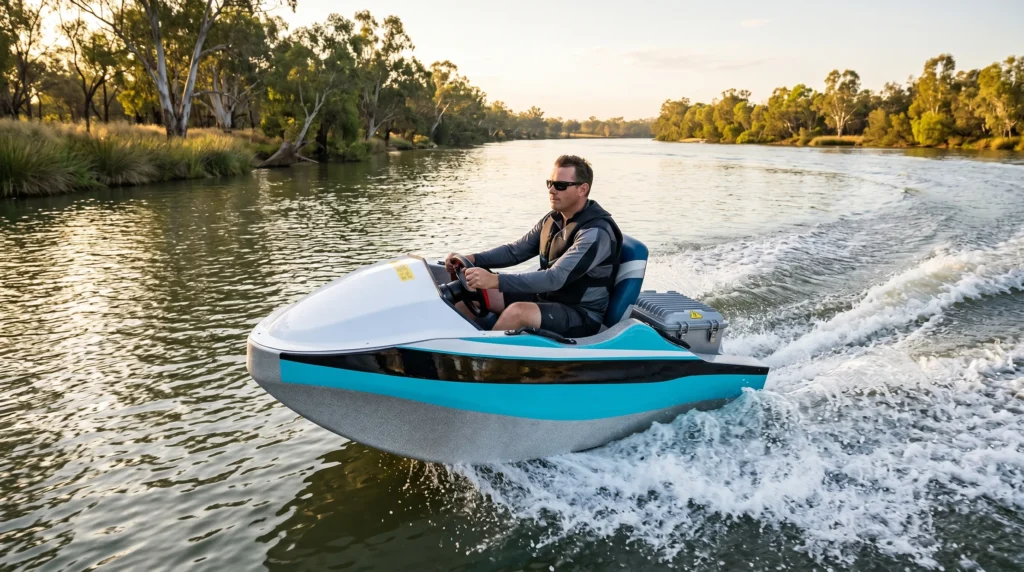
Fire Risk Reality: Electric Mini Jet Boats vs Petrol Personal Watercrafts – Battery Management Systems, Fuel Vapour, Leaks, and Ignition Sources Explained

Article Category:
Published On: May 12, 2026

Table of Contents

Fire Risk Reality Electric Mini Jet Boats vs Petrol Personal Watercrafts - Battery Management Systems, Fuel Vapour, Leaks, and Ignition Sources Explained

Introduction: Fire Risk Is About Probability, Not Headlines

Fire risk in personal watercraft is often discussed emotionally rather than technically. Isolated incidents involving lithium batteries attract disproportionate attention, while the everyday fire risks associated with petrol systems are treated as normal or unavoidable.

For buyers, regulators, councils, and families, this creates confusion. Electric Mini Jet Boats (MJBS) and petrol-powered personal watercraft (PWCs) present very different fire risk profiles. One relies on volatile liquid fuel, vapour, and ignition sources. The other relies on stored electrical energy managed by software and protective systems.

This article explains — calmly and factually — where fire risk actually comes from, how it manifests in real-world use, how professional-grade MJBS manage battery safety, and why, in practical Australian conditions, electric MJBS often represent a lower overall fire risk than petrol PWCs.

Fire Risk Is a System Problem, Not a Component Problem

No single component causes fires. Fires occur when multiple failures align:

  • Energy source present
  • Ignition pathway available
  • Failure of containment or control
  • Delay or absence of protective shutdown

Understanding fire risk requires examining entire systems, not isolated parts.

Petrol PWCs: Where Fire Risk Comes From

Petrol-powered PWCs have been in use for decades, and their risks are well understood — but often underestimated.

Key Fire Risk Elements in Petrol PWCs

  • Liquid fuel storage
  • Fuel vapour accumulation
  • Pressurised fuel lines
  • Hot engine components
  • Electrical ignition systems
  • Exhaust heat
  • User refuelling practices

Each element alone may be manageable. Together, they create multiple ignition pathways.

Fuel Vapour: The Invisible Risk

Petrol vapour is far more flammable than liquid petrol. It ignites at low concentrations and can travel unseen.

In PWCs, vapour can accumulate due to:

  • Heat expansion in fuel tanks
  • Leaking seals or hoses
  • Poor ventilation
  • Hot ambient temperatures
  • Refuelling spills

Australian summer conditions amplify all of these factors.

Ignition Sources in Petrol PWCs

Petrol PWCs contain multiple potential ignition sources:

  • Spark plugs
  • Electrical wiring
  • Starter motors
  • Hot exhaust components
  • Engine block heat
  • Static discharge during refuelling

If vapour and ignition coincide, fire risk becomes immediate.

Real-World Petrol Fire Scenarios

Common petrol-related fire incidents include:

  • Refuelling with hot engines
  • Vapour ignition in enclosed storage areas
  • Fuel hose degradation over time
  • Corrosion-induced leaks
  • Poor maintenance
  • Improvised repairs

These are not extreme misuse cases — they are everyday scenarios.

Electric MJBS: A Fundamentally Different Risk Model

Electric MJBS replace liquid fuel systems with sealed energy storage, monitored electronically and protected by multiple layers of control.

The question is not whether lithium batteries can fail — they can — but how likely failure is in properly engineered marine systems.

Lithium Battery Fire Reality

Lithium battery fires require a specific chain of events:

  • Cell damage or internal defect
  • Thermal runaway initiation
  • Failure of containment
  • Continued energy release

In consumer electronics, this can happen due to:

  • Physical abuse
  • Manufacturing defects
  • Poor charging control
  • Overheating

Professional-grade MJBS are engineered specifically to prevent these conditions.

Battery Management Systems (BMS): The Core Safety Layer

The most important fire-prevention system in an electric MJBS is the Battery Management System (BMS).

A proper BMS continuously monitors:

  • Cell voltage
  • Current flow
  • Temperature
  • Charge/discharge rates
  • Imbalances between cells
  • Fault conditions

If unsafe conditions are detected, the system:

  • Reduces power
  • Limits charging
  • Isolates the battery
  • Shuts down propulsion if required

Petrol systems have no equivalent real-time intelligence.

Thermal Monitoring and Control

Heat is the precursor to fire.

Professional MJBS:

  • Monitor battery temperature at multiple points
  • Prevent operation outside safe ranges
  • Integrate with cooling systems
  • Shut down safely before damage occurs

Petrol PWCs rely on passive thermal tolerance and user judgement.

Containment: Keeping Energy Where It Belongs

Electric MJBS use:

  • Reinforced battery enclosures
  • Impact-resistant housings
  • Fire-retardant materials
  • Structural integration into the hull
  • Electrical isolation barriers

Petrol PWCs rely on:

  • Plastic fuel tanks
  • Rubber hoses
  • Mechanical clamps
  • Ventilation to dissipate vapour

The containment philosophy is entirely different.

Water and Fire Risk: Counterintuitive but Important

Water is a fire suppressant for petrol — but a hazard for poorly designed electric systems.

This is why professional MJBS:

  • Treat water ingress as the primary design threat
  • Isolate batteries completely
  • Use ingress protection strategies

When battery enclosures are properly engineered, water does not increase fire risk. Poor engineering does.

Charging Risk: Where Electric Safety Is Often Misunderstood

Charging is often cited as a major lithium fire risk — but context matters.

Professional MJBS Charging Characteristics

  • Dedicated chargers
  • Controlled charge rates
  • Temperature monitoring
  • Automatic shutoff
  • Clear user instructions

Petrol Refuelling Characteristics

  • Open liquid transfer
  • Vapour release
  • Static electricity risk
  • User-dependent behaviour
  • Hot ambient environments

Statistically, refuelling petrol craft introduces more ignition risk than charging well-designed electric craft.

Human Factors: Where Most Fires Begin

Fire risk increases when systems rely heavily on perfect human behaviour.

Petrol PWCs depend on users to:

  • Refuel correctly
  • Maintain hoses and seals
  • Detect vapour smells
  • Avoid hot-engine refuelling
  • Store fuel safely

Electric MJBS rely more on:

  • Automated monitoring
  • System-enforced limits
  • Passive safety design

Reducing reliance on human perfection reduces real-world risk.

Maintenance and Ageing: How Risk Evolves Over Time

Petrol PWCs

Over time:

  • Hoses harden and crack
  • Seals degrade
  • Corrosion develops
  • Vapour leakage increases
  • Fire risk increases with age

Electric MJBS

Over time:

  • Battery capacity declines gradually
  • Electronics continue monitoring
  • No vapour pathways develop
  • Fire risk does not increase in the same way

Ageing behaviour matters for long-term ownership.

Storage Risk: Garages, Sheds, and Carports

Many Australian owners store watercraft at home.

Petrol PWCs stored in garages introduce:

  • Vapour accumulation risk
  • Fire hazard near vehicles
  • Insurance complications

Electric MJBS:

  • Do not emit vapour
  • Do not leak liquid fuel
  • Can be stored with fewer ignition concerns when designed correctly

This is particularly relevant for suburban and canal-front homes.

Incident Response: What Happens If Something Goes Wrong

In the rare event of a serious fault:

Electric MJBS

  • Systems shut down automatically
  • No spreading fuel
  • No vapour cloud
  • Contained energy source
  • Predictable behaviour

Petrol PWCs

  • Fuel can leak or spread
  • Vapour may ignite
  • Fire can escalate rapidly
  • Environmental contamination occurs

Containment matters during failure, not just normal use.

Insurance and Regulatory Perspective

Insurers and regulators evaluate:

  • Probability of ignition
  • Severity of outcome
  • Ease of mitigation
  • Predictability of failure modes

As electric MJBS mature, professionally engineered systems increasingly present lower insurable fire risk than ageing petrol PWCs.

Sensationalism vs Statistics

Media attention often focuses on:

  • Rare lithium incidents
  • Dramatic visuals
  • Isolated failures

Everyday petrol fire incidents are underreported because they are familiar. Risk assessment must be statistical, not emotional.

What Australian Buyers Should Actually Ask

Instead of fearing batteries, buyers should ask:

  • Is there a documented BMS?
  • How is temperature monitored?
  • How is the battery enclosed?
  • What happens during a fault?
  • What certifications or testing exist?
  • How is charging controlled?

Transparent answers indicate professional engineering.

Fire Risk in Context: The Broader Safety Picture

Fire risk does not exist in isolation. It must be weighed alongside:

  • Capsize risk
  • Recovery behaviour
  • Noise and stress
  • Fuel handling
  • Environmental exposure

MJBS reduce risk across multiple dimensions simultaneously.

Conclusion: Electric MJBS Do Not Eliminate Risk — They Manage It Better

No energy system is risk-free. The meaningful comparison is which system manages risk more intelligently under real-world conditions.

Petrol PWCs rely on:

  • Volatile fuel
  • Mechanical containment
  • User vigilance
  • Ageing components

Electric MJBS rely on:

  • Sealed energy storage
  • Continuous electronic monitoring
  • Automated shutdowns
  • Conservative engineering margins

When professionally designed, electric MJBS present a lower, more predictable fire risk profile than petrol PWCs — particularly in Australian heat, storage, and family-use scenarios. Fire safety is not about fear. It is about systems, probability, and control. On those terms, electric Mini Jet Boats represent a safer evolution of personal watercraft, not a compromise.

Product Categories
Main Links
Get in touch