
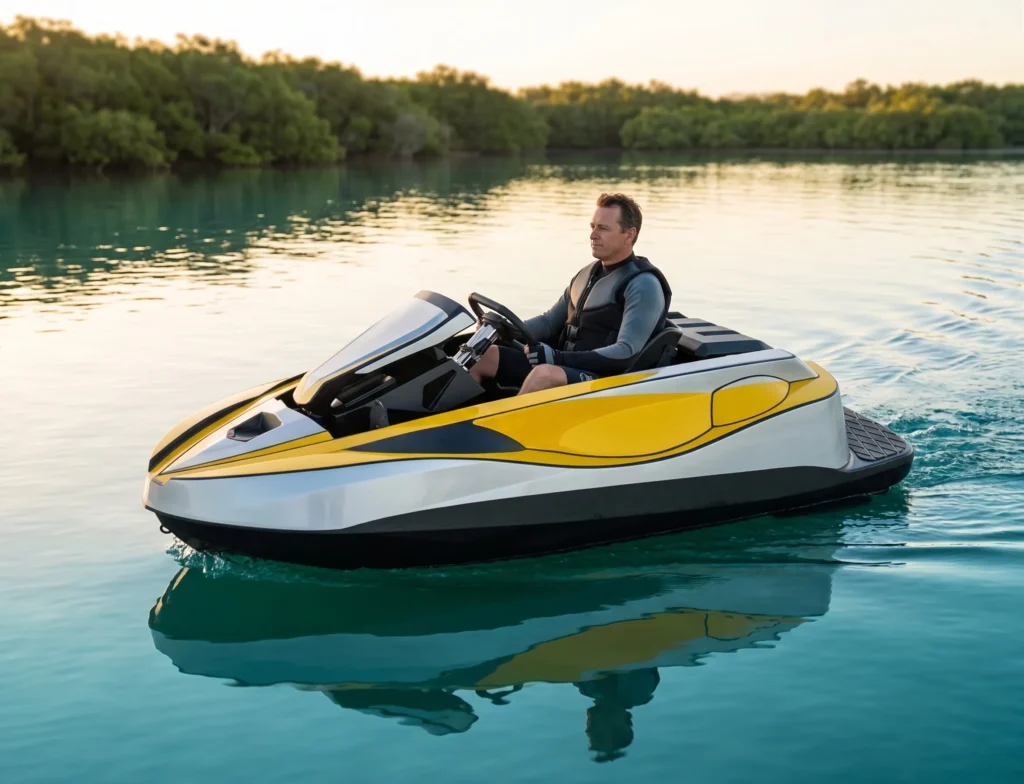
For decades, the definition of a personal watercraft (PWC) in Australia has been narrow and largely unquestioned. A PWC was assumed to be a petrol-powered jet ski—large, loud, trailer-dependent, and performance-oriented. Regulations, infrastructure, consumer expectations, and even marine retail models evolved around that assumption.
Electric Mini Jet Boats (EMJBs) are now forcing a re-examination of what a personal watercraft actually is, and more importantly, what it should be in the Australian context. This is not a marginal shift. It is a fundamental reframing of size, purpose, accessibility, and responsibility on the water.
The redefining of PWCs is not happening because of technology alone. It is happening because Australia’s waterways, users, and regulators are demanding a different balance between enjoyment, safety, access, and impact.
Traditional PWCs were built around spectacle: speed, acceleration, and aggressive styling. These characteristics shaped not only the craft itself, but also how and where it could be used.
Electric Mini Jet Boats begin with a different question: What role should a personal watercraft play in modern Australian recreation and utility?
The answer increasingly includes:
This shift in purpose changes everything downstream—from hull design to propulsion, from regulatory acceptance to buyer demographics.
Historically, size became synonymous with capability. Bigger hulls, larger engines, and heavier builds were assumed to equal better performance and legitimacy.
Electric Mini Jet Boats challenge that assumption directly.
Modern EMJBs are engineered to deliver:
In Australian conditions—rivers, bays, lakes, estuaries, canals, and near-shore waters—these characteristics are often more relevant than outright scale.
As a result, the definition of a PWC is shifting from “largest practical machine” to “most appropriate machine.”
Electric propulsion does more than replace petrol with batteries. It changes how a craft behaves, how it is controlled, and how riders interact with it.
Electric motors deliver torque instantly and smoothly. This reshapes the riding experience:
For many Australian riders—particularly in shared or confined waterways—this control is more valuable than peak speed.
Without complex drivetrains, fuel systems, or combustion cycles, electric systems behave consistently. This reliability lowers the learning curve and expands the pool of capable users.
As a result, PWCs are no longer limited to thrill-seekers—they become broadly usable recreational tools.
One of the most under-appreciated shifts brought about by EMJBs is the re-prioritisation of stability.
Traditional PWCs often require active riding techniques to maintain balance, particularly at low speeds or in chop. EMJBs are increasingly designed to:
This changes who feels comfortable using them.
In Australia, this has implications for:
A stable personal watercraft invites participation rather than intimidating it.
Electric Mini Jet Boats are expanding—not shrinking—the places where PWCs make sense.
Noise has long been a limiting factor for PWCs. Complaints, restrictions, and outright bans have shaped access across many Australian waterways.
Electric operation dramatically reduces acoustic impact, allowing EMJBs to operate in:
This does not just benefit riders—it benefits councils, regulators, and communities.
Another major shift is the growing recognition of PWCs as functional tools, not just recreational toys.
Electric Mini Jet Boats are increasingly considered for:
Their controllability, low noise, and reduced operational footprint make them suitable for roles where petrol PWCs may be excessive or inappropriate.
This functional legitimacy strengthens their position within the broader PWC definition.
For decades, PWC ownership in Australia has quietly filtered out large segments of the population. EMJBs reverse that trend.
Electric Mini Jet Boats reduce or remove:
This opens the category to:
When access widens, categories evolve.
Australian marine authorities are increasingly aware that existing PWC frameworks were written around petrol jet skis—not electric, compact craft.
EMJBs are prompting:
As this continues, Electric Mini Jet Boats are likely to influence how personal watercraft are defined in legislation—not just in the marketplace.
Public tolerance for noisy, fuel-burning recreational equipment is diminishing across many sectors. On water, this sensitivity is amplified.
Electric Mini Jet Boats align with:
This alignment strengthens their social licence to operate—a critical factor in long-term category sustainability.
Traditional PWCs often become “occasion” machines—used infrequently due to setup effort, transport complexity, or time constraints.
EMJBs tend to be used more often because they are:
As a result, value is increasingly measured in hours enjoyed, not just specifications.
Australia’s water culture has always balanced adventure with practicality. Electric Mini Jet Boats fit that ethos.
They represent:
In doing so, they are not replacing petrol jet skis entirely—but they are redefining what it means to own and use a personal watercraft in Australia.
As adoption increases, EMJBs are quietly establishing a new baseline expectation for PWCs:
This does not signal the end of traditional jet skis—but it does mark the beginning of a more nuanced, diversified category.
Electric Mini Jet Boats are not waiting for permission to redefine personal watercraft in Australia. They are doing so through use, acceptance, and alignment with modern expectations.
The question is no longer whether EMJBs qualify as personal watercraft. The real question is whether future PWCs can afford not to follow the direction they are setting.