
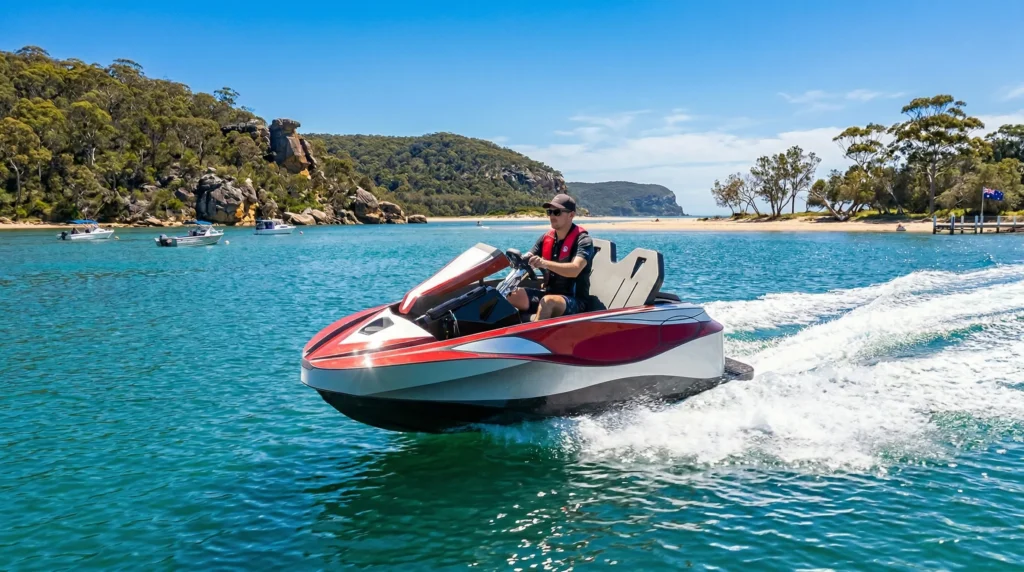
Recreational boating in Australia is undergoing a quiet but profound transformation. Electric personal watercraft are not merely offering an alternative power source; they are reshaping how Australians interact with waterways, how often they use them, and who participates at all.
This shift mirrors what has already occurred in the automotive and cycling sectors. Electric power has moved from novelty to norm, not because it is fashionable, but because it solves long-standing practical problems.
Traditional petrol-powered watercraft are mechanically complex. Carburettors, fuel systems, exhausts, cooling circuits and regular servicing are simply accepted as part of ownership. For many Australians, particularly casual users, this complexity is a deterrent.
Electric personal watercraft dramatically simplify ownership. Electric motors have far fewer moving parts, near-instant torque delivery and predictable performance. Maintenance is reduced to basic inspections and battery care rather than constant mechanical intervention.
This reliability encourages more frequent use. When a craft starts every time, with no warm-up and no fuel concerns, owners stop rationing their enjoyment.
Noise has long been a source of conflict on Australian waterways. Jet skis and small petrol boats are frequently restricted or discouraged in certain areas due to noise complaints.
Electric personal watercraft operate with significantly reduced acoustic footprint. The absence of engine roar changes how these craft are perceived by the public and regulators alike.
This opens access to waterways that were previously off-limits or socially contentious. Rivers near residential areas, early morning or late afternoon use, and mixed-use environments become viable again.
Australia’s waterways are under increasing environmental pressure. Councils, marine authorities and communities are placing greater emphasis on sustainability and ecological protection.
Electric personal watercraft produce zero direct emissions and eliminate fuel leakage risks. While no powered craft is impact-free, electric propulsion represents a meaningful step towards responsible recreation.
This compatibility makes electric craft more future-proof. As regulations tighten over coming decades, electric platforms are far more likely to remain permissible than high-emission petrol alternatives.
Historically, boating has skewed towards mechanically confident owners willing to manage trailers, engines and servicing schedules. Electric personal watercraft dramatically lower this barrier.
New participants — including older Australians, urban residents and families — are entering the boating space for the first time. The learning curve is gentler, the intimidation factor lower, and the perceived risk reduced.
This broadening of the user base is one of the most significant long-term impacts of electrification. It does not just replace petrol craft; it grows the entire recreational boating market.
Electric motors deliver torque instantly and smoothly. For personal watercraft, this translates to responsive handling, controlled acceleration and consistent performance regardless of load.
Unlike petrol engines, which often require high revs to deliver power, electric systems provide usable thrust from zero speed. This improves low-speed manoeuvring, docking and shallow-water operation — all highly relevant to Australian conditions.
Fuel costs, servicing and repairs discourage frequent use of traditional craft. Electric personal watercraft drastically reduce ongoing expenses.
Charging costs are predictable and relatively low. Servicing intervals are extended. Mechanical failures are less common. Over time, owners feel more comfortable using their craft regularly rather than saving it for “special occasions.”
This change in behaviour is critical. A watercraft that is used weekly provides far more value than one used twice a year.
Electric personal watercraft integrate seamlessly with modern lifestyles. Home charging, minimal storage requirements and clean operation align with contemporary expectations.
For Australians accustomed to charging phones, bikes and vehicles at home, electric watercraft feel familiar rather than experimental. This normalisation accelerates adoption far faster than previous technological transitions.
Early scepticism around electric performance is rapidly fading. Advances in battery energy density, motor efficiency and thermal management have closed the gap significantly.
Modern electric personal watercraft offer impressive run times, strong acceleration and reliable top speeds suitable for recreational use. Performance is no longer a compromise; it is simply delivered differently.
The move towards electric personal watercraft is not driven by marketing hype. It is driven by structural advantages that directly address long-standing frustrations in boating ownership.
As infrastructure improves and technology continues to advance, the balance will only tilt further in favour of electric platforms. For Australia’s diverse waterways and lifestyle-driven recreation culture, electric personal watercraft represent a logical evolution rather than a radical departure.