
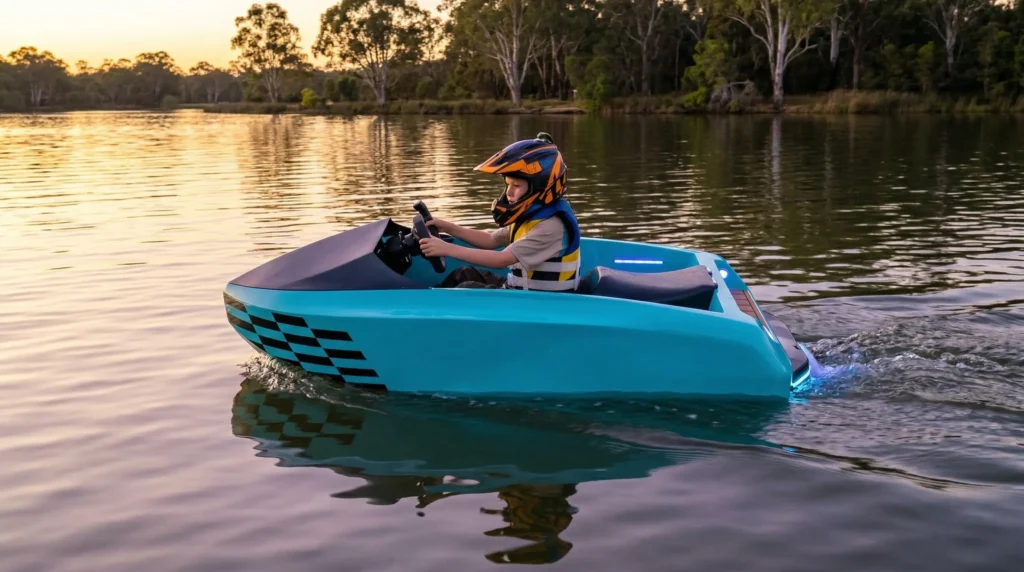
Electric propulsion has quietly reshaped many transport sectors, but nowhere is the change more immediate—or more misunderstood—than on the water. In the emerging category of Mini Jet Boats (MJBS), compact electric power is not a compromise. It is the very reason these craft perform the way they do. The defining advantage is not headline top speed, but instant, controllable torque, delivered smoothly and predictably from the moment the throttle is engaged.
For Australian buyers assessing MJBS for recreation, family use, safety programs, or light professional applications, understanding how electric torque changes real-world performance is essential. This article explains the physics, the practical outcomes, and the on-water advantages—without hype, and without borrowing assumptions from petrol jet skis that simply do not apply.
Traditional petrol-powered personal watercraft rely on internal combustion engines that must build revs before meaningful thrust is produced. Power delivery is tied to RPM, gear ratios, and the engine’s torque curve. At low speeds, output is modest. At high revs, power arrives abruptly.
Electric motors work on an entirely different principle. An electric motor produces maximum torque from zero RPM. There is no waiting for revs to rise, no clutch engagement, and no lag between throttle input and thrust output. In a compact watercraft like an MJBS, this characteristic changes everything.
From a standing start:
This is not a marginal improvement—it is a structural shift in how a watercraft behaves on water.
Many buyers arrive with a familiar question: “How fast does it go?” In full-size petrol jet skis, top speed has long been the primary marketing metric. In compact electric mini jet boats, it is far less relevant than usable thrust.
Torque determines:
Electric torque delivers consistent thrust across the entire speed range. The result is a craft that feels strong, not frantic; responsive, not aggressive. For families, councils, and first-time operators, this distinction matters far more than raw speed figures.
One of the most noticeable differences when stepping into an electric MJBS for the first time is how predictable acceleration feels. With electric drive:
This makes the craft easier to learn, easier to dock, and significantly safer to operate near swimmers, pontoons, or shorelines. In practical terms, an MJBS can accelerate briskly when needed—yet remain composed at walking pace without constant throttle modulation.
Electric propulsion allows MJBS designers to place components more intelligently within the hull. Unlike petrol engines, which are bulky, vibration-heavy, and heat-intensive, electric motors are smaller, lighter, and orientation-flexible. Batteries, while heavier, are low-mounted and centrally positioned. This results in:
The net effect is a hull that feels planted, not twitchy—particularly important in short, lightweight craft.
One of the most overlooked advantages of electric torque is load insensitivity. Petrol craft lose responsiveness rapidly when additional weight is introduced (like a second adult or rescue gear). Electric MJBS behave differently. Because torque is available instantly and continuously, acceleration remains consistent under load and handling remains predictable. This is why MJBS platforms are increasingly suited to family use, council roles, and patrol tasks.
Electric torque also changes how jet propulsion interacts with water. Jet pumps rely on steady, controllable rotational input to maintain efficient water flow. Electric motors provide precise RPM control and immediate response to load changes, which improves low-speed manoeuvrability and lateral control. In tight waterways or shallow areas, this level of control is a major safety advantage.
Torque is not only about force—it is about how that force is delivered. Electric MJBS are quiet and low-vibration. This creates a calmer operating environment for children and inexperienced operators. Reduced noise also improves situational awareness; operators can hear what is happening around them—other vessels, swimmers, or instructions—without engine roar masking critical cues.
Petrol engines can lose efficiency as temperatures rise or as fuel quality varies. Modern electric MJBS powertrains are designed to maintain consistent torque delivery and protect components through intelligent thermal management. This means the craft behaves the same at the end of a session as it did at the beginning.
In safety-critical situations, hesitation costs time. Electric torque enables immediate forward thrust and rapid directional correction. Whether approaching a swimmer or retrieving a tow line, the operator has full authority over the craft at all times. This is one reason electric MJBS platforms are increasingly evaluated as practical tools for rescue support.
Electric MJBS are most efficient where people actually operate them: at low to medium speeds and during short runs with frequent manoeuvring. Torque-rich motors allow the craft to stay “on the plane” without high RPM, extending usable runtime. This aligns perfectly with Australian boating conditions where many waterways are speed-restricted or environmentally sensitive.
Because electric torque allows strong performance from compact systems, MJBS do not require trailers or large towing vehicles. This expands access for families with limited storage and users launching from beaches or small pontoons. The power is there when needed, but it’s never intimidating.
Judging electric MJBS by petrol-era metrics misses the point. Performance in this category is defined by control, usable thrust, and confidence. Electric torque delivers a calmer, safer, and more capable on-water experience, particularly in compact platforms where every design choice matters.
Mini Jet Boats succeed not despite electric propulsion—but because of it. Compact electric torque redefines acceleration, improves stability, and enables broader access to waterways. As Australian buyers become more informed, the conversation is shifting. The question is no longer “How fast is it?” but rather, “How well does it perform where it actually matters?” Electric torque provides that answer—quietly, instantly, and reliably.