
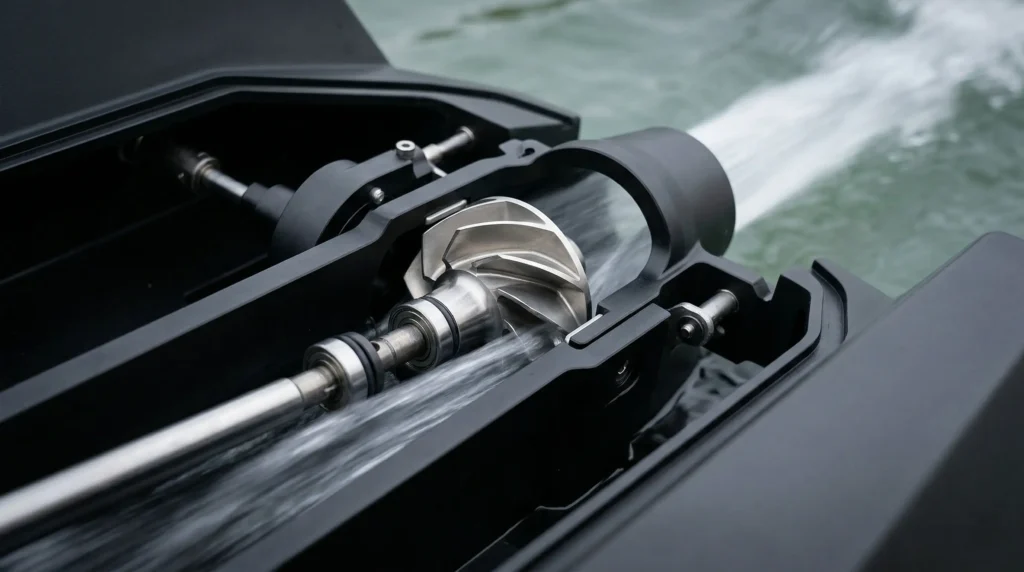
Propulsion Systems in Mini Jet Boats: Jet Pump Design, Impeller Materials, Cavitation Resistance, and Efficiency Compared to Petrol PWCs

Article Category:
Published On: April 8, 2026

Table of Contents

Propulsion Systems in Mini Jet Boats Jet Pump Design, Impeller Materials, Cavitation Resistance, and Efficiency Compared to Petrol PWCs

Introduction: Propulsion Is the Heart of Every Mini Jet Boat

In any watercraft, propulsion determines far more than speed. It affects acceleration, efficiency, noise, safety, reliability, maintenance, and long-term operating cost. In electric Mini Jet Boats (MJBS), propulsion design becomes even more critical because electric torque behaves very differently from petrol power.

Many buyers assume that a jet pump is simply a jet pump — that electric MJBS use a scaled-down version of petrol PWC propulsion systems. This assumption is incorrect. While both use water-jet propulsion, the engineering priorities are fundamentally different.

This article explains how propulsion systems in MJBS are designed, how electric torque reshapes jet pump requirements, why impeller materials and geometry matter, how cavitation is controlled, and how overall efficiency compares with petrol PWCs under real Australian operating conditions.

What a Jet Propulsion System Actually Does

A jet propulsion system performs four essential functions:

  • Draws water into the hull
  • Accelerates that water using a rotating impeller
  • Converts rotational energy into directed thrust
  • Expels water through a nozzle to propel the craft forward

The efficiency of this process depends on precision engineering, not raw power.

In MJBS, propulsion must be optimised for:

  • Instant torque delivery
  • Lower top speed than full-size PWCs
  • Frequent low-speed manoeuvring
  • Shallow-water operation
  • Lightweight hulls

These requirements change everything about the design.

Electric Torque Changes Propulsion Requirements

Petrol engines produce peak torque at higher RPM. As a result, petrol PWCs rely on:

  • High impeller speeds
  • Aggressive throttle application
  • Sustained high RPM to maintain planing

Electric motors behave differently.

Electric Torque Characteristics

  • Maximum torque available from zero RPM
  • Smooth, linear torque curve
  • Immediate response to throttle input
  • No lag or ramp-up delay

This allows MJBS propulsion systems to be designed for usable thrust, not peak speed.

Jet Pump Design in Electric MJBS

Pump Size and Geometry

Electric MJBS typically use smaller-diameter jet pumps than petrol PWCs. This is not a limitation — it is an optimisation.

Smaller pumps:

  • Reduce rotational inertia
  • Respond faster to torque changes
  • Improve low-speed thrust
  • Reduce cavitation risk at moderate speeds

Pump geometry is matched to the electric motor’s torque curve, not engine RPM.

Impeller Blade Design

Impeller blades are the most critical component of the propulsion system. In MJBS, impeller design prioritises:

  • High thrust at low to medium speeds
  • Smooth water flow
  • Reduced turbulence
  • Lower cavitation onset

This often results in:

  • Fewer blades than petrol systems
  • Optimised blade pitch
  • Carefully controlled blade thickness
  • Precision machining rather than casting

Impeller Materials: Why They Matter More in Electric Systems

Electric MJBS place different stresses on impellers compared to petrol PWCs.

Common Impeller Materials

  • Stainless steel
  • Hardened aluminium alloys
  • Composite-reinforced polymers (in some consumer units)

Why Material Choice Is Critical

Electric torque applies instant load to the impeller. Inferior materials can:

  • Deform under load
  • Lose blade geometry
  • Increase cavitation
  • Reduce efficiency
  • Accelerate wear

Professional-grade MJBS typically use precision-machined stainless steel impellers, offering:

  • Dimensional stability
  • Corrosion resistance
  • Long service life
  • Consistent thrust characteristics

Cavitation: The Enemy of Efficiency and Control

What Is Cavitation?

Cavitation occurs when water pressure drops low enough for vapour bubbles to form and collapse violently. This causes:

  • Thrust loss
  • Vibration
  • Noise
  • Surface erosion
  • Reduced control

Cavitation is particularly problematic in lightweight craft with high torque — exactly the MJBS profile.

How MJBS Reduce Cavitation Risk

Electric MJBS are engineered to minimise cavitation through:

  • 1. Controlled Impeller Speed: Electric systems do not require sudden RPM spikes, reducing pressure drops.
  • 2. Optimised Intake Design: Smooth, well-shaped intakes reduce turbulence before water reaches the impeller.
  • 3. Matching Pump Load to Motor Output: The motor and pump are designed as a system, not separate components.
  • 4. Throttle Mapping: Electronic throttle control prevents aggressive torque spikes that would induce cavitation.

This results in smoother acceleration and better low-speed control.

Intake Grates and Debris Management

Australian waterways often contain:

  • Sand
  • Weed
  • Organic debris
  • Fine silt

MJBS propulsion systems must account for this reality.

Intake Grate Design Priorities

  • Prevent large debris ingestion
  • Maintain smooth water flow
  • Minimise drag
  • Reduce clogging risk

Well-designed MJBS use intake grates that balance protection with efficiency — a compromise poorly executed in many low-cost electric craft.

Nozzle Design and Steering Control

Thrust Vectoring

Jet boats steer by redirecting thrust. In MJBS, nozzle design must allow:

  • Precise low-speed control
  • Predictable response
  • Minimal lag

Electric systems excel here because:

  • Thrust changes are instantaneous
  • Fine throttle modulation is possible
  • Reverse thrust can be precisely controlled

This improves docking, launching, and confined-space manoeuvring.

Reverse and Neutral in Electric MJBS

Many MJBS integrate electronically controlled reverse buckets or directional nozzles.

Advantages include:

  • Safer docking
  • Improved control in currents
  • Easier retrieval in shallow water

Electric propulsion allows reverse thrust without mechanical complexity or gearbox noise.

Efficiency: Electric MJBS vs Petrol PWCs

Energy Conversion Efficiency

  • Electric motors: typically 85–95% efficient
  • Petrol engines: typically 25–30% efficient

While battery energy density is lower than petrol, energy utilisation is vastly superior in electric systems.

Real-World Efficiency Differences

Electric MJBS excel in:

  • Stop-start operation
  • Short trips
  • Low to medium speed cruising
  • Frequent manoeuvring

Petrol PWCs are optimised for:

  • Sustained high-speed running
  • Open-water use
  • Long, uninterrupted sessions

For many Australian users — canals, rivers, estuaries, family use — MJBS efficiency is more relevant.

Noise and Propulsion Interaction

Jet pump design directly affects noise.

MJBS propulsion systems produce:

  • Lower mechanical noise
  • Reduced cavitation noise
  • Minimal resonance through the hull

Maintenance Implications of Electric Propulsion

Electric MJBS propulsion systems:

  • Have fewer moving parts
  • Eliminate oil changes
  • Remove exhaust system wear
  • Reduce vibration-induced fatigue

Key maintenance focuses instead on:

  • Impeller inspection
  • Intake cleanliness
  • Seal integrity
  • Bearing condition

Overall maintenance demands are lower than petrol PWCs when systems are properly designed.

Shallow Water Operation: A Key MJBS Advantage

Electric MJBS propulsion systems are often optimised for:

  • Shallow launches
  • Beach starts
  • Riverbank access

Lower intake depth and controlled thrust reduce the risk of:

  • Bottom strikes
  • Debris ingestion
  • Propulsion damage

This directly expands where MJBS can be used in Australia.

Propulsion and Safety: An Overlooked Connection

Well-designed MJBS propulsion systems improve safety by:

  • Providing predictable thrust
  • Eliminating sudden surges
  • Allowing fine speed control
  • Reducing rider fatigue

Electric propulsion reduces the “on/off” nature of petrol throttle response, particularly valuable for families and inexperienced operators.

Consumer vs Professional MJBS: Propulsion Is the Divider

Consumer-grade electric craft often use:

  • Generic pumps
  • Low-grade impellers
  • Poor intake design
  • Minimal cavitation control

Professional-grade MJBS invest heavily in propulsion engineering because failures here are catastrophic, not cosmetic.

Buyers can often identify quality simply by examining:

  • Impeller material
  • Intake finish
  • Pump housing construction
  • Manufacturer transparency about design

The Future of MJBS Propulsion

Expect continued innovation in:

  • High-efficiency impeller profiles
  • Advanced composites and coatings
  • Integrated motor-pump units
  • Smarter electronic control

As electric watercraft mature, propulsion will increasingly be optimised for use cases, not top speed.

Conclusion: Propulsion Is Where MJBS Prove Their Maturity

Electric Mini Jet Boats succeed or fail on propulsion design.

When engineered correctly, MJBS propulsion systems deliver:

  • Smooth, immediate thrust
  • High efficiency
  • Low noise
  • Reduced maintenance
  • Superior control
  • Long-term reliability

They are not scaled-down petrol systems. They are purpose-built solutions designed around electric torque and modern Australian usage patterns.

For buyers who look beyond headline speed figures, propulsion design reveals which MJBS are serious watercraft — and which are not.

Product Categories
Main Links