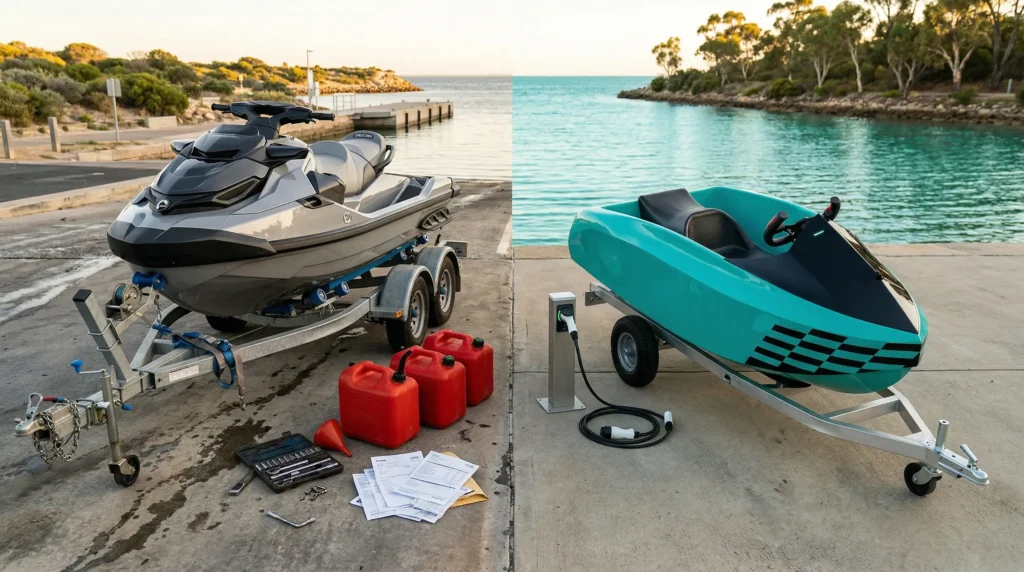
When Australians compare an Electric Mini Jet Boat (EMJB) with a full-size petrol jet ski, the first instinct is to look at the sticker price. That instinct is understandable—but it is also misleading.
The real cost of ownership is not determined on the day of purchase. It is determined over five to ten years, across dozens of hidden decisions, ongoing expenses, and friction points that quietly shape how much a watercraft actually costs you in money, time, stress, and lost usage. This article does not repeat convenience arguments, category redefinition, or lifestyle framing already covered elsewhere.
Its purpose is singular and precise: To expose the true economic lifecycle cost of owning an Electric Mini Jet Boat versus a petrol jet ski in the Australian market.
To understand real cost, we must look at the full lifecycle across seven unavoidable cost categories:
Only when all seven are considered together does the cost difference become clear.
Petrol Jet Ski: The Illusion of the Base Price
A petrol jet ski is rarely purchased alone. In Australia, the effective acquisition cost includes:
What appears to be a competitive base price rapidly expands. It is common for Australian buyers to underestimate the true “drive-away” cost of a petrol jet ski by 15–25% once mandatory accessories are included.
Electric Mini Jet Boat: A Closed Cost System
Electric Mini Jet Boats are typically acquired as self-contained systems:
The purchase price you see is far closer to the actual ownership entry cost. From an accounting perspective, EMJBs offer cost certainty at entry, while petrol jet skis introduce immediate cost expansion.
Petrol Jet Skis: Transport Is Not Optional
Owning a petrol jet ski in Australia means committing to:
For urban Australians, storage alone can become a recurring cost—either financially or in lost space value.
Electric Mini Jet Boats: Transport Is Integrated
Most EMJBs are designed to be:
There is no secondary asset (trailer) to maintain, register, insure, or store. Over time, this difference alone accounts for thousands of dollars in avoided costs.
Petrol Jet Skis: Volatile, Compounding Fuel Costs
Fuel costs for petrol jet skis are not linear. They are affected by riding style, engine size, and fuel prices, as well as the transport fuel required for towing. In Australia, fuel prices fluctuate significantly, and recreational usage often coincides with peak pricing periods. Fuel also introduces storage issues, spillage risks, and degradation over time.
Electric Mini Jet Boats: Predictable Energy Economics
Electric Mini Jet Boats rely on grid electricity, offering stable and forecastable energy pricing. Charging costs are measurable, consistent, and immune to global oil volatility. Over a multi-year ownership period, energy costs for EMJBs are dramatically lower and more predictable than petrol fuel expenditure.
Petrol Jet Skis: Maintenance Is Structural
Petrol jet skis require ongoing servicing whether they are heavily used or not. This includes engine servicing, cooling system flushing, oil and filter changes, fuel system maintenance, and wear component replacement. Missed servicing reduces resale value and increases failure risk. These costs are unavoidable and compound annually.
Electric Mini Jet Boats: Maintenance Is Minimal by Design
Electric propulsion eliminates combustion engines, oil systems, fuel injectors, exhaust components, and cooling complexity. Servicing is typically limited to visual inspections, battery health checks, and general mechanical wear items. From a long-term cost perspective, EMJBs remove entire categories of servicing expenditure.
Petrol Jet Skis: Multi-Layered Compliance
In Australia, petrol jet ski ownership commonly involves separate registrations for both the jet ski and the trailer, as well as insurance for both assets. Increased premiums due to power and risk classification add further recurring costs.
Electric Mini Jet Boats: Simplified Compliance
While registration requirements vary by state, EMJBs typically benefit from lower risk classifications, reduced insurance premiums, and the total absence of trailer compliance costs.
A rarely discussed cost factor is how often the craft is actually used. Transport logistics, towing, and setup time for petrol jet skis often create high friction, which reduces spontaneous use. A craft used less frequently delivers lower value per dollar spent.
Conversely, the low friction of EMJBs—ease of deployment, charging simplicity, and minimal setup—means they are used more often. Higher usage spreads the ownership cost across more hours and improves the cost-per-use metric.
Petrol jet skis depreciate based on engine hours, servicing history, mechanical wear, and fuel system ageing. Buyers often discount heavily for unknown maintenance history. Electric Mini Jet Boats have fewer mechanical systems to assess, meaning resale value is influenced primarily by battery health and physical condition. As electric adoption grows, demand for well-maintained EMJBs is expected to remain strong.
When all factors are combined, a clear pattern emerges: petrol jet skis accumulate multiple parallel cost streams, while Electric Mini Jet Boats operate within a contained cost ecosystem. Over a realistic ownership period, the total cost of ownership gap widens significantly.
Cost Is Not Just Money. The real cost of ownership also includes time spent maintaining, stress managing logistics, and missed usage opportunities. These costs are rarely quantified—but they are real.
For Australian buyers evaluating ownership through a disciplined, long-term lens, Electric Mini Jet Boats represent:
Petrol jet skis remain powerful machines—but power comes with cost, complexity, and commitment. Electric Mini Jet Boats redefine value by removing unnecessary expense from the ownership equation.