
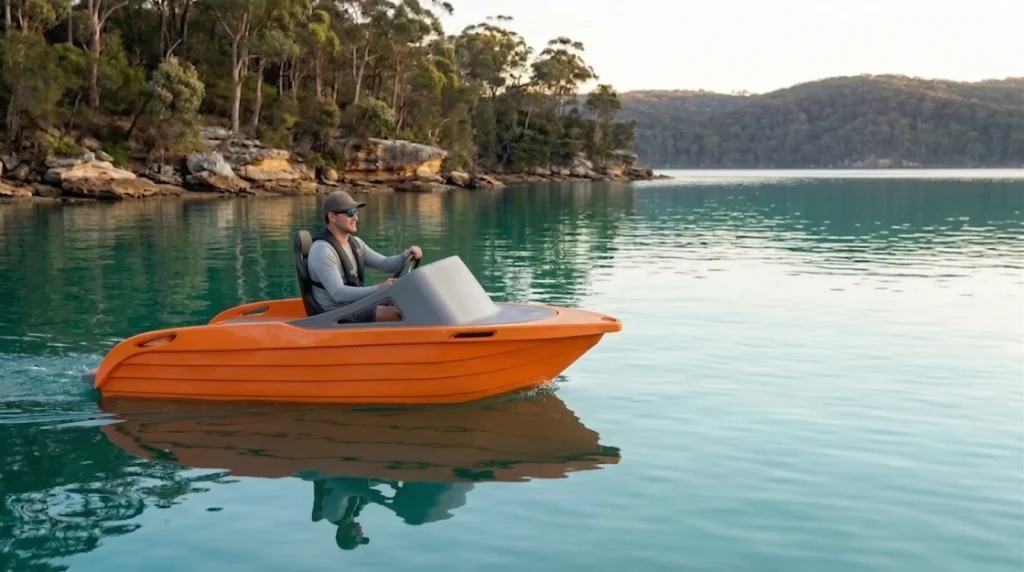
In Australia, noise has quietly become one of the most important – and least understood — factors shaping the future of personal watercraft. While performance, speed, and price often dominate buyer conversations, it is sound that increasingly determines where watercraft are allowed, how communities respond, and whether families feel comfortable using them.
Electric Mini Jet Boats (MJBS) represent a fundamental shift in this discussion. Unlike petrol-powered personal watercraft (PWCs), MJBS operate with dramatically lower noise output — not just at idle, but across the entire operating range. This difference is not cosmetic. It changes access, acceptance, regulation, and safety perception in ways that are highly relevant to Australian conditions.
This article explains why electric MJBS are quieter, how their real-world noise levels compare to petrol PWCs, and why this matters so deeply to councils, water authorities, families, and everyday users.
Before comparing electric MJBS to petrol PWCs, it is essential to understand where noise comes from on watercraft.
In petrol PWCs, noise is generated by multiple overlapping systems:
These sound sources compound, meaning even modest throttle inputs can create high decibel output, sharp tonal spikes, and long-distance sound propagation over water.
Electric MJBS eliminate or reduce most of these sources entirely.
Electric motors do not rely on explosions. There are:
This alone removes the primary noise generator present in petrol PWCs.
Electric motors deliver torque via smooth electromagnetic rotation. There is no cyclical vibration pattern, which means:
Petrol PWCs rely on exhaust routing — often water-injected but still acoustically active. Electric MJBS have:
Electric torque is available instantly at low RPM. This means MJBS do not need to:
Lower RPM = lower acoustic energy.
While exact decibel readings vary by model and operating conditions, real-world testing and field observations consistently show a large acoustic gap between electric MJBS and petrol PWCs.
Over water, sound travels farther and reflects off surfaces. This magnifies the impact of petrol engine noise and explains why PWCs are often perceived as intrusive even when operating legally.
Australia has many waterways where noise — not speed — is the limiting factor:
In these areas, petrol PWCs often face:
Electric MJBS, by contrast, align far better with the expectations of these environments.
Local councils and water authorities are under constant pressure to balance:
Noise complaints are one of the most common triggers for restrictions on watercraft.
For councils, quieter craft are not just preferable — they are easier to manage politically and practically.
Noise is not only about annoyance. It directly affects family safety and comfort.
Electric MJBS allow:
Petrol PWCs often require:
High noise environments increase:
Lower noise improves:
Australian waterways support diverse wildlife, including:
Sudden, high-frequency noise can:
Electric MJBS produce:
This makes them far more compatible with shared-use waterways.
Public perception matters. Even when petrol PWCs are operated legally, they are often:
Electric MJBS are typically perceived as:
This perception directly affects social acceptance, likelihood of complaints, and future regulatory outcomes.
Noise laws are difficult to enforce objectively on water. Unlike speed, noise:
As a result, regulators often choose blanket restrictions rather than nuanced enforcement. Quieter craft reduce the need for these blunt tools.
Several trends point toward increasing importance of noise reduction:
MJBS align with these trends by default.
Electric MJBS are not merely quieter — they:
Noise is not a secondary benefit. It is a strategic advantage.
For decades, louder watercraft were associated with power. That thinking is outdated. In modern Australian waterways, the most valuable attributes are:
Electric MJBS deliver all four — starting with silence. As regulations tighten and communities demand better behaviour on shared waterways, noise will increasingly determine which watercraft thrive and which are restricted. Electric Mini Jet Boats are positioned not just as an alternative, but as the natural evolution of personal watercraft in a noise-conscious future.