
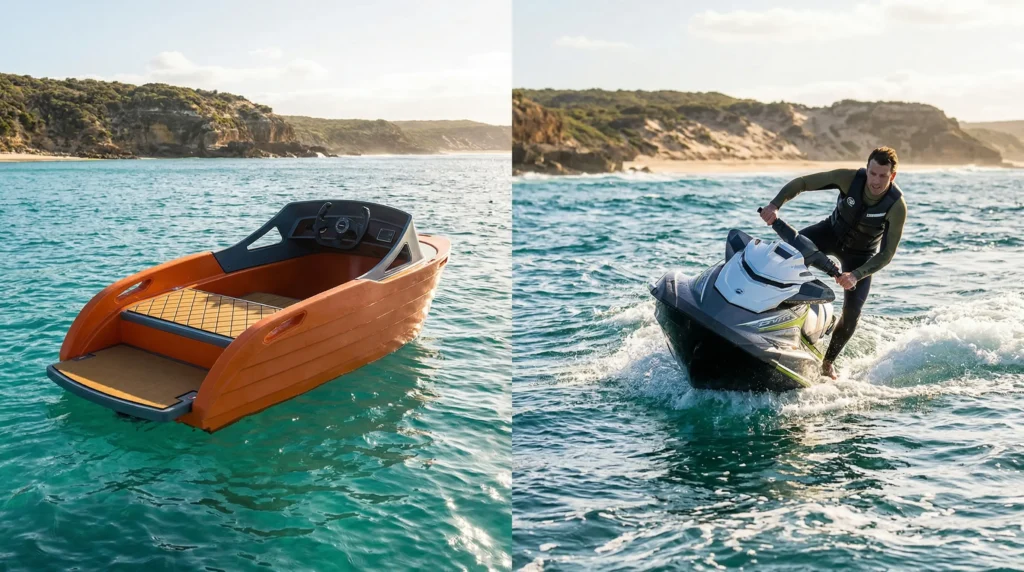
In discussions about personal watercraft, instability is often dismissed as a “skill issue.” Riders are told that falls, loss of control, or capsizes are simply part of the learning curve. This mindset has shaped decades of jet ski design and regulation.
Electric Mini Jet Boats (MJBS) challenge that assumption. They demonstrate that stability is not primarily a rider attribute — it is a design outcome. By fundamentally rethinking hull geometry, centre of gravity, seating position, and weight distribution, MJBS achieve a level of inherent stability that jet skis simply cannot match, regardless of rider experience.
This article explains why MJBS are inherently more stable than jet skis, how beam width and hull form change behaviour on water, how centre of gravity affects control, and why these factors translate directly into real-world accident prevention under Australian conditions.
Australian waterways are increasingly shared environments. They include:
In these settings, loss of balance — not excessive speed — is one of the most common precursors to incidents. Jet skis, by design, prioritise agility and dynamic balance. MJBS prioritise static and dynamic stability. This difference reshapes safety outcomes.
Jet skis are fundamentally balance-dependent craft. Their design assumptions include:
These characteristics are not flaws — they are deliberate design choices aimed at sport riding.
However, they also explain why:
MJBS start from a different premise.
Beam width is the width of the craft at its widest point. It directly influences static stability — how stable the craft is when stationary or moving slowly.
This difference alone explains much of the safety gap.
A wider beam:
In practical terms, this means:
Jet skis amplify rider error. MJBS absorb it.
Jet skis place:
This creates a high, dynamic centre of gravity that changes during use.
The result:
MJBS are engineered with:
This creates:
Physics, not skill, does the work.
Jet skis typically use:
These hulls are excellent at speed but unforgiving when stationary or manoeuvring slowly.
MJBS hulls prioritise:
This hull form:
Stability is not just about sitting still. It is about how the craft behaves while accelerating, turning, or encountering wake.
This makes MJBS far more forgiving in real-world conditions.
Seated operation is not about comfort — it is about control and risk reduction.
Many incidents occur not at speed, but during:
Jet skis are least stable at exactly these moments. MJBS are most stable at low speed. This inversion of risk profile is one of the most important safety advantages MJBS offer.
In safety engineering, time matters. The longer a system takes to destabilise, the more time the user has to react.
MJBS provide:
Jet skis provide:
MJBS turn potential accidents into manageable moments.
While any watercraft can capsize under extreme conditions, probability matters.
MJBS reduce capsize likelihood through:
Jet skis accept higher capsize probability as a trade-off for agility. For families and general users, this trade-off is rarely desirable.
Families introduce variables:
MJBS accommodate these realities. Jet skis demand discipline and skill to manage them safely. This is why MJBS are increasingly viewed as family-appropriate watercraft, not merely alternatives.
While comprehensive MJBS-specific datasets are still emerging, existing accident analysis consistently shows:
MJBS reduce:
Prevention is built into the platform.
Regulators and insurers care deeply about risk profiles, not marketing claims.
Craft that:
…are inherently more defensible from a risk perspective.
MJBS stability aligns with future regulatory priorities focused on accident reduction rather than enforcement escalation.
There is a cultural bias that equates instability with excitement. This is outdated thinking.
Modern recreational design prioritises:
MJBS stability reflects this evolution.
Electric Mini Jet Boats are not “easier” jet skis. They are a different class of watercraft built around a fundamentally safer stability model.
Through:
MJBS remove many of the instability-driven risks that have long been accepted as normal in jet ski use.
This is not about limiting enjoyment. It is about expanding who can enjoy watercraft safely — families, older riders, beginners, and anyone who values confidence over constant correction.
In the context of Australian waterways, that is not just an advantage. It is a necessity.