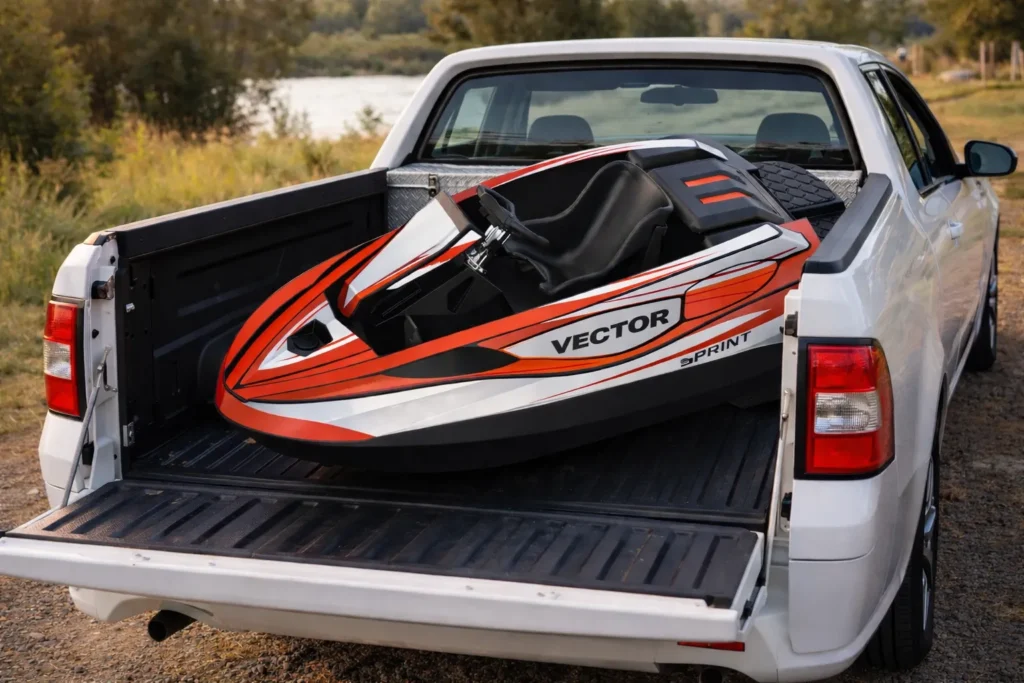
For decades, Australian boating culture has been shaped by one unavoidable assumption: if you want a powered watercraft, you need a trailer. From jet skis and tinnies to small runabouts, ownership has traditionally meant towing, reversing, storing, registering, insuring, launching and retrieving. It has been accepted as “just the way boating works”.
Electric Mini Jet Boats (EMJBs) fundamentally break that assumption.
By removing the need for trailers altogether, EMJBs represent far more than a new propulsion method. They signal a structural shift in how Australians access the water — who can do it, how often they do it, where they do it, and how much friction exists between the desire to go boating and the act of actually doing it.
This is why trailer-free watercraft are not simply a convenience upgrade. They represent a genuine reset for Australian boating.
Australia’s coastline, rivers and lakes are among the best in the world, yet participation rates in small powered boating have been quietly constrained for years. The reason is not lack of interest — it is friction.
Trailers introduce friction at every stage of ownership.
Before you even launch, you must own or access a suitable tow vehicle. This excludes a large segment of Australians who drive standard sedans, hatchbacks, wagons, EVs, or compact SUVs. Even among those with suitable vehicles, towing adds stress, fuel cost, wear, and risk.
Then there is storage. Trailers require space — driveways, side access, garages, or paid storage. In urban Australia, particularly in coastal cities, this is becoming increasingly impractical.
Launching and retrieval are another barrier. Boat ramps are crowded, time-consuming, and intimidating for many. Solo launching is difficult. Newcomers often avoid boating entirely because they do not want to learn trailer handling under pressure.
Finally, there are ongoing costs: trailer registration, maintenance, bearings, tyres, corrosion, insurance, and compliance.
Australians have tolerated these issues because, until now, there was no credible alternative for powered watercraft performance.
Electric Mini Jet Boats change that equation completely.
Trailer-free does not mean compromising on performance or safety. It means redesigning the entire ownership model around portability and ease.
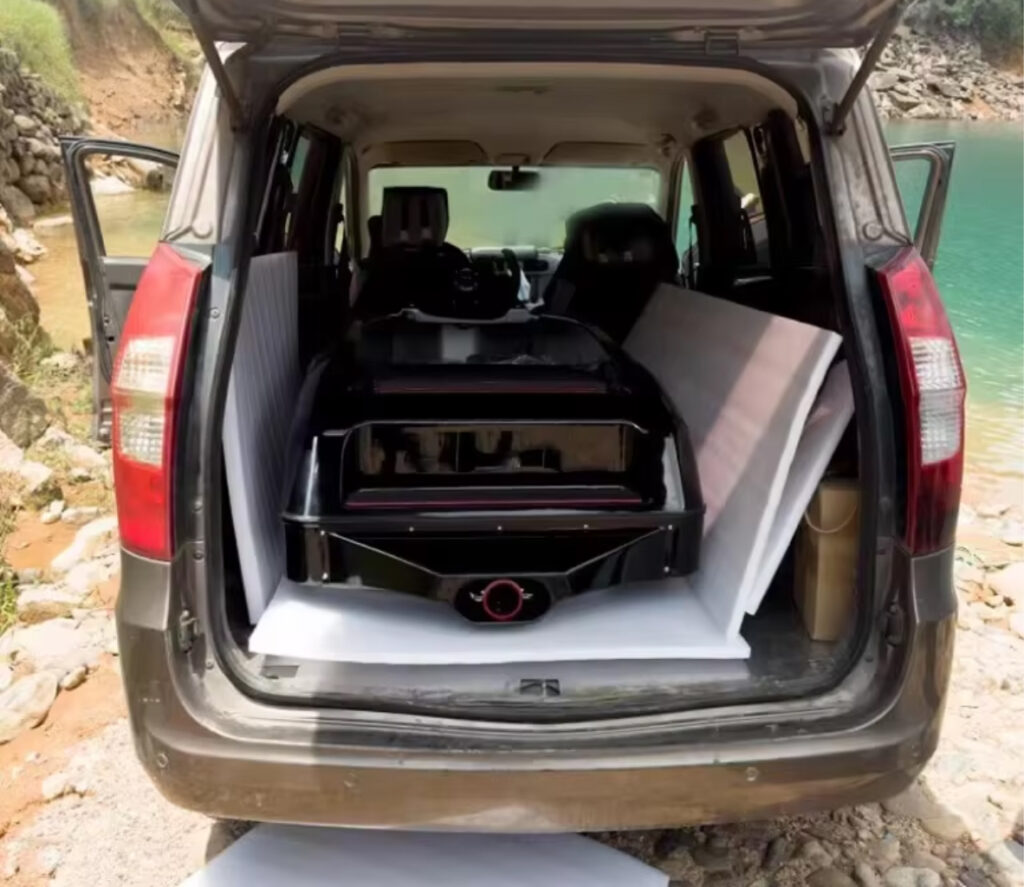
Modern EMJBs are compact, lightweight, and designed to be transported without specialised equipment. Depending on model, they can be:
The key point is that the trailer is no longer a prerequisite for ownership.
This instantly changes who can participate. People who would never consider towing suddenly find boating accessible. Urban dwellers, apartment owners, retirees, and families with limited space are no longer excluded.
Trailer-free design also means faster decision-to-water time. The barrier between “I feel like going out on the water” and actually doing it collapses from hours to minutes.
That behavioural shift is critical.
One of the most overlooked truths in boating is this: people use boats less than they expect, not because they don’t enjoy boating, but because the preparation cost is too high.
Trailers create planning overhead. You must allocate time, ensure ramps are clear, check bearings, tie-downs, straps, and traffic conditions. This turns spontaneous outings into logistical exercises.
Trailer-free EMJBs invert this pattern.
Owners are far more likely to use them before work, after work, or for short sessions. A quick run on a river, estuary, or calm coastal zone becomes realistic. You no longer need to justify “making a day of it”.
In behavioural economics, reducing friction increases participation dramatically. This is why gyms focus on proximity and ease. The same principle applies here.
A trailer-free watercraft is used more often, and that fundamentally changes its value proposition.
Trailers introduce risk well before a watercraft touches the water.
Towing accidents, reversing mishaps, ramp collisions, trailer detachment, brake failures, and rollbacks are all common. Many boating incidents occur on land, not on water.
By eliminating the trailer, you eliminate an entire category of risk.
On the water, EMJBs also offer inherent safety advantages tied to their design:
For families, councils, and safety-conscious users, trailer-free watercraft are not just easier — they are objectively safer across the full ownership lifecycle.
Australian waterways are under increasing pressure. Noise, fuel spills, ramp congestion, and shoreline degradation all contribute to conflict between users.
Trailer-free electric watercraft reduce this pressure in several ways.
First, electric propulsion eliminates fuel spills at ramps and in transport. There is no refuelling infrastructure required, no jerry cans, and no vapour emissions.
Second, quieter operation reduces disturbance to wildlife and nearby residents. This matters particularly on rivers, lakes, and urban waterways where community tolerance for noise is declining.
Third, reduced ramp congestion has flow-on benefits for traditional boaters. When small craft no longer require ramps, access improves for everyone.
From a regulatory and planning perspective, trailer-free electric craft align closely with future waterway management goals.
Trailer ownership is rarely included honestly in cost comparisons. Beyond purchase price, trailers impose:
Over five years, these costs are substantial.
EMJBs eliminate the trailer entirely and dramatically reduce ancillary expenses. Combined with lower energy costs and reduced servicing requirements of electric drivetrains, the ownership equation shifts decisively.
For many Australians, the realisation comes not when comparing sticker prices, but when comparing total friction and lifetime cost.
Trailer-free watercraft democratise access.
These groups have historically been under-served by traditional boating products.
EMJBs are not just replacing jet skis — they are expanding the market by inviting new participants who were previously excluded.
This is why their growth trajectory differs from legacy watercraft categories. They are additive, not merely substitutive.
Local councils and tourism bodies face increasing pressure to provide water-based recreation without expanding expensive infrastructure.
Trailer-free watercraft align perfectly with this goal.
They require no new ramps, minimal storage space, and produce low environmental impact. For hire fleets, guided experiences, and public access programs, EMJBs offer a scalable solution without the headaches of traditional boating logistics.
This is already influencing procurement decisions across Australia.
Every major shift in transport history has involved removing friction:
Trailer-free watercraft fit this same pattern.
Once people experience powered boating without trailers, the old model feels unnecessarily complex. What was once accepted becomes questioned.
This is not a short-term trend. It is a structural change driven by design, technology, and behavioural reality.
For decades, boating has asked Australians to adapt to the equipment. Trailer-free electric mini jet boats reverse that relationship. The equipment now adapts to the user.
This is why trailer-free watercraft represent a genuine new beginning — not just for early adopters, but for the future of Australian boating itself.
As electric mini jet boats continue to mature, it will become increasingly difficult to justify why small personal watercraft should still require trailers at all.
The reset has already begun.