
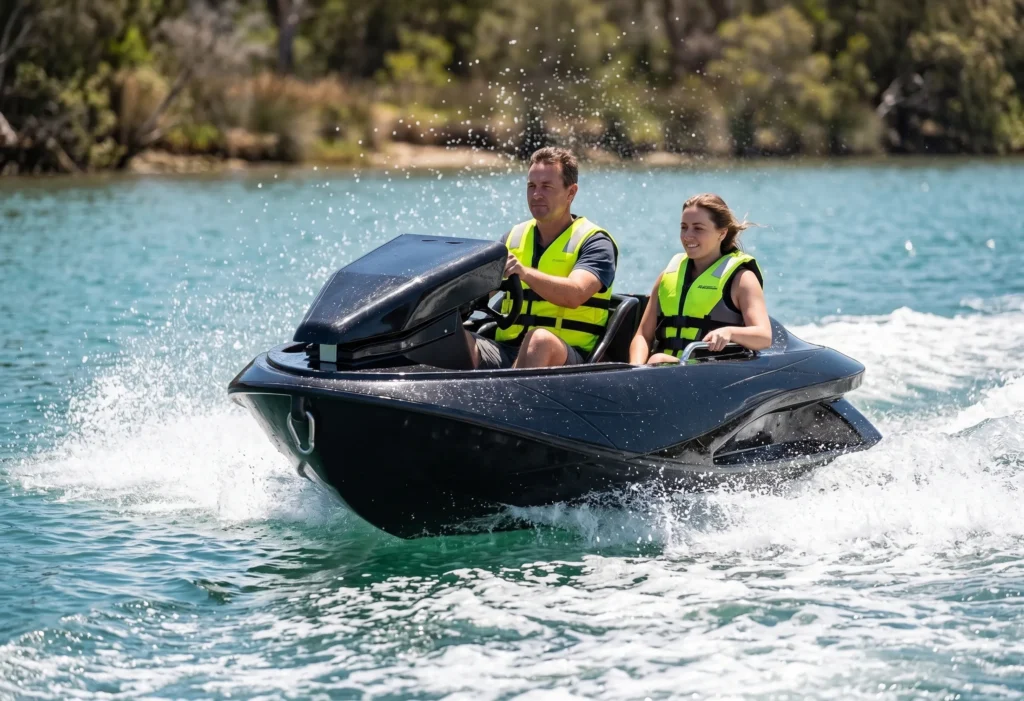
Every serious discussion about watercraft safety must begin with a simple truth: incidents happen. Weather changes, wake appears unexpectedly, riders make mistakes, equipment is misused, and conditions are not always ideal. Good safety design does not rely on perfect behaviour — it assumes imperfection and plans for it.
Electric Mini Jet Boats (MJBS) are engineered around this philosophy. Rather than expecting riders to constantly manage balance, posture, and recovery, MJBS are designed to reduce the likelihood of capsize and to make recovery straightforward if it does occur.
This article examines how capsize risk arises in personal watercraft, what actually happens during real-world incidents, how MJBS differ fundamentally from jet skis in recovery behaviour, and why these differences matter most for inexperienced riders, families, and shared Australian waterways.
Any floating craft can capsize under extreme conditions. The meaningful question is not “can it capsize,” but rather:
Jet skis and MJBS answer these questions very differently.
Jet skis are dynamically balanced craft, meaning they rely on motion and rider input to remain stable. This creates inherent vulnerabilities in specific situations. Common capsize-risk scenarios include:
In many cases, the craft itself is not at fault — it is behaving exactly as designed. The issue is that the design assumes high skill and constant engagement.
MJBS are built around static and dynamic stability, not dynamic balance. This fundamentally reduces capsize risk before recovery is even considered. Key design elements include:
These features dramatically reduce the probability that a destabilising event escalates into a full capsize.
Jet Skis: Sudden movement shifts the centre of gravity sharply, often exceeding the hull’s righting moment.
MJBS: Wider hull and seated posture absorb the movement with minimal roll response.
Jet Skis: Cross-wake impact can cause abrupt roll and rider ejection.
MJBS: Hull geometry dampens wake energy, maintaining contact and control.
Jet Skis: Least stable at low speed, particularly during tight turns.
MJBS: Remain most stable at low speed — the exact opposite risk profile.
Jet Skis: Reboarding is physically demanding and destabilising, often causing repeated capsizes.
MJBS: Lower freeboard, wider beam, and stable platform reduce reboarding instability.
In safety engineering, post-incident behaviour often determines injury risk.
After a capsize:
Secondary risks include striking the craft, being separated from the vessel, exposure to traffic, or delayed rescue.
In the rare event of capsize:
Recovery is procedural, not athletic.
While not all MJBS are designed to fully self-right like specialised rescue craft, their mass distribution significantly influences recovery. Key factors include low battery placement, distributed buoyancy, hull symmetry, and reduced superstructure mass. These elements increase the likelihood that the craft returns upright naturally and avoids complete inversion.
Electric MJBS introduce important safety advantages during incidents:
Time spent in the water increases risk from fatigue, boat traffic, and disorientation. MJBS recovery typically takes less time and requires less physical exertion. For families and inexperienced riders, this is a critical safety margin.
First-time or occasional users often over-correct steering, misjudge wake, or lose balance under stress. MJBS absorb these errors, whereas jet skis can amplify them. This makes MJBS particularly suited to beginners, older riders, and shared family use.
Australian waterways present unique challenges like busy river systems, narrow canals, and strong tidal flows. In these environments, the ability to remain stable and recover quickly is more important than peak performance. MJBS align better with these local realities.
Panic worsens outcomes. MJBS provide a stable platform to hold onto and clear reboarding options, which reduces stress and chaos. A jet ski often requires the rider to perform a complex physical task while in the water, which can escalate anxiety.
When incidents involve children or multiple occupants, the need for platform stability is paramount. MJBS function as floating platforms and temporary refuge, whereas jet skis are optimised for solo athletic recovery.
From an insurance perspective, lower capsize frequency and easier recovery translate into fewer injury claims and reduced severity of incidents. This matters as electric MJBS become more common and scrutiny increases.
Training helps, but it cannot eliminate fatigue or the unpredictability of water conditions. Engineering solutions reduce risk regardless of training level. MJBS represent an engineering-led safety approach.
As watercraft become more accessible, safety expectations change. The future favours stability over spectacle, recovery over bravado, and inclusion over exclusivity.
Electric Mini Jet Boats do not promise that incidents will never happen. Instead, they ensure that when something does go wrong, the outcome is manageable, predictable, and far safer. Through reduced capsize probability and stable post-incident behaviour, MJBS redefine what responsible recreational watercraft look like in modern Australia.