
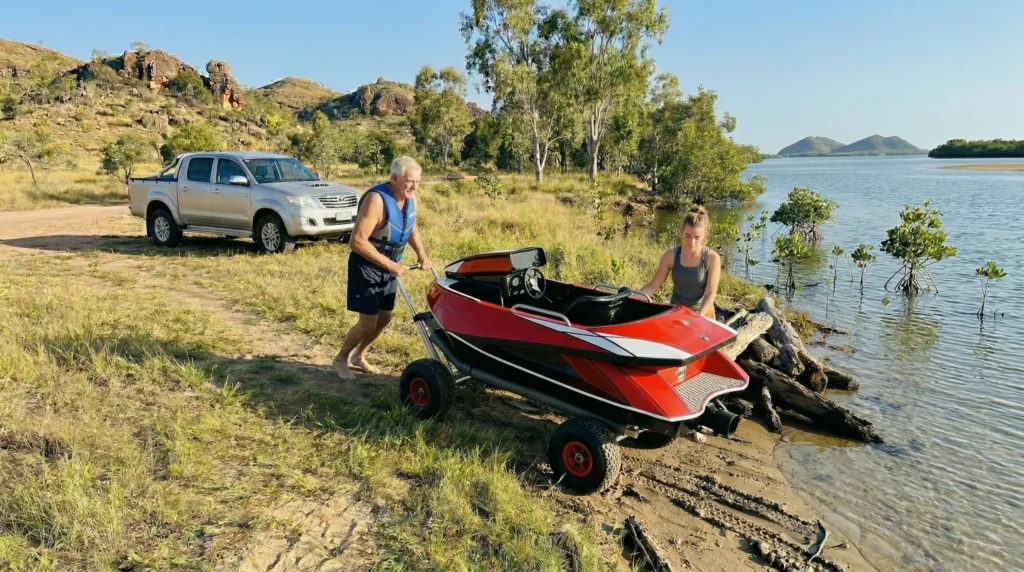
For decades, access to boating in Australia has quietly narrowed. Larger vessels, heavier personal watercraft, mandatory trailers, specialised tow vehicles, and increasingly crowded ramps have turned what was once spontaneous into something planned, expensive, and restrictive. In this environment, lightweight Mini Jet Boats (MJBS) represent not merely a new category of watercraft, but a return to something older and more sensible: easy access to water, on your terms.
This article examines how the low weight, compact form, and electric propulsion of MJBS fundamentally expand access to Australia’s rivers, estuaries, lakes, beaches, and coastal margins—changing who can get on the water, where they can launch, and how often they can use it.
This is not a marketing promise. It is a structural shift in how boating fits into everyday Australian life.
Australia has no shortage of water. What it increasingly lacks is easy access. Traditional boating has accumulated friction:
Full-size petrol jet skis, once positioned as “easy,” now often weigh well over 350 kg dry, require dedicated trailers, and are effectively locked to formal ramps. Spontaneity has been replaced by logistics. MJBS reverse this trend entirely.
The defining characteristic of MJBS is not speed or novelty—it is mass. Electric mini jet boats are engineered from the outset to be:
This is achieved through:
Crucially, weight reduction does not come at the expense of structural integrity. Modern MJBS are designed to tolerate beach launches, shallow-water operation, and frequent handling without the fatigue issues seen in older lightweight craft.
Removing the trailer changes everything. Without a trailer:
MJBS can be transported:
This opens launch options that have largely disappeared from mainstream boating.
Australia’s coastline is defined by beaches, not marinas. Lightweight MJBS can be:
This is particularly valuable in:
Unlike heavier craft, MJBS do not require deep water at launch. The shallow draft of the hull and jet propulsion allow operation in minimal water depth, reducing environmental impact and avoiding propeller damage.
Rivers and estuaries are often the most underutilised waterways—not because they lack appeal, but because access points are informal. MJBS thrive in these environments:
Their lightweight nature allows:
For councils and community organisations, this also reduces infrastructure pressure. Not every watercraft requires a concrete ramp.
Australia’s inland lakes and dams are often surrounded by simple access tracks rather than formal facilities. MJBS enable:
This has implications beyond recreation. Water authorities, councils, and emergency services increasingly recognise the value of craft that can be deployed quickly without specialised infrastructure.
One of the quiet advantages of MJBS is who can use them. Heavier craft exclude:
MJBS reverse this trend. Because they are:
They reintroduce boating to demographics that have gradually been pushed out—not through regulation, but through weight and complexity. This matters in an ageing population where access should be expanding, not contracting.
Weight is only part of the equation. Noise and emissions also limit access. Electric MJBS:
This enables use in:
In many locations, noise—not speed—is the primary source of conflict between water users. Electric propulsion dramatically reduces this friction.
Jet propulsion combined with low weight allows MJBS to operate in shallow water with minimal disturbance. Advantages include:
This is critical in:
As access restrictions tighten in sensitive areas, MJBS align with regulatory and environmental expectations rather than fighting them.
Beyond recreation, launch-anywhere capability has practical implications. Lightweight MJBS can be:
This makes them suitable for:
The ability to carry a craft to the water is often the difference between immediate action and delayed response.
Access does not start at the water—it starts at home. MJBS address modern storage realities:
For apartment dwellers, downsizers, and suburban households, this removes a major barrier. Ownership no longer demands property changes or long-term storage commitments.
When a watercraft requires hitching a trailer, planning a ramp visit, or coordinating assistance, usage drops. MJBS remove these mental hurdles. Owners are more likely to:
This aligns with how Australians actually live—not how boating brochures imagine they do.
Launching heavy craft requires skill. Mistakes are public and costly. MJBS simplify the process:
This lowers the learning curve and increases confidence, particularly for first-time operators and families.
Historically, boating access has been framed around infrastructure like ramps, marinas, and storage yards. MJBS shift the focus back to water itself. If there is:
There is potential access. This reframes boating as a personal, local activity rather than an event requiring permission and preparation.
Australia’s geography favours lightweight, adaptable craft. With long coastlines, vast inland waterways, and dispersed populations, MJBS fit naturally into this landscape. They do not demand that the environment change to accommodate them. They adapt instead.
This is a return to practical boating values that once defined regional and coastal life.
Launch-anywhere capability is not a feature—it is the foundation. It influences:
As access becomes a defining constraint in boating, lightweight MJBS are positioned not as alternatives, but as solutions.
Mini Jet Boats succeed because they restore something boating has slowly lost: freedom of access. By being lightweight, compact, and electrically powered, MJBS:
In an era of increasing restriction, the ability to launch anywhere is not a convenience—it is the future of practical watercraft in Australia.